Area Calculator

Find the area of six common shapes with one tool. Pick a rectangle, triangle, circle, square, trapezoid or parallelogram, enter the measurements, and this area calculator gives the area with the formula shown.

Pick the shape that matches what you are measuring.

For a rectangle use the length, for a circle use the radius, for a square use the side, for a triangle or trapezoid use the base.

For a rectangle use the width, for a triangle or parallelogram use the perpendicular height, for a trapezoid use the second base.

Only used for a trapezoid. It is the perpendicular distance between the two parallel bases. Leave it for other shapes.

Formula: rectangle length x width, square side squared, triangle 1/2 x base x height, circle pi x radius squared, trapezoid (base 1 + base 2) / 2 x height, parallelogram base x height.

How to Use the Area Calculator

Pick the shape that matches what you are measuring, then enter its dimensions. Only the boxes that shape needs are used.

  1. Choose a shape in the first box. Rectangle is the default.
  2. Enter the first measurement. For a rectangle it is the length, for a circle it is the radius, for a square it is the side.
  3. Enter the second measurement, and the height if you picked a trapezoid. The example is a rectangle 12 by 8, so you can press Calculate right away.
  4. Press Calculate, or press Enter. The area appears first and large, with the perimeter or circumference below.
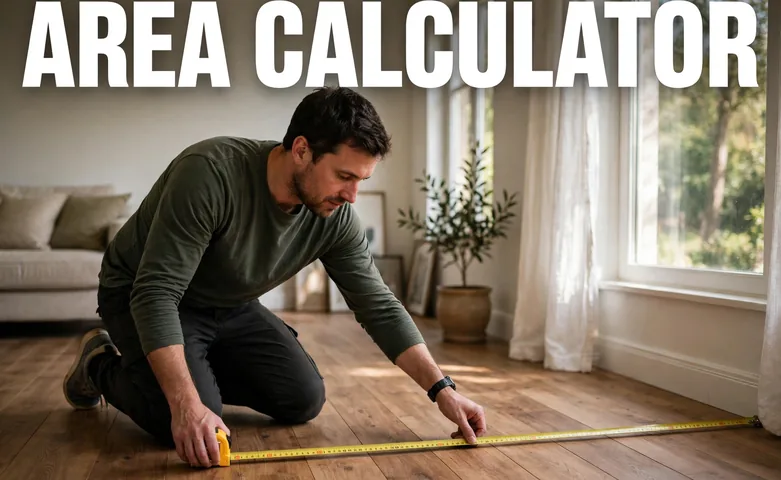
A photo of a person measuring a rectangular living room floor with a yellow tape measure in natural window light
A room 12 by 8 has an area of 96 square units.

The Area Formulas for Six Shapes

Every shape has its own formula, but all six are short. A rectangle is length x width. A square is side squared, which is the rectangle formula with both sides equal. A triangle is 1/2 x base x height, where the height is the perpendicular distance from the base to the opposite corner, not the slanted side.

A circle is pi x radius squared, with pi about 3.14159. A trapezoid is (base 1 + base 2) / 2 x height, where the two bases are the parallel sides and the height is the distance between them. A parallelogram is base x height, again with the perpendicular height. Our square footage calculator does the same job for rooms in square feet, and our area converter converts the answer between square feet, square meters and acres.

Worked Example: A Rectangle 12 by 8

Find the area of a rectangle 12 by 8.

  1. Pick Rectangle in the shape box.
  2. Enter the length, 12, and the width, 8.
  3. Multiply. Area = 12 x 8 = 96 square units.
  4. Check the perimeter. Perimeter = 2 x (12 + 8) = 40.

As a second check, a circle with radius 5 has an area of pi x 5 squared = 3.14159 x 25 = 78.54, and a circumference of 2 x pi x 5 = 31.42. A triangle with base 10 and height 6 has an area of 1/2 x 10 x 6 = 30. The same steps work for any shape, so try your own numbers in the tool above.

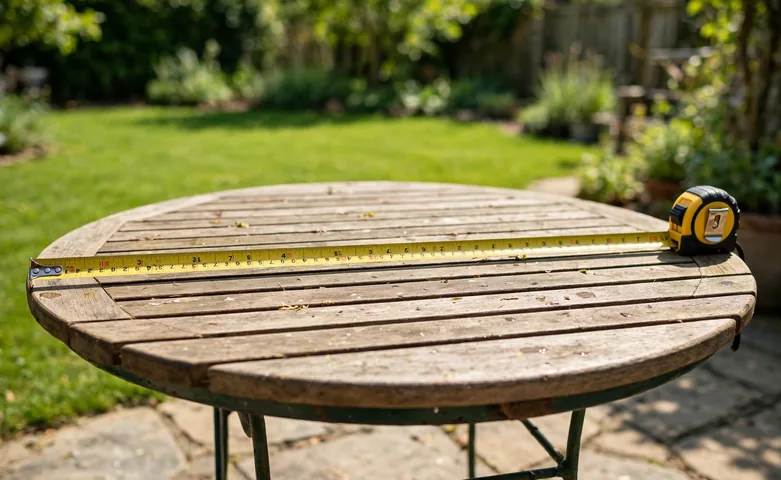
A photo of a round garden table with a tape measure stretched across its diameter on a sunny patio
A circle with radius 5 has an area of 78.54, from pi x 5 squared.

Measuring Tips for Real Rooms and Plots

Measure twice and write the numbers down before you type them in. For a rectangle, measure two adjacent sides at right angles. For a circle, measure the diameter across the middle and halve it to get the radius. A radius of 5 comes from a diameter of 10.

For a triangle, the height is the straight line from the base to the opposite corner at a right angle. The slanted edge is longer than the height, so using it gives an answer that is too big. For a trapezoid, measure both parallel sides and the perpendicular distance between them, not the slanted ends.

Keep every measurement in the same unit. Mixing feet and inches is the most common measuring error, and the calculator cannot catch it. If you measured in feet, the area comes back in square feet. If you measured in meters, it comes back in square meters.

Common Mistakes to Avoid

The most common mistake is using the diameter as the radius. A circle with a diameter of 10 has a radius of 5, and an area of 78.54. Using 10 as the radius gives 314.16, four times too big, because the radius is squared.

A second mistake is using the slanted side as the height in a triangle or a parallelogram. The height is always the perpendicular distance. For a triangle with base 10 and a slanted side of 8, the height is less than 8, so 1/2 x 10 x 8 = 40 is wrong.

A third mistake is forgetting that area is in square units. A room 12 feet by 8 feet is 96 square feet, not 96 feet. The perimeter is 40 feet, and the two numbers measure different things.

Area in Everyday Projects

Flooring, paint and sod are all sold by area. A room 12 by 8 needs 96 square feet of flooring, plus a little extra for cuts and waste. Paint covers a stated area per gallon, so the wall area tells you how many gallons to buy. Our paint calculator and flooring calculator work out the materials from the same measurements.

Gardens and plots use the same formulas. A triangular flower bed, a round patio and a trapezoidal lawn section each need their own formula, and an odd shaped plot can be split into rectangles and triangles whose areas add up. A plot split into a 12 by 8 rectangle and a triangle with base 10 and height 6 has a total area of 96 + 30 = 126 square units.

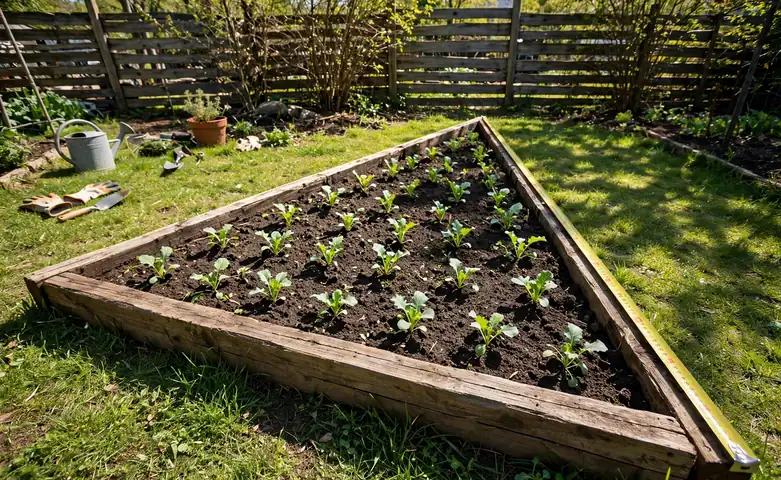
A photo of a triangular garden bed with fresh soil and young plants in a sunny backyard with a measuring tape along one edge
Split an odd shaped plot into rectangles and triangles, then add the areas.

Frequently asked questions

How do you calculate the area of a rectangle?

Multiply the length by the width. A rectangle 12 by 8 has an area of 12 x 8 = 96 square units.

What is the area of a circle with radius 5?

Use pi x radius squared. Pi x 5 squared is 3.14159 x 25 = 78.54 square units.

How do you find the area of a triangle?

Use 1/2 x base x height, where the height is the perpendicular distance from the base to the opposite corner. A triangle with base 10 and height 6 has an area of 30.

What is the area of a trapezoid?

Use (base 1 + base 2) / 2 x height. Bases of 8 and 12 with a height of 6 give (8 + 12) / 2 x 6 = 60 square units.

What units does area use?

Square units of the unit you measured in. Measure in feet and the area comes back in square feet. Measure in meters and it comes back in square meters.

How do I measure an irregular shape?

Split it into rectangles, triangles and trapezoids, work out each piece with its own formula, and add the areas. A 12 by 8 rectangle plus a triangle of base 10 and height 6 gives 96 + 30 = 126.

Start Calculating Now!

Discover the power of smart tools at KitQuarter.

Explore All Tools