Square Footage Calculator: Measure Rooms, Lots and Projects
How many square feet is your room, yard or lot? Enter the length and width in feet and inches — add more areas for L-shaped rooms or whole houses — and this free square footage calculator returns the total in square feet, square inches, square yards, square meters and acres.
Formulas verified against standard references. Calculator logic tested with verified worked examples. Last reviewed: October 2026. Our methodology
The square footage formula
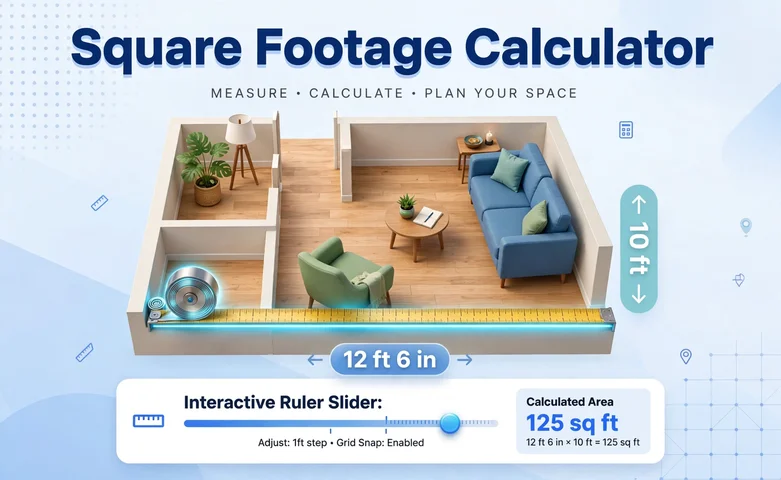
Square footage is simply length times width — the catch is keeping both measurements in the same unit. When one side is 12 ft 6 in and the other is 10 ft, convert the inches to feet first: 6 in = 0.5 ft, so the length is 12.5 ft, and 12.5 × 10 = 125 sq ft. Since 1959 the foot has been defined as exactly 0.3048 meters by international agreement, which is why every conversion below is exact — the National Institute of Standards and Technology maintains the official definitions.
| To convert square feet | Multiply or divide by |
|---|---|
| Square inches | × 144 |
| Square yards | ÷ 9 |
| Square meters | × 0.09290304 |
| Acres | ÷ 43,560 |
If you are starting from a different unit instead of feet and inches — acres, hectares, or square meters — the area converter converts between them and feeds back into square feet for your project math.
Worked example
A bedroom measures 12 ft 6 in by 10 ft. Here is the full calculation:
- Convert inches to feet: 6 ÷ 12 = 0.5, so the length is 12.5 ft.
- Square feet: 12.5 × 10 = 125 sq ft.
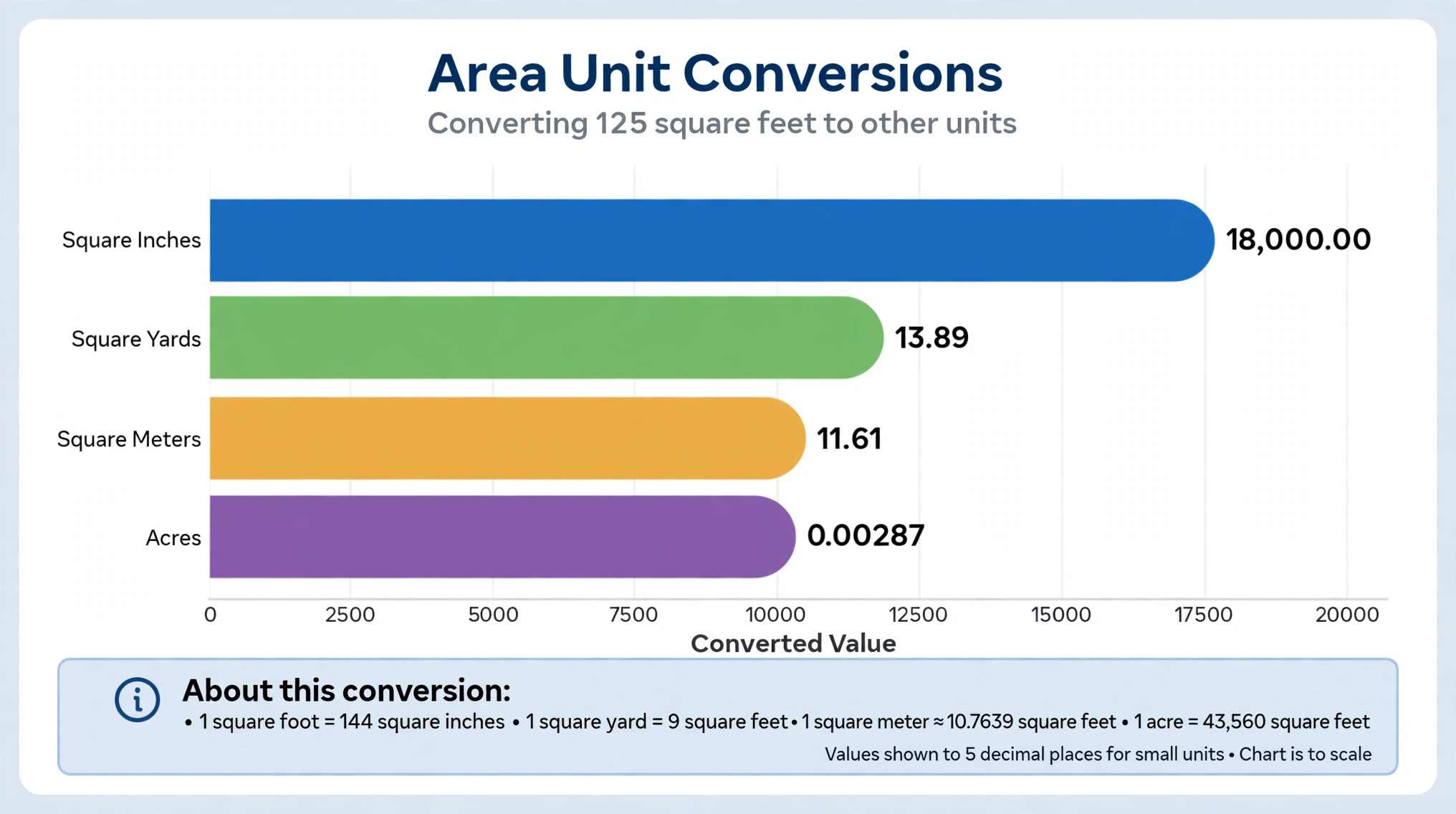
- Square inches: 125 × 144 = 18,000 sq in.
- Square yards: 125 ÷ 9 = 13.89 sq yd.
- Acres: 125 ÷ 43,560 = 0.0028694 acres.
Type the same numbers into the calculator above and you will get exactly these results.
How to use the square footage calculator
A tape measure and this page are all you need.
Step by step
- Enter the length. Put whole feet in the feet box and leftover inches in the inches box — 12 ft 6 in becomes 12 and 6.
- Enter the width the same way.
- Add more areas if needed. Click "Add another area" for L-shaped rooms, extra rooms, or a whole house; the calculator totals everything.
- Press Calculate. Use the grand total when ordering flooring or paint, and add 5–10% extra for waste.
Irregular rooms: measure in rectangles, add the areas
Most "impossible" rooms are just rectangles glued together. An L-shaped bedroom is two rectangles: measure section A (say 10 ft × 8 ft = 80 sq ft) and section B (say 6 ft × 4 ft = 24 sq ft), then add them for 104 sq ft. Each row in the calculator above is one rectangle, and the grand total adds them automatically.
| Shape | How to measure it |
|---|---|
| Rectangle / square | Length × width |
| L-shape / T-shape | Split into rectangles, add the areas |
| Circle | π × r² (radius = diameter ÷ 2) |
| Triangle | ½ × base × height |
For round or angled sections, calculate the area separately and either add it as another rectangle row (close enough for ordering materials) or work it by hand and add it to the total.
Square feet to square inches, yards, meters and acres
Stores and contractors speak different units: flooring is priced by the square foot, carpet and concrete by the square yard, and land by the acre. The calculator shows every result in all five units at once.
| Unit | 1 sq ft equals | Handy rule |
|---|---|---|
| Square inches | 144 sq in | Multiply sq ft by 144 |
| Square yards | 0.1111 sq yd | Divide sq ft by 9 |
| Square meters | 0.092903 sq m | Multiply sq ft by 0.0929 |
| Acres | 0.00002296 acres | Divide sq ft by 43,560 |
A 10 × 10 ft room is 100 sq ft = 11.11 sq yd. Carpet retailers sell by the square yard and round up, so expect to be quoted for 12.
How much extra to order (the waste factor)
Net square footage is what you measure; gross is what you buy. Cuts, pattern matching and broken pieces mean you should always order extra:
- 5% extra — simple rectangular rooms, straight-lay flooring.
- 10% extra — most rooms; the default for flooring and paint.
- 15% extra — diagonal patterns, intricate tile, or rooms with many corners.
On a 200 sq ft room, 10% waste means ordering 220 sq ft. Running short mid-project is far more expensive than a leftover box, because dye lots change between batches. Planning a floor with these numbers? A tile calculator turns the same measurements into tile counts, layout and grout.
Frequently asked questions
How do I calculate the square footage of a room?
Measure the length and width in feet and multiply them. If a measurement includes inches, divide the inches by 12 first — 12 ft 6 in is 12.5 ft, so a 12 ft 6 in × 10 ft room is 125 sq ft.
How do you find the square footage of an irregular or L-shaped room?
Split the room into rectangles, calculate each rectangle's area, and add them together. This calculator does that for you: click "Add another area" for each section and it returns the grand total.
How many square feet are in a square yard?
9. A square yard is a 3 ft × 3 ft square, so divide square feet by 9 — 125 sq ft equals 13.89 sq yd.
How do I convert square feet to acres?
Divide by 43,560, the number of square feet in an acre. A 125 sq ft room is 125 ÷ 43,560 = 0.0028694 acres.
How many square inches are in a square foot?
144. A square foot is 12 in × 12 in, so multiply square feet by 144 — 125 sq ft equals 18,000 sq in.
Should I add extra for waste when ordering materials?
Yes — 5% for simple rectangular rooms, 10% for most flooring and paint jobs, and 15% for diagonal layouts or intricate tile. On 200 sq ft, 10% waste means ordering 220 sq ft.
What is the difference between square feet and linear feet?
Linear feet measure one dimension (length); square feet measure area (length × width). A 10-linear-foot board covers 10 sq ft only if it is exactly 1 ft wide.