Tile Calculator: Tiles Needed, Boxes and Waste
Measure the room, enter the tile size, and this free tile calculator works out the floor area, the exact number of tiles needed, a waste allowance for cuts and breakage, and how many boxes to buy.
Formulas verified against standard finance references. Calculator logic tested with verified worked examples. Last reviewed: October 2026. Our methodology
Formula
Floor area (sq ft) = room length × room width − openings. Tile area (sq ft) = (tile length ÷ 12) × (tile width ÷ 12). Exact tiles = floor area ÷ tile area. Tiles to buy = round up(exact tiles × (1 + waste % ÷ 100)). Boxes to buy = round up(tiles to buy ÷ tiles per box).
Worked example
A 10 ft × 10 ft room with 12 in × 12 in tiles, 10% waste, and 10 tiles per box: floor area = 10 × 10 = 100 sq ft. Each tile covers (12 ÷ 12) × (12 ÷ 12) = 1 sq ft, so 100 ÷ 1 = 100 tiles exactly. With 10% waste: 100 × 1.10 = 110 tiles to buy. Boxes: 110 ÷ 10 = 11 boxes.
How to use the tile calculator
Running out of tile halfway through a job is expensive: matching dye lots weeks later is hard, and a second delivery eats the profit. This tile calculator gives you a shopping list before you buy — how many tiles to cover the floor, how many to add for waste, and how many boxes that means.
Step by step
- Enter the room length and width in feet, measured wall to wall.
- Enter the tile length and width in inches, exactly as printed on the box.
- Set the waste allowance. The default is 10% — right for most straight grid layouts.
- Enter tiles per box from the box label (default 10), and any openings to subtract, such as doorways or built-in fixtures, in square feet.
- Press Calculate. You get the floor area, exact tiles, tiles with waste, boxes to buy, and a note on leftovers.
What you get
- Floor area in square feet, after subtracting openings
- Exact tiles to cover that area with no waste
- Tiles to buy, including your waste allowance and rounded up
- Boxes to buy, rounded up to whole boxes
- Leftover note, telling you how many spare tiles the boxes give you
The formulas
- Floor area = room length × room width − openings
- Tile area = (tile length ÷ 12) × (tile width ÷ 12)
- Exact tiles = floor area ÷ tile area
- Tiles to buy = round up(exact tiles × (1 + waste % ÷ 100))
- Boxes = round up(tiles to buy ÷ tiles per box)

Tile size and coverage
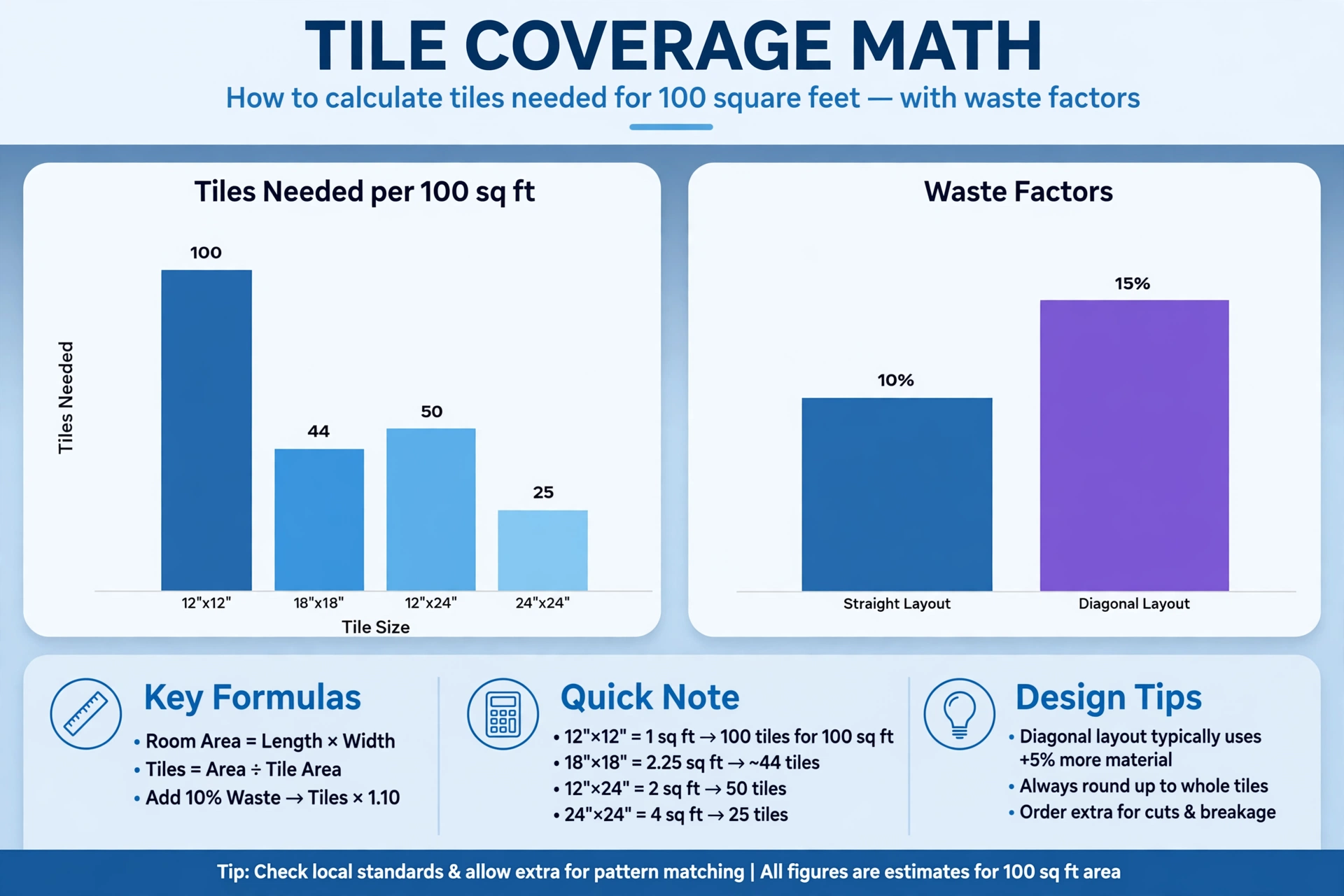
Tile size decides how many pieces cover a square foot. A 12×12 inch tile covers exactly 1 sq ft, so a 100 sq ft room needs 100 tiles before waste. Larger tiles cover more area per piece and need fewer tiles — but they create more offcuts, especially in small rooms with lots of corners.
Common tile sizes and coverage
The table below shows how many tiles cover 100 sq ft of floor before any waste allowance:
| Tile size | Area per tile | Tiles per 100 sq ft |
|---|---|---|
| 12 × 12 in | 1.00 sq ft | 100 |
| 6 × 24 in | 1.00 sq ft | 100 |
| 18 × 18 in | 2.25 sq ft | 45 |
| 12 × 24 in | 2.00 sq ft | 50 |
| 24 × 24 in | 4.00 sq ft | 25 |
The pattern is simple: area per tile = (length ÷ 12) × (width ÷ 12). Doubling each side of a tile quadruples its coverage, which is why 24×24 tiles need only a quarter as many pieces as 12×12 tiles. If your tile size mixes feet and inches, our length converter converts between the two before you start.
Waste factors by layout
The waste allowance covers cuts at walls and corners, broken tiles, and a few spares for future repairs. A cracked tile years from now is easy to replace only if you kept spares from the same dye lot — that is the real reason installers insist on extra.
How much waste to add
| Layout | Recommended waste | Why |
|---|---|---|
| Straight grid | 10% | Cuts only along walls; offcuts are minimal |
| Diagonal (45°) | 15% | Every border tile is cut at an angle, wasting half pieces |
| Complex rooms or large format | 15–20% | Many corners, niches, or tiles over 24 inches break more often |
These percentages mirror what suppliers like calculator.net's tile calculator recommends: 5–10% extra for cutting and waste, plus spares for future repairs. On a straight run in a plain rectangular room, 10% is plenty; on a diagonal pattern or a bathroom full of fixtures, take 15% and keep the spares.
Measuring tricky rooms and avoiding mistakes
Rectangular rooms are the easy case. For an L-shaped room, split it into two rectangles, measure each, and add the areas — or enter the total area as length × width of one equivalent rectangle. Measure wall to wall at the widest points; small alcoves rarely change the box count because everything rounds up anyway.
Subtract what you will not tile
Door swings, built-in cabinets, and floor vents do not need tile. Estimate each opening in square feet and enter the total in the openings field — the calculator subtracts it before doing the tile math. Do not subtract for grout lines: the gap between tiles is a fraction of an inch, and its area is negligible compared with your waste allowance.
Common mistakes to avoid
- Forgetting the waste allowance. Raw tile counts always run short once cutting starts.
- Rounding down. You cannot buy a fraction of a tile or a fraction of a box — always round up.
- Mixing dye lots. Buy all boxes at once from the same lot; shades vary between batches.
- Skipping the percentage check. If you want to double-check the waste math by hand, our percentage calculator does the 10% or 15% step in seconds.

Frequently asked questions
How do I calculate how many tiles I need?
Measure the room length and width in feet and multiply them to get the floor area, subtracting any openings. Divide the floor area by the area of one tile — (tile length ÷ 12) × (tile width ÷ 12) in square feet. Add your waste percentage and round up to whole tiles, then round up again to whole boxes.
What waste percentage should I use for floor tile?
Use 10% for a straight grid layout in a simple rectangular room. Use 15% for a diagonal 45-degree pattern, where every border tile is cut at an angle. For complex rooms with many corners, niches, or tiles larger than 24 inches, go with 15–20%. The extra tiles also cover future repairs from the same dye lot.
How do I measure a room for tiles?
Measure the length and width wall to wall in feet, at the widest points. For an L-shaped room, split it into two rectangles, measure each, and add the areas together. Enter the total floor area as length and width, or subtract openings like doorways and built-ins in the openings field.
How many tiles come in a box?
It varies by tile size and brand — common counts are 8 to 12 tiles per box, but large-format tiles may ship only 2 or 3 per box. Check the label on the box and enter that number in the tiles-per-box field so the calculator rounds up to the right number of boxes.
Should I subtract doorways and fixtures?
Yes. Estimate the area of each opening you will not tile — door swings, built-in cabinets, floor vents — in square feet and enter the total in the openings field. The calculator subtracts it from the room area before computing the tile count, so you do not buy tile for floor you will never cover.
Does this calculator account for grout lines?
It does not add tile area for grout gaps, and it does not need to: grout lines are typically 1/16 to 1/2 inch wide, and the area they take up is tiny compared with a 10% waste allowance. The waste factor comfortably covers the gap area plus cutting and breakage.
Can I use this for wall tile or a backsplash?
Yes. Measure the wall length and height in feet and enter them as the room length and width — the math is identical. For a backsplash, subtract window and outlet areas as openings. Wall tile often uses smaller tiles, so double-check the tile size in inches on the box.