Wallpaper Calculator: How Many Rolls Do You Need?
Find out how many wallpaper rolls your room needs before you shop. Enter your room dimensions, door and window counts, roll size and a waste allowance — this free wallpaper calculator works out your wall area, usable coverage per roll, and exactly how many rolls to buy.
Formulas verified against standard home-improvement references. Calculator logic tested with verified worked examples. Last reviewed: October 2026. Our methodology
How the wallpaper math works
Wallpaper math is area math with one adjustment: you can never use every square inch of a roll, because pattern matching and trimming eat part of it. This calculator follows the standard trade method.
- Gross wall area: 2 × (room length + room width) × ceiling height — the room perimeter times the wall height.
- Openings: (doors × 21) + (windows × 12) square feet. A standard door removes about 21 sq ft and a standard window about 12 sq ft.
- Wall area to cover: gross wall area − openings, never less than zero.
- Roll coverage: (roll width ÷ 12) × roll length. A standard US single roll of 20.5 in × 33 ft covers (20.5 ÷ 12) × 33 = 56.38 sq ft.
- Usable coverage: roll coverage × 0.75. Roughly a quarter of each roll is lost to pattern matching, trimming and mistakes.
- Rolls to buy: wall area ÷ usable coverage × (1 + waste % ÷ 100), rounded up to a whole roll. You cannot buy half a roll, so the result always rounds up.
Standard roll figures follow common US single-roll sizing (20.5 in × 33 ft); openings use standard trade allowances.
Worked example
Take a room that is 12 ft long and 15 ft wide with 8 ft ceilings, 1 door and 2 windows, using standard 20.5 in × 33 ft rolls with 15% waste:
- Perimeter: 2 × (12 + 15) = 54 ft
- Gross wall area: 54 × 8 = 432 sq ft
- Openings: 1 × 21 + 2 × 12 = 45 sq ft
- Wall area to cover: 432 − 45 = 387 sq ft
- Roll coverage: (20.5 ÷ 12) × 33 = 56.38 sq ft; usable = 56.38 × 0.75 = 42.28 sq ft
- Rolls: 387 ÷ 42.28 = 9.15; with 15% waste = 9.15 × 1.15 = 10.53
- Rounded up: buy 11 rolls
How to use the wallpaper calculator
Measure your room, read the roll label, and let the calculator do the rest. Five minutes of measuring saves a return trip to the store.
Step by step
- Measure room length and width in feet. Measure wall to wall at the baseboard; round up if you are between marks.
- Measure the ceiling height in feet. Measure floor to ceiling, or to wherever the wallpaper will stop.
- Count the doors and windows. The calculator subtracts a standard 21 sq ft per door and 12 sq ft per window.
- Read the roll label. Enter the roll width in inches and the roll length in feet — the defaults are the common US single roll (20.5 in × 33 ft).
- Set your waste allowance. 15% is a safe default; use 10% for plain paper and 20% for large pattern repeats.
- Press Calculate. You get the wall area, coverage per roll, rolls needed, and the whole number of rolls to buy.
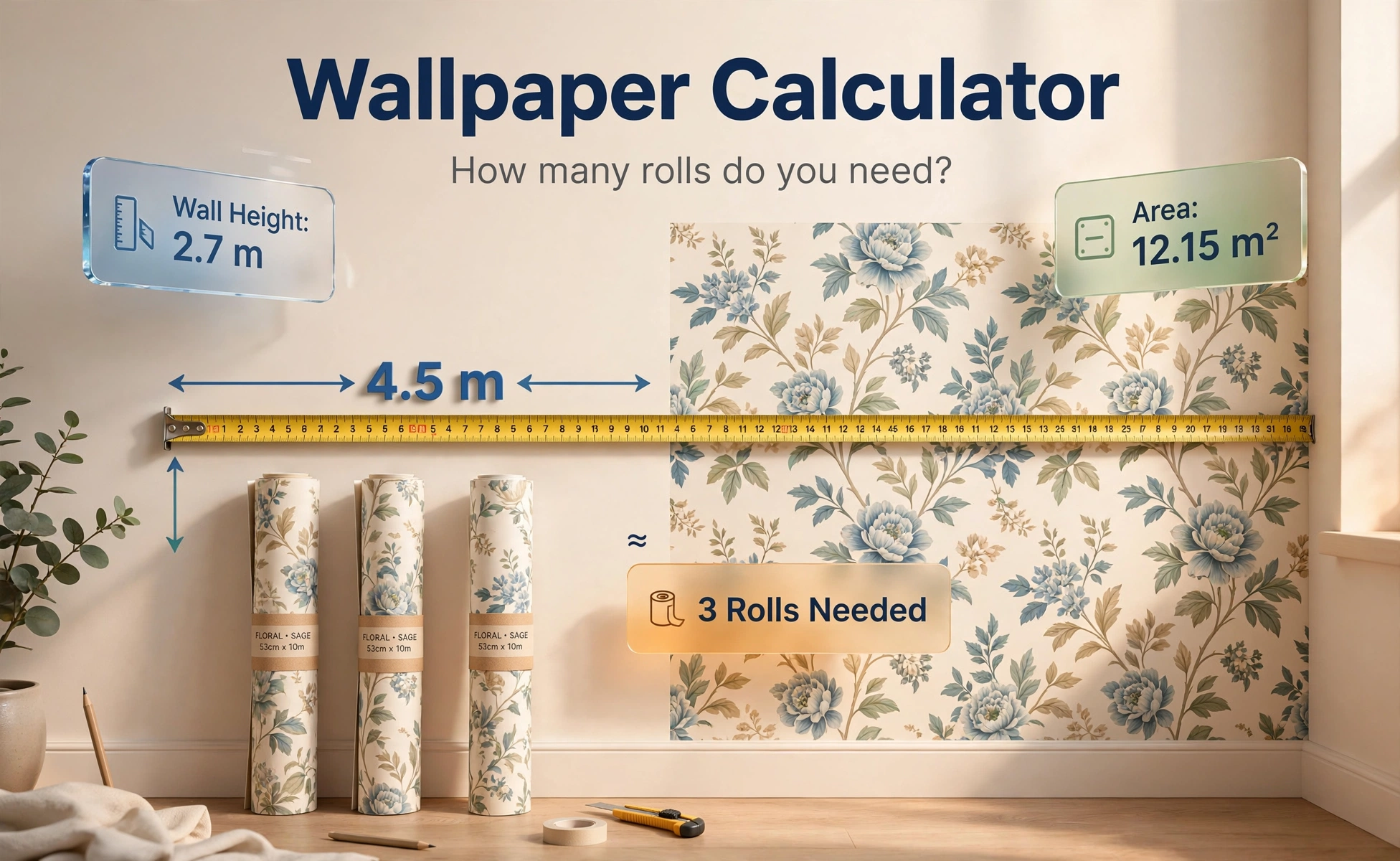
Measuring your room the right way
Accurate measuring is the whole game. Being a foot off on the room length swings the roll count, and guessing the ceiling height is how people end up one roll short with half a wall left to paper.
What to measure
| Measurement | How | Why it matters |
|---|---|---|
| Room length and width | Wall to wall, in feet | Sets the perimeter — the biggest driver of roll count |
| Ceiling height | Floor to ceiling, in feet | Every extra foot adds a full strip of wall around the room |
| Doors | Count them | Each door removes about 21 sq ft you do not need to paper |
| Windows | Count them | Each window removes about 12 sq ft |
Measure twice, buy once
Measure each wall separately if the room is not a perfect rectangle — L-shaped rooms and alcoves need the perimeter walked with a tape measure, not guessed from a floor plan. Note unusually tall doors or picture windows: the standard 21 and 12 sq ft allowances assume average openings, so oversized ones deserve their real measurements.
If the walls need paint instead of paper, our paint calculator works from the same room measurements.
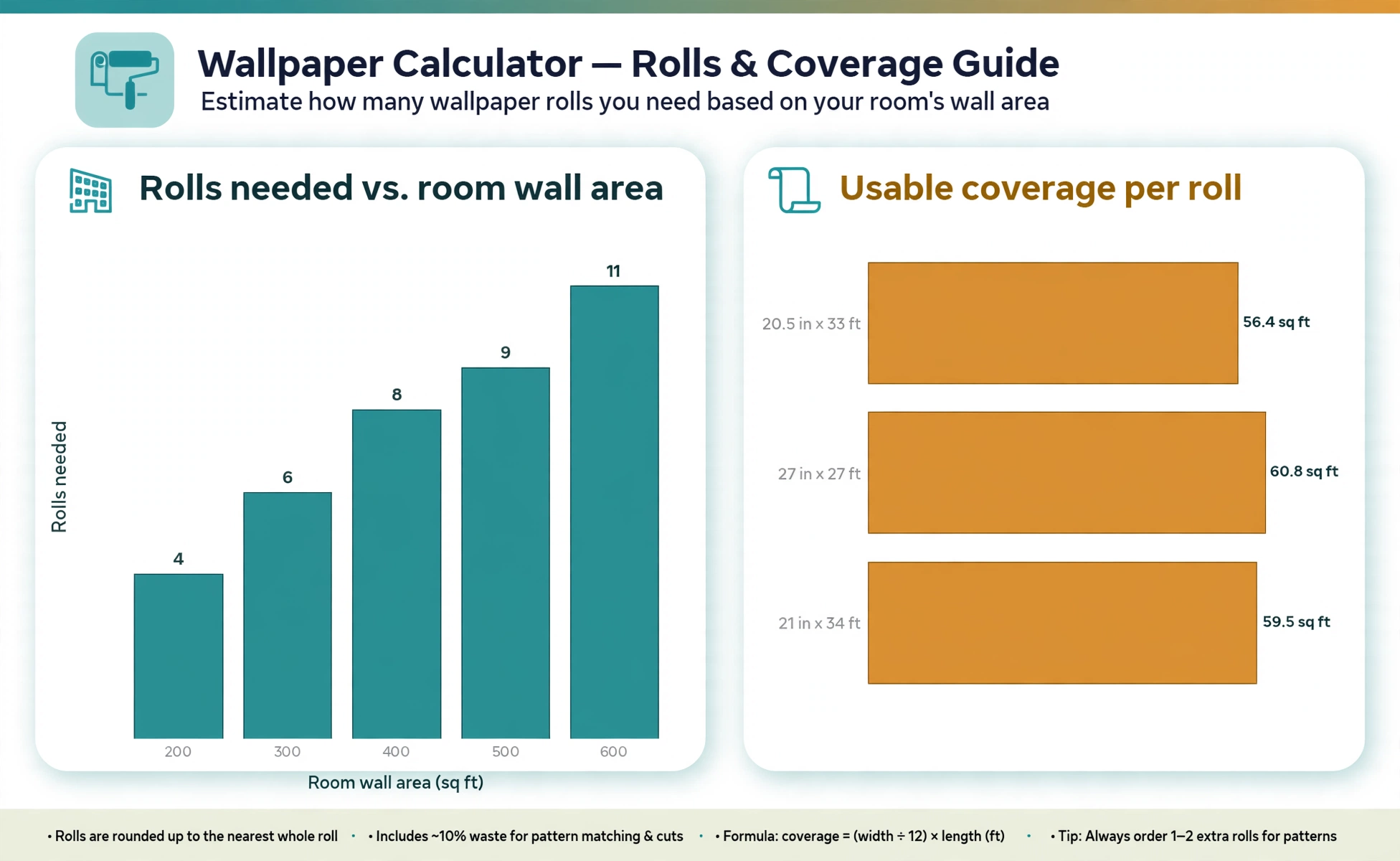
Roll sizes, coverage and usable yield
Rolls come in several standard sizes, and the label's square footage is not what you actually get on the wall. The difference is pattern repeat and trimming.
Common roll sizes
| Roll type | Size | Label coverage | Usable (≈75%) |
|---|---|---|---|
| US single roll | 20.5 in × 33 ft | 56.4 sq ft | 42.3 sq ft |
| US double roll | 20.5 in × 66 ft | 112.8 sq ft | 84.6 sq ft |
| European roll | 21 in × 33 ft | 57.8 sq ft | 43.3 sq ft |
| Wide roll | 27 in × 27 ft | 60.8 sq ft | 45.6 sq ft |
Why usable coverage is lower
Every strip is cut a little long, ends get trimmed at the ceiling and baseboard, and patterned paper needs the design matched across strips — the offcuts from matching never go back on the wall. Wallpaper makers publish usable-yield charts by pattern repeat size rather than raw roll coverage, for exactly this reason.
Read the label before you buy: some brands list coverage already reduced for waste, in which case the calculator's usable figure would double-count the loss — check whether the label says gross or usable coverage.
Waste allowance, pattern repeats and dye lots
The waste percentage is your insurance policy. Ten percent covers plain paper and careful work; the default 15% suits most patterned papers; step up to 20% for large repeats, diagonal patterns, or rooms full of corners and outlets.
- Plain or textured paper: 10% waste is usually enough.
- Small repeats (under 12 in): 15% is the safe default.
- Large repeats (over 12 in) or diagonal designs: use 20% — every strip wastes nearly a full repeat at the ceiling line.
- Buy one spare roll beyond the calculation for future repairs; wallpaper lines get discontinued without warning.
Order every roll from the same production batch. Wallpaper makers advise checking the batch number on all rolls so the colors match exactly when installed — two rolls of the same design from different dye lots can look like different papers on the wall.
If the project grows beyond papering — say the walls themselves need work first — a drywall calculator estimates the sheets for walls and ceilings with openings taken out.
Frequently asked questions
How do I calculate how many wallpaper rolls I need?
Measure the room's perimeter and multiply by the ceiling height, then subtract about 21 sq ft per door and 12 sq ft per window. Divide that wall area by the roll's usable coverage (roughly 75% of the label coverage), add your waste percentage, and round up to a whole roll.
How many square feet does one wallpaper roll cover?
A standard US single roll (20.5 in × 33 ft) lists about 56.4 sq ft of coverage, but after pattern matching and trimming you can actually use about 42.3 sq ft — roughly three-quarters of the roll. That usable figure is what matters when counting rolls.
Should I subtract doors and windows from the calculation?
Yes. A standard door removes about 21 sq ft and a standard window about 12 sq ft of wall you will not paper. This calculator subtracts them automatically from your door and window counts, so you do not buy rolls for openings you will never cover.
What waste percentage should I use for wallpaper?
Use 10% for plain or textured paper with no pattern, 15% for most patterned papers (this calculator's default), and 20% for large repeats, diagonal patterns, or rooms with many corners, outlets and switches. The waste covers trimming, mistakes and future repairs.
How does pattern repeat affect the number of rolls?
A pattern repeat forces every strip to start at the same point in the design, so the offcut at the ceiling and floor of one strip cannot be reused on the next. Larger repeats mean larger offcuts — which is why big-repeat papers need the 20% waste setting while small-repeat papers get by with 15%.
Can I use this calculator for a single accent wall?
Yes, with one adjustment. Enter the wall's width as the room length and set the room width to 0; the calculator will then count the wall twice, so halve the rolls-needed figure and round up. The rounded-up result still leaves you a comfortable margin.
Should all my rolls come from the same batch?
Yes — buy every roll from the same production batch (dye lot). Wallpaper makers advise checking the batch number on all rolls so the colors match exactly when installed; two rolls of the same design from different batches can look like different papers on the wall.
What is the standard wallpaper roll size?
The common US single roll is 20.5 inches wide by 33 feet long (about 56.4 sq ft of coverage). Double rolls are the same width at twice the length, and European rolls are often 21 in × 33 ft. Always read your roll's label, because sizes vary by brand and product line.