Concrete Calculator: Estimate Volume, Bags & Cubic Yards
Ordering too little concrete means a costly second delivery and a weak cold joint; ordering too much wastes money. Enter your slab's length, width and thickness below, and this free concrete calculator will work out the volume in cubic feet and cubic yards, add a waste allowance, and tell you exactly how many 80, 60 and 40 lb bags you need.
Formulas verified against standard construction references. Calculator logic tested with verified worked examples. Last reviewed: October 2026. Our methodology
How the concrete volume math works
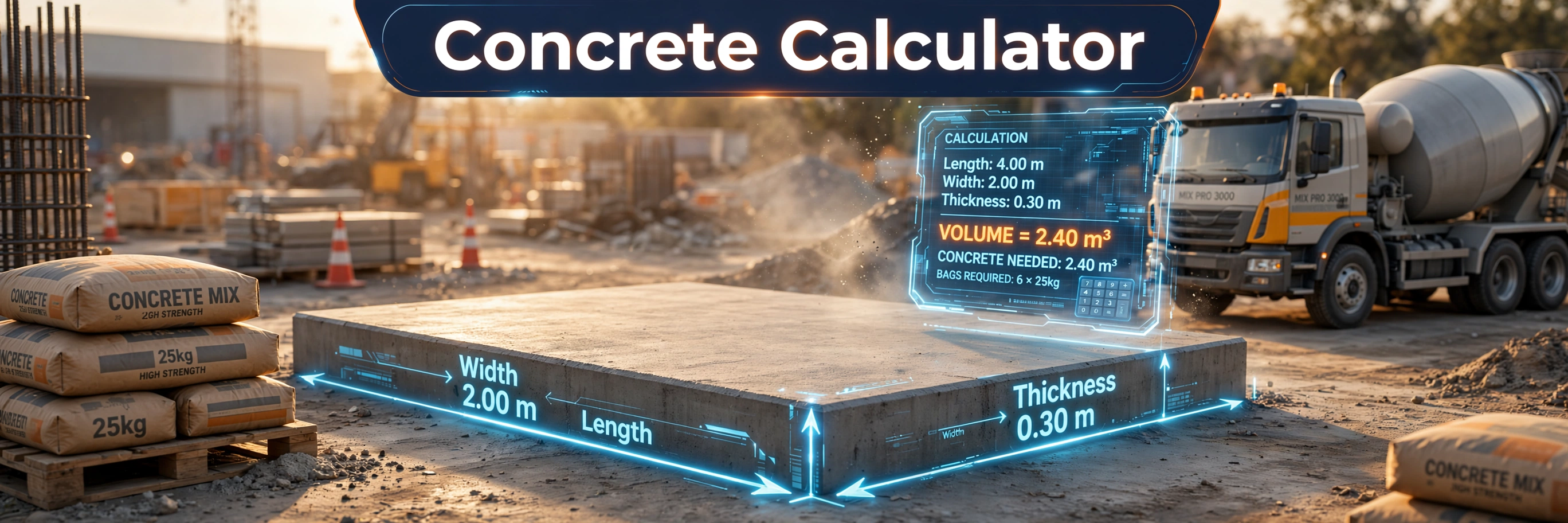
A slab is a rectangular box, so its volume is just length times width times thickness. The only catch is the units: length and width are measured in feet, but thickness is usually measured in inches, so it has to be converted first.
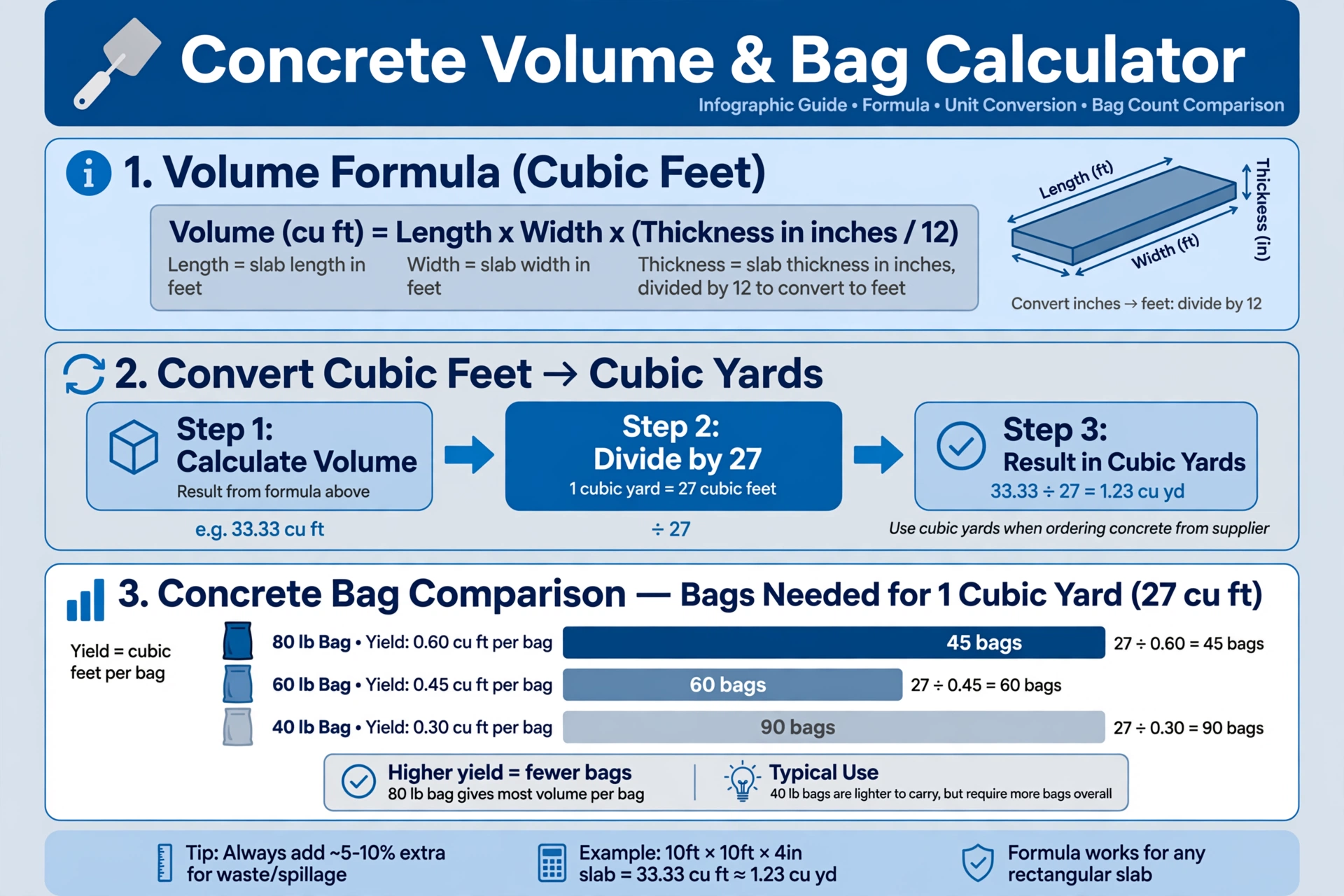
- Volume (cubic feet): length (ft) × width (ft) × (thickness (in) ÷ 12). Dividing inches by 12 turns the thickness into feet.
- Cubic yards: cubic feet ÷ 27. There are 27 cubic feet in one cubic yard, and ready-mix suppliers quote prices per cubic yard.
- Waste allowance: volume × (1 + waste % ÷ 100). A 10% waste factor on 33.33 cubic feet gives 36.67 cubic feet to order.
- Bag count: total cubic feet (with waste) ÷ yield per bag, always rounded up. An 80 lb bag yields 0.60 cubic feet, a 60 lb bag yields 0.45 cubic feet, and a 40 lb bag yields 0.30 cubic feet.
| Bag size | Yield per bag | Bags per cubic yard |
|---|---|---|
| 80 lb | 0.60 cu ft | 45 |
| 60 lb | 0.45 cu ft | 60 |
| 40 lb | 0.30 cu ft | 90 |
Sources: Calcshed — concrete bag formulas and ASTM C387/C387M bagged-mix notes; DIY Concrete Calculator — QUIKRETE published bag yield table.
Worked example
Take a patio slab that is 10 ft long, 10 ft wide and 4 in thick, with a 10% waste factor. First convert the thickness: 4 ÷ 12 = 0.333 ft. The volume is 10 × 10 × 0.333 = 33.33 cubic feet. Divide by 27 to get 1.23 cubic yards.
Add the waste allowance: 33.33 × 1.10 = 36.67 cubic feet, or 36.67 ÷ 27 = 1.36 cubic yards. That is the amount to order. For bags, divide by the yield and round up: 36.67 ÷ 0.60 = 61.1, so 62 bags of 80 lb mix; 36.67 ÷ 0.45 = 81.5, so 82 bags of 60 lb mix; 36.67 ÷ 0.30 = 122.2, so 123 bags of 40 lb mix.
How to use the concrete calculator
Measure the slab area where the concrete will go, then work through the four fields. The calculator does the unit conversion and the waste math for you.
Step by step
- Enter the slab length in feet. Measure the longest side of the form.
- Enter the slab width in feet. Measure the shorter side at right angles to the length.
- Enter the thickness in inches. This is the depth of the form — 4 inches is the standard for patios and walkways.
- Set the waste factor (default 10%). Raise it for uneven ground, deep forms or a hard-to-reach pour; lower it for a clean, well-prepared site.
- Press Calculate. Read the volume in cubic feet and cubic yards, then the bag counts for 80, 60 and 40 lb bags underneath.
Choosing the right slab thickness
Thickness is the dimension that most often goes wrong. Too thin and the slab cracks under load; too thick and you pay for concrete you do not need. These are the thicknesses residential contractors reach for most often.
| Project | Typical thickness | Notes |
|---|---|---|
| Walkway or path | 4 in | Light foot traffic only |
| Patio or shed floor | 4 in | The most common residential pour |
| Driveway | 5–6 in | Must carry vehicle weight |
| Garage floor | 5–6 in | Go 6 in for heavy trucks |
Every extra inch of thickness adds roughly 25% more concrete to a 4-inch slab, so measure the form depth honestly. Local building codes may require a minimum thickness or reinforcement for driveways — check before you pour.
Bags or ready-mix: which should you order?
Bags and ready-mix trucks are two ways to buy the same material, and the breakpoint is smaller than most people expect. An 80 lb bag covers only 0.60 cubic feet, so a single cubic yard takes 45 of them — mixing that many by hand is a long day. If your measurements are not in feet, a volume converter can turn your cubic meters or liters into cubic feet before you start.
| Project size | Best option | Why |
|---|---|---|
| Under 1 cubic yard | Bags | Fewer than 45 × 80 lb bags; mixing by hand is realistic |
| Around 1 cubic yard | Compare both | Ready-mix gets cheaper per yard once bags pass ~30–40 |
| Over 1 cubic yard | Ready-mix truck | Consistent mix, one pour, no cold joints, far less labor |
Watch for short-load fees: many plants add $50–$200 for orders under 7 cubic yards, so ask your supplier about minimums before assuming the truck quote is final. However you buy it, keep one or two spare bags on site — running short mid-pour is far more expensive than a leftover bag.
Concrete pouring tips
Good math only helps if the pour itself goes well. These habits are what separate a slab that lasts decades from one that cracks in a year.
- Never short the waste factor. Uneven subgrade and spillage routinely eat 5–10% of the order. Leftover concrete is cheap; a second delivery is not.
- Do not add extra water to the mix. It makes pouring easier but weakens the finished slab — roughly 15% less strength per extra pint in an 80 lb bag.
- Keep it moist while it cures. Concrete needs about 7 days of moist curing to reach most of its strength; cover it with plastic or wet burlap in hot weather.
- Pour in one continuous session. Stopping halfway creates a cold joint where the two sections never fully bond.
- Plan the finish. Once the slab has cured, sealing or coating it extends its life — a paint calculator estimates how much coating a finished surface needs.
Frequently asked questions
How do I calculate how much concrete I need?
Multiply length × width × thickness in consistent units. For a slab, measure length and width in feet, divide thickness in inches by 12 to convert to feet, then multiply the three numbers for cubic feet. Divide by 27 for cubic yards, and add 5–10% for waste. A 10 × 10 ft slab at 4 in thick is 33.33 cu ft, or 1.23 cubic yards.
How many 80 lb bags of concrete are in a cubic yard?
About 45. An 80 lb bag of concrete mix yields roughly 0.60 cubic feet, and a cubic yard is 27 cubic feet, so 27 ÷ 0.60 = 45 bags. Smaller bags yield less: a 60 lb bag yields 0.45 cubic feet (60 bags per yard) and a 40 lb bag yields 0.30 cubic feet (90 bags per yard).
How many bags of concrete do I need for a 10×10 slab 4 inches thick?
With a 10% waste factor, a 10 × 10 ft slab at 4 in thick needs 36.67 cubic feet of concrete, which is 62 bags of 80 lb mix, 82 bags of 60 lb mix, or 123 bags of 40 lb mix. Always round bag counts up to the next whole bag.
How thick should a concrete slab be?
Walkways, patios and shed floors are typically 4 inches thick. Driveways and garage floors that carry vehicles are usually 5–6 inches. Thicker slabs need more concrete — every extra inch on a 4-inch slab adds about 25% more volume. Check your local building code for minimums.
Should I add extra concrete for waste?
Yes. Add 5–10% for a clean, well-prepared pour, and more if the subgrade is uneven, the forms may bulge, or the pour is hard to reach. Running short mid-pour forces a second delivery and creates a weak cold joint, so a little extra concrete is the cheapest insurance on the job.
When should I order ready-mix instead of bags?
Once the job exceeds about 1 cubic yard (27 cubic feet), which is 45 bags of 80 lb mix. Above that point, ready-mix delivery is usually cheaper per yard, the mix is more consistent, and you avoid hours of hand mixing. Ask the plant about short-load fees for orders under 7 cubic yards.
How much does a cubic yard of concrete weigh?
Normal-weight concrete is commonly taken as 150 lb per cubic foot, which makes one cubic yard weigh about 4,050 lb — a little over 2 tons. This matters if you are hauling bagged mix yourself: 45 bags of 80 lb mix weigh 3,600 lb before water.