Volume Converter: Liters, Gallons, Cups & More
Convert any liquid volume measurement in seconds. Enter a value, choose the from and to units, and this volume converter returns the exact result plus a full conversion table across milliliters, liters, cubic meters, teaspoons, tablespoons, cups, pints, quarts and gallons.
Formulas verified against standard measurement references. Calculator logic tested with verified worked examples. Calculator logic tested with verified worked examples. Last reviewed: October 2026. Our methodology
How volume conversion works
All conversions run through liters as the base unit. Your value is first multiplied by the from-unit’s factor to get liters, then divided by the to-unit’s factor to get the answer. No rounding happens until the final display.
- Liters: value × liters per from-unit
- Result: liters ÷ liters per to-unit
- Example: 1 US gallon × 3.78541 = 3.78541 L
Sources: NIST — SI and US customary unit definitions.
Worked example
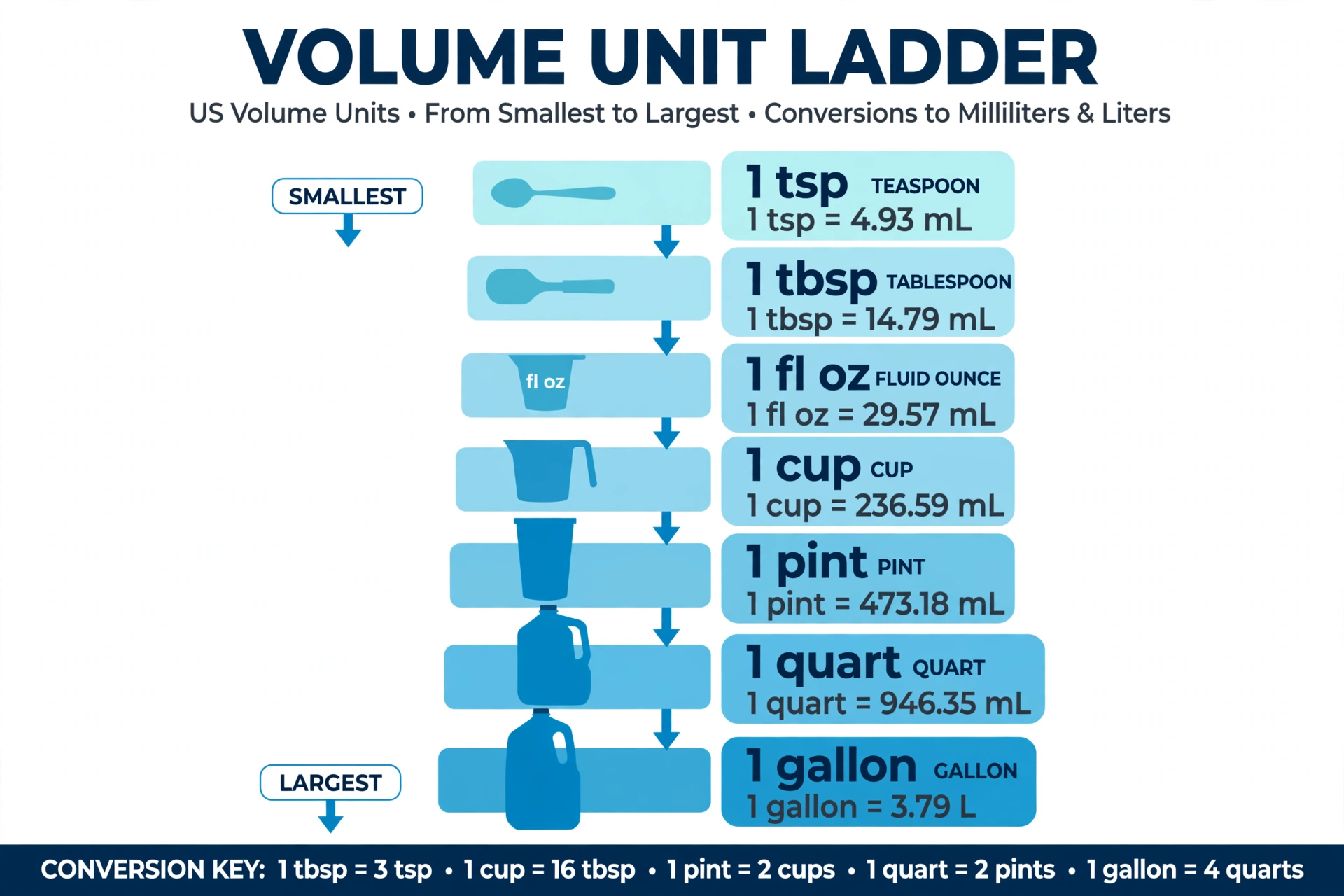
A water container is labeled 2.5 liters — how many US gallons is that? Divide by the gallon factor: 2.5 ÷ 3.785411784 = 0.66043 US gallons, about two-thirds of a gallon. Going the other way, 1 US gallon × 3.78541 = 3.78541 liters. And 16 fluid ounces × 29.5735 mL = 473.18 mL, exactly 2 cups or 1 US pint.
How to use the volume converter
Three inputs give you every unit at once — the table below the form shows your value in all eleven units, so you rarely need a second calculation.
Step by step
- Enter the value. Any number zero or above, including decimals.
- Choose the from unit. Metric (milliliters, liters, cubic meters), US kitchen units (teaspoons through quarts) or gallons — US or imperial.
- Choose the to unit. The headline result is shown in this unit.
- Press Calculate. Read the headline result, the full conversion table and the step-by-step working underneath.
US vs imperial: the gallon trap
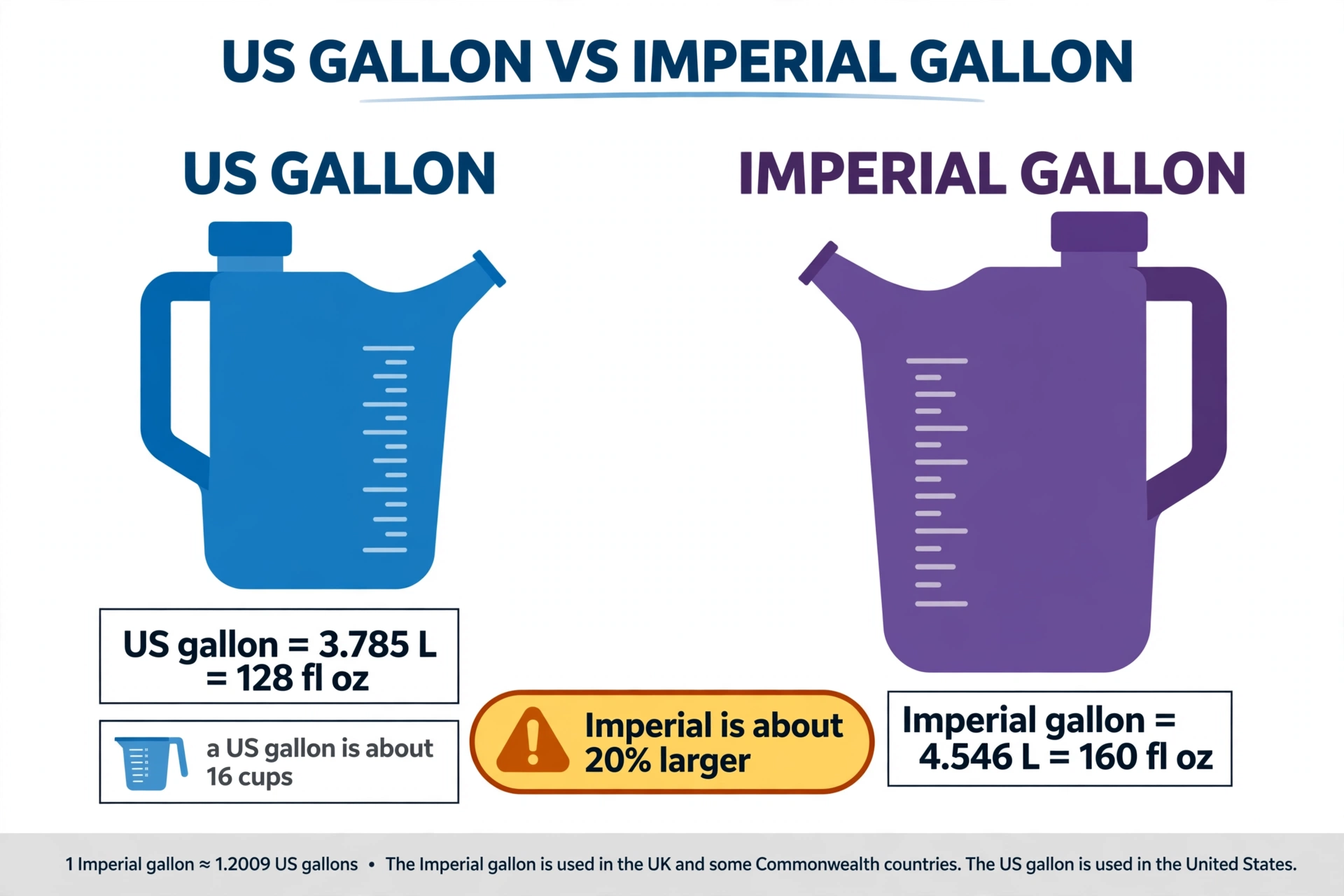
The word “gallon” is the biggest trap in volume conversion. The US gallon and the imperial gallon are different units with different histories — and confusing them introduces a 20% error.
| Unit | US | Imperial |
|---|---|---|
| Gallon | 3.78541 L (128 fl oz) | 4.54609 L (160 fl oz) |
| Quart | 0.94635 L | 1.13652 L |
| Pint | 473.176 mL | 568.261 mL |
| Fluid ounce | 29.5735 mL | 28.4131 mL |
This converter keeps US and imperial gallons as separate units — pick the one your recipe, fuel figure or specification actually uses. For kitchen work with cups, spoons and ingredient weights, the cooking converter adds ingredient densities on top of volume.
Metric volume units and everyday references
The metric side is refreshingly simple: everything is a power of ten. One milliliter is one cubic centimeter, one liter is one cubic decimeter (1,000 mL), and one cubic meter is 1,000 liters.
| Reference | Volume |
|---|---|
| Standard soda bottle | 2 liters |
| US gallon of milk | 3.785 liters |
| Cubic meter | 1,000 liters (≈ 264.17 US gallons) |
| Teaspoon (medicine dosing) | ≈ 5 mL |
Volume often pairs with linear dimensions — for example, sizing a tank from its length, width and height. The length converter handles the metric-imperial side of those measurements.
Tips for accurate conversions
Volume conversion is exact math, so errors almost always come from picking the wrong unit rather than the arithmetic.
- Identify US vs imperial first. If a UK recipe or older specification says “gallon” or “pint”, it almost certainly means imperial.
- Do not mix dry and liquid measures. US dry pints and quarts are larger than their liquid namesakes and are not covered here.
- Keep enough decimals. For fuel and lab work, keep 4–5 significant figures; for cooking, 2–3 are plenty.
- Sanity-check with a known pair. A US gallon is just under 4 liters; a cup is just under a quarter liter. If your answer is far off, recheck the units.
Frequently asked questions
How many liters are in a US gallon?
Exactly 3.785411784 liters — usually rounded to 3.78541 L. A US gallon is defined as 231 cubic inches, and with the inch defined as exactly 25.4 mm, the liter value follows exactly.
What is the difference between a US gallon and an imperial gallon?
The imperial gallon is 4.54609 liters, about 20% larger than the US gallon at 3.78541 liters. The US gallon comes from the old Queen Anne wine gallon (231 cubic inches); the imperial gallon was defined in 1824 as the volume of 10 pounds of water. Mixing them up causes a 20% error.
How many milliliters are in a US cup?
236.588 mL. A US cup is also 16 US tablespoons, 8 US fluid ounces or half a US pint. Note that the metric cup used in some countries is 250 mL instead.
How do I convert liters to US gallons?
Divide liters by 3.78541. For example, 2.5 liters divided by 3.78541 is 0.66043 US gallons — about two-thirds of a gallon, roughly a large soda bottle.
What is a cubic meter, and when is it used?
A cubic meter is 1,000 liters — the SI unit of volume. It is used for large quantities like room volumes, shipping, concrete and water tanks. One cubic meter equals about 264.172 US gallons.
Are dry pints the same as liquid pints?
No. This converter uses US liquid measures throughout. US dry pints and quarts are a different, larger set of units used for produce, so do not use liquid conversions for dry goods.
How accurate are the conversion results?
The converter uses exact defined factors (for example 3.785411784 L per US gallon and 4.54609 L per imperial gallon) with no rounding until the final display, so results are accurate for everyday cooking, fuel, lab and construction use.