Cooking Converter: Cups, Grams & Kitchen Units
A cup of flour and a cup of honey do not weigh the same — because every ingredient has its own density. Enter an amount and unit, pick the ingredient, and this cooking converter shows the full conversion table: volume from teaspoons to liters, and weight in grams and ounces.
Formulas verified against standard measurement references. Calculator logic tested with verified worked examples. Calculator logic tested with verified worked examples. Last reviewed: October 2026. Our methodology
How the cooking converter calculates
Every conversion runs through milliliters. First your amount is converted to milliliters using the exact size of the unit; then the milliliters are multiplied by the ingredient’s density (grams per milliliter) to get the weight.
- Volume in milliliters: amount × milliliters per unit
- Weight in grams: milliliters × density (g/mL)
- Weight in ounces: grams ÷ 28.3495
- Volume from a weight: grams ÷ density, then ÷ milliliters per unit
Sources: NIST — SI and US customary unit definitions; standard published ingredient densities.
Worked example
A recipe needs 2 cups of all-purpose flour, but your scale only reads grams. Two cups are 2 × 236.588 = 473.18 mL. All-purpose flour has a density of about 0.529 g/mL, so 473.18 × 0.529 = 250.3 g — weigh 250 grams of flour. Going the other way, 500 g of granulated sugar (density 0.845 g/mL) is 500 ÷ 0.845 = 591.7 mL, and 591.7 ÷ 236.588 = 2.50 cups.
How to use the cooking converter
Three inputs are all it takes. Use the converter for any single amount — it shows every unit at once, so one calculation covers the whole recipe.
Step by step
- Enter the amount. Any positive number, including decimals such as 2.5.
- Choose the from unit. Teaspoons, tablespoons, fluid ounces, cups, pints, quarts, milliliters, liters — or grams and ounces if you are starting from a weight.
- Pick the ingredient. This sets the density used for every weight conversion. Water works as a neutral default for thin liquids.
- Press Calculate. Read the full table of volume equivalents plus the weight in grams and ounces, with the step-by-step working underneath.
Why a cup weighs differently for every ingredient
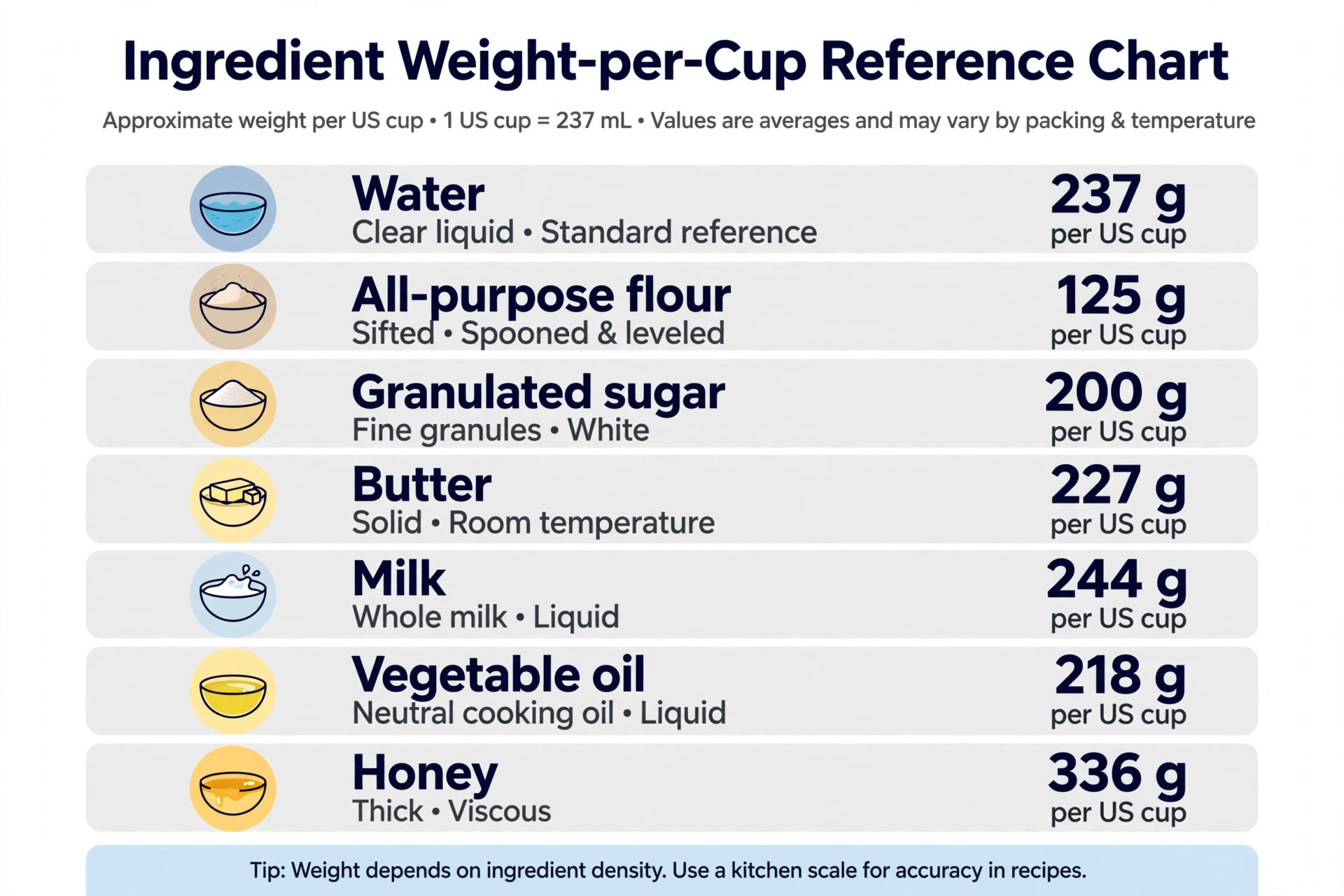
A cup measures volume — the space an ingredient fills. What a recipe really depends on is mass: how much ingredient is actually there. The bridge between the two is density, and it varies enormously between ingredients.
| Ingredient | Density (g/mL) | 1 US cup weighs |
|---|---|---|
| Water | 1.000 | 236.6 g |
| All-purpose flour | 0.529 | 125.2 g |
| Granulated sugar | 0.845 | 199.9 g |
| Butter | 0.959 | 226.9 g |
| Milk | 1.030 | 243.7 g |
| Vegetable oil | 0.920 | 217.7 g |
| Honey | 1.420 | 336.0 g |
Densities are standard published averages for spooned-and-leveled dry ingredients at room temperature; real batches vary slightly. If a recipe lists grams and your scale is set to ounces, the weight converter handles that last step.
US kitchen units vs metric units
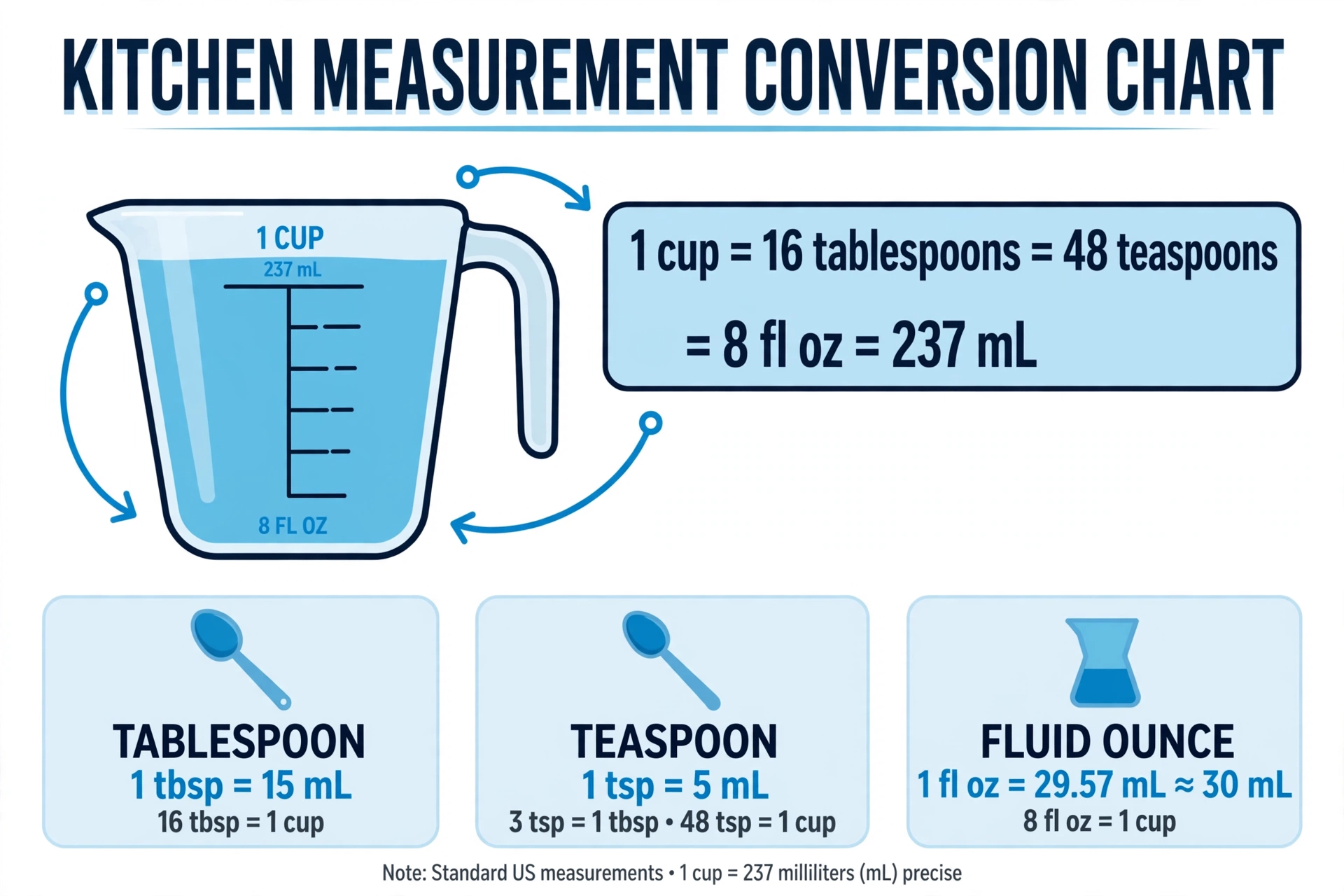
American recipes use US customary units, where everything is defined off the gallon: 1 cup is exactly 236.588 mL, 1 tablespoon is 14.787 mL and 1 teaspoon is 4.929 mL. Metric recipes usually work in milliliters and grams directly, and the metric cup is an exact 250 mL.
| US unit | Milliliters |
|---|---|
| Teaspoon (tsp) | 4.92892 |
| Tablespoon (tbsp) | 14.78676 |
| Fluid ounce (fl oz) | 29.57353 |
| Cup | 236.58824 |
| Pint | 473.17647 |
| Quart | 946.35295 |
Watch out for the Australian tablespoon: it is 20 mL, a full 35% larger than the US tablespoon, which can wreck seasoning-sensitive dishes. Regional differences reach the oven too — a temperature converter sorts out Fahrenheit, Celsius and gas marks when the recipe and your oven disagree.
Tips for accurate baking measurements
Baking is chemistry, and small measurement errors change the result. These habits remove the biggest sources of error.
- Spoon and level flour. Spoon flour into the measuring cup, then sweep the top flat with a knife. Never scoop the cup through the bag — it compacts the flour and adds up to 20% more.
- Weigh when it matters. For flour, cocoa and leavening, a digital scale beats any cup. Grams are the same everywhere; cups are not.
- Check which cup the recipe means. A US recipe’s cup and a metric recipe’s cup differ by 6% — enough to matter in bread and pastry.
- Use room-temperature ingredients unless the recipe says otherwise; cold butter and eggs behave differently from room-temperature ones.
Frequently asked questions
How many grams are in a cup of flour?
About 125 grams of all-purpose flour, spooned into the cup and leveled off. Scooping the cup straight from the bag compacts the flour and can push it to 150 grams or more, which is enough to make cakes and bread dense.
Why does one cup weigh a different amount for each ingredient?
Because every ingredient has its own density — its mass per unit of volume. Weight equals volume times density, so a cup of honey (density 1.42 g/mL) weighs about 336 grams while a cup of flour (density 0.529 g/mL) weighs only about 125 grams.
How many tablespoons are in a cup?
16 tablespoons, which is also 48 teaspoons or 8 fluid ounces. In milliliters, 1 US cup is 236.588 mL, 1 tablespoon is 14.787 mL and 1 teaspoon is 4.929 mL.
Are US cups and metric cups the same size?
No. A US cup is 236.588 mL while a metric cup (used in Australia, New Zealand and some other countries) is exactly 250 mL — about 6% larger. If a recipe does not say which cup it means, check where the recipe was written.
How do I convert grams back to cups?
Divide the grams by the ingredient's density to get milliliters, then divide by 236.588 to get US cups. For example, 500 grams of granulated sugar (density 0.845 g/mL) is 591.7 mL, which is 2.5 cups.
Should I measure by weight or by volume when baking?
By weight. Volume measures like cups vary with how packed the ingredient is — the same cup of flour can differ by 20% between scooping and spooning. A digital kitchen scale removes that variation and gives the same result every time.
What is the density of honey and oil?
Honey is about 1.42 g/mL, so one US cup weighs roughly 336 grams. Vegetable oil is about 0.92 g/mL, so one US cup weighs roughly 218 grams. Water is the reference at 1.00 g/mL, exactly 236.6 grams per cup.