Loan Calculator
Calculate your monthly loan payment, total interest, and total cost in seconds. Enter the loan amount, interest rate, and term to see exactly what you will pay over the life of the loan.
How the loan calculator works
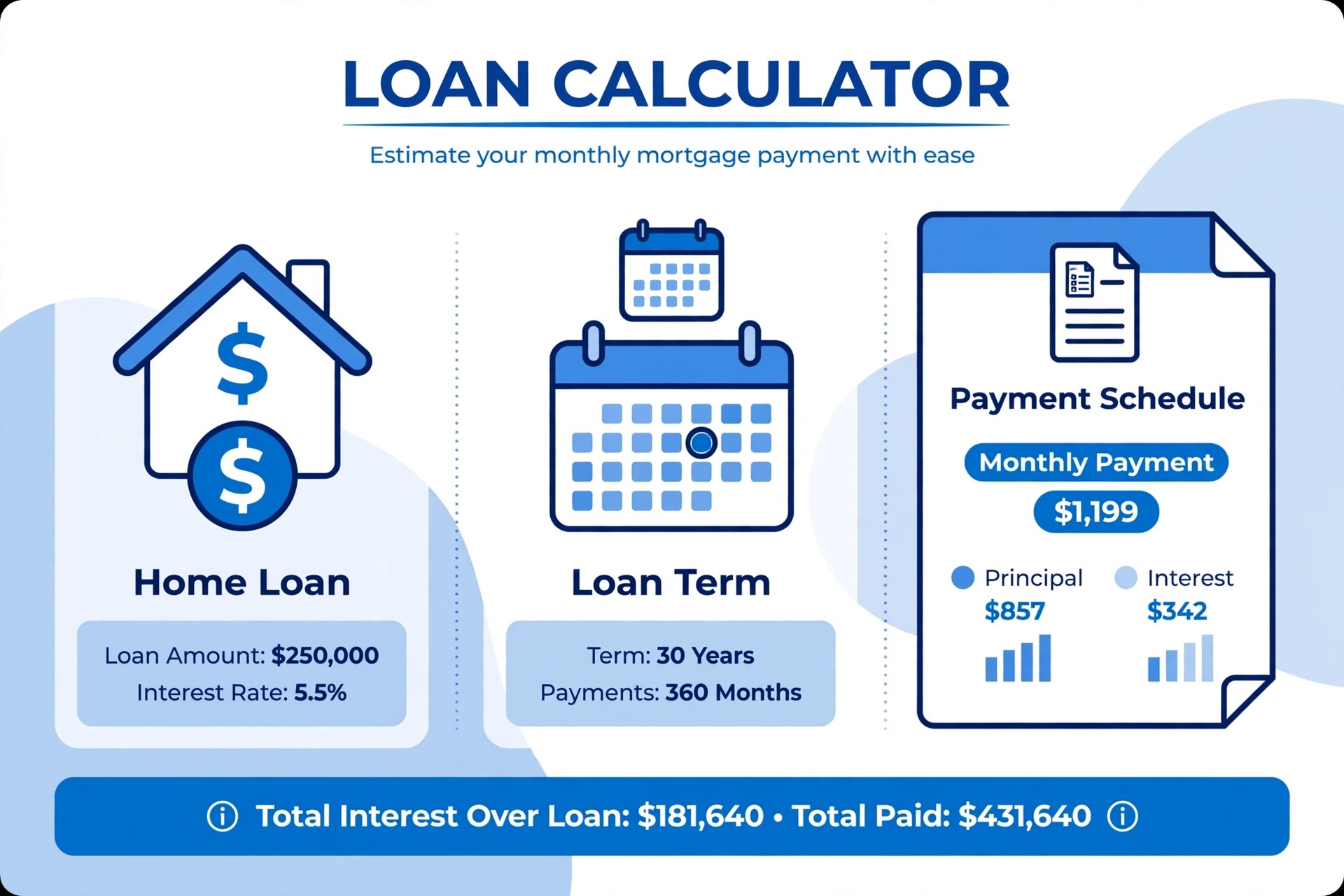
A loan calculator turns three numbers — the amount you borrow, the interest rate, and the repayment term — into your monthly payment, total interest, and total cost. Enter your details above and the calculator applies the standard amortization formula instantly.
Step by step
- Enter the loan amount — how much you want to borrow, e.g. $200,000.
- Enter the annual interest rate — e.g. 6%. This is the nominal rate, not APR.
- Enter the loan term in years — e.g. 30 for a 30-year loan.
- Optional: add a start date to see the exact payoff date.
- Click Calculate to see your monthly payment, total interest, and a yearly breakdown.
What you get
- Monthly payment — principal and interest, excluding taxes and insurance
- Total interest — what the loan costs you beyond the amount borrowed
- Total of payments — principal plus interest over the full term
- Yearly amortization table — interest vs principal paid each year
- Payoff date — when the loan ends, if you entered a start date
The loan payment formula
Monthly payments on an amortizing loan are calculated with this formula:
M = P × r(1+r)n ÷ ((1+r)n − 1)
- M = monthly payment
- P = principal (loan amount)
- r = monthly interest rate (annual rate ÷ 12 ÷ 100)
- n = number of monthly payments (years × 12)
Worked example
For a $200,000 loan at 6% annual interest over 30 years:
- r = 6 ÷ 12 ÷ 100 = 0.005
- n = 30 × 12 = 360
- M = 200,000 × 0.005(1.005)360 ÷ ((1.005)360 − 1)
- M = 200,000 × 0.0059955 ÷ 5.0226 = $1,199.10
Total paid = $1,199.10 × 360 = $431,676.38. Total interest = $431,676.38 − $200,000 = $231,676.38.
Interest works the same way in reverse when your money grows: our compound interest calculator shows how compounding builds savings over time.
Understanding amortization
Amortization means each monthly payment is split between interest and principal. Early on, most of your payment goes to interest because the balance is high. As the balance shrinks, more of each payment attacks the principal. The payment amount never changes — only the split does.
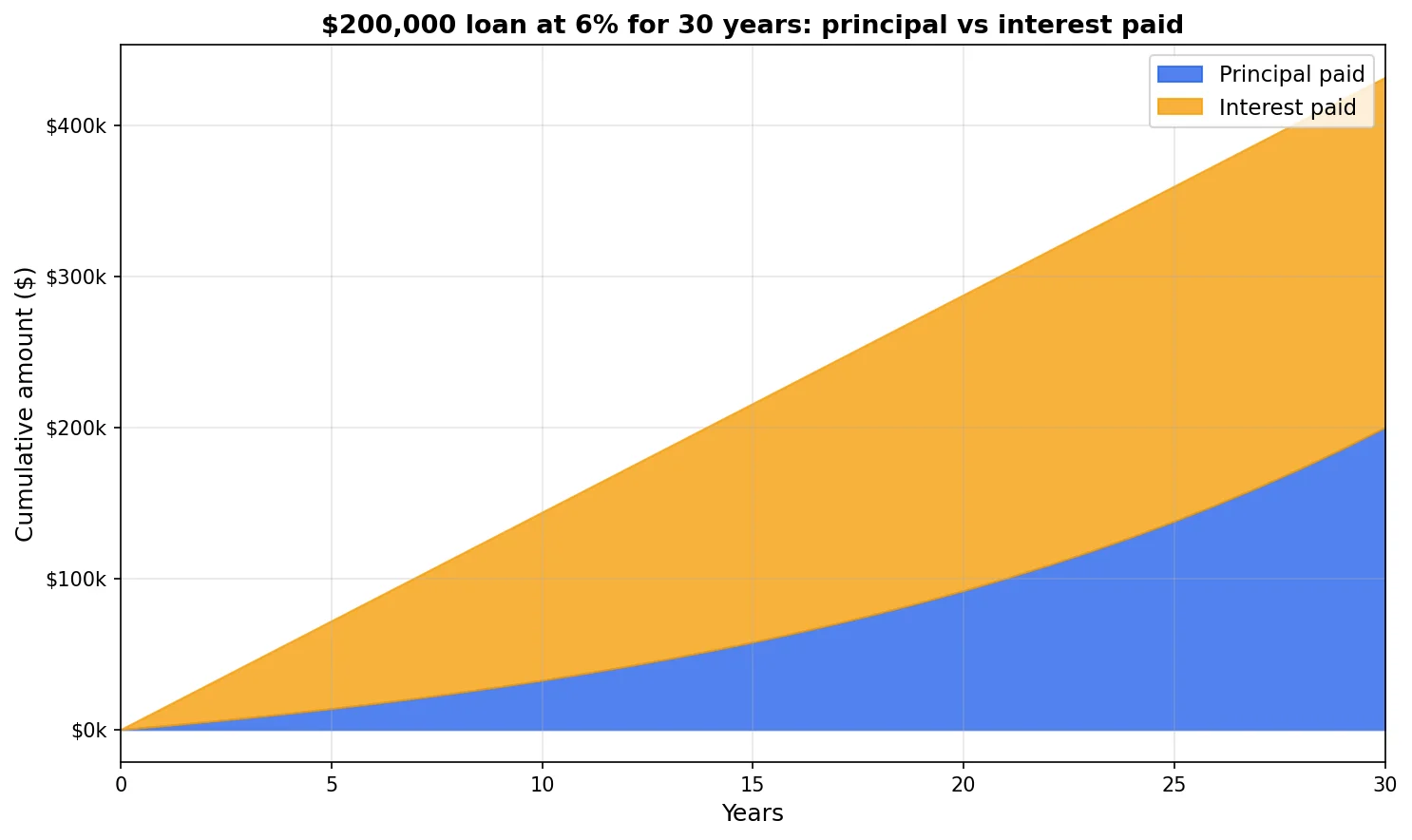
Year-by-year breakdown ($200,000 at 6%, 30 years)
| Year | Interest paid | Principal paid | Balance |
|---|---|---|---|
| 1 | $11,933 | $2,456 | $197,544 |
| 2 | $11,783 | $2,607 | $194,937 |
| 3 | $11,623 | $2,766 | $192,171 |
| 4 | $11,454 | $2,936 | $189,235 |
| 5 | $11,274 | $3,116 | $186,119 |
| ... | ... | ... | ... |
| 30 | $418 | $13,971 | $0 |
In year 1, about 83% of your payments go to interest. In the final year, nearly all of it goes to principal. This front-loaded interest is why extra payments early in the loan save so much.
15-year vs 30-year loan term
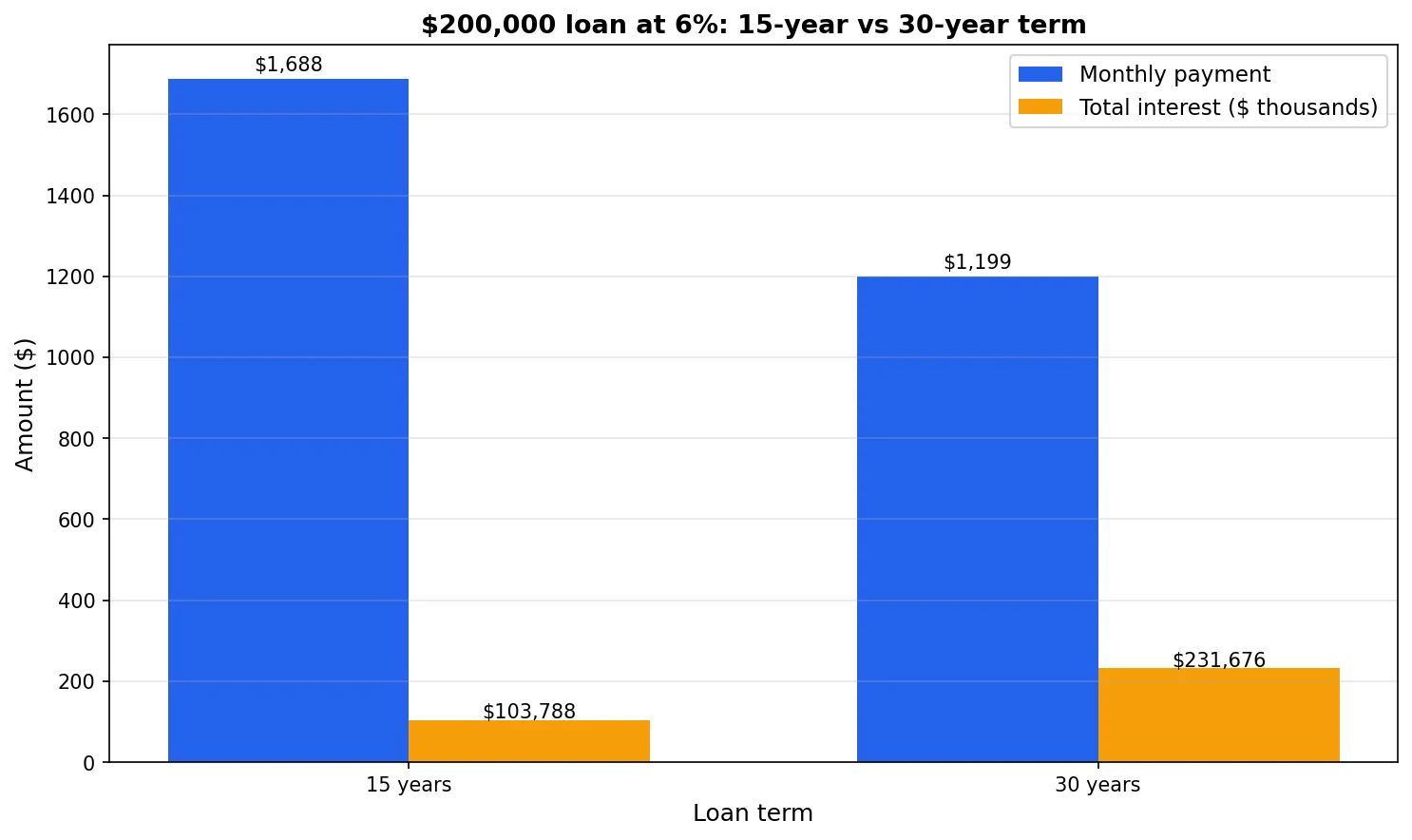
A shorter term means higher monthly payments but dramatically less total interest. Here is the same $200,000 loan at 6% with different terms:
| Term | Monthly payment | Total interest | Total cost |
|---|---|---|---|
| 15 years | $1,687.71 | $103,788 | $303,788 |
| 20 years | $1,432.86 | $143,887 | $343,887 |
| 30 years | $1,199.10 | $231,676 | $431,676 |
The 30-year payment is about 29% lower than the 15-year payment, but you pay more than twice the interest. Choose the shortest term whose payment fits your budget comfortably. If you are borrowing for a home specifically, our mortgage calculator adds taxes, insurance, and PMI to the picture.
5 tips to pay less interest
- Choose a shorter term. A 15-year loan at the same rate saves over $100,000 in interest on a $200,000 loan compared with 30 years.
- Make extra principal payments. Even $100 extra per month early in the loan cuts years off the term because it directly reduces the balance that interest accrues on.
- Make biweekly half-payments. Paying half the monthly amount every two weeks equals 26 half-payments a year — one extra full payment annually.
- Refinance when rates drop. If rates fall 1% or more below your current rate and you plan to stay, refinancing can save thousands. Watch out for closing costs.
- Avoid extending the term to lower payments. Refinancing into a new 30-year loan restarts the amortization clock, putting you back in the high-interest early years.
According to the Consumer Financial Protection Bureau, understanding how amortization front-loads interest helps borrowers compare the true cost of loan offers beyond the monthly payment.
Frequently asked questions
How is the monthly loan payment calculated?
With the amortization formula: M = P x r(1+r)^n / ((1+r)^n - 1), where P is the loan amount, r is the monthly interest rate, and n is the number of payments. For a $200,000 loan at 6% over 30 years, the monthly payment is $1,199.10.
What is loan amortization?
Amortization is the process of paying off a loan through regular payments. Each payment is split between interest and principal. Early payments are mostly interest; later payments are mostly principal. The payment amount stays the same throughout the loan.
How can I pay less interest on my loan?
Choose a shorter loan term, make extra principal payments, pay biweekly instead of monthly, or refinance when rates drop. Extra payments early in the loan save the most because they reduce the balance that future interest accrues on.
Is a 15-year or 30-year loan better?
A 15-year loan has higher monthly payments but costs far less in total interest. On a $200,000 loan at 6%, the 15-year option saves about $128,000 in interest versus 30 years. Choose the shortest term whose payment fits your budget.
What is the difference between interest rate and APR?
The interest rate is the cost of borrowing the principal. APR (annual percentage rate) includes the interest rate plus fees and other costs, expressed as a yearly rate. APR is usually slightly higher and better for comparing loan offers.
Does making extra payments really help?
Yes. Extra payments go directly toward principal, which reduces the balance that interest is calculated on. Even $100 extra per month on a $200,000, 30-year loan at 6% can shave years off the term and save tens of thousands in interest.
What happens if I miss a loan payment?
Missing a payment typically triggers a late fee and can hurt your credit score. Interest continues to accrue on the unpaid balance. If you are struggling, contact your lender before missing a payment — many offer hardship options.
Related calculators
Related calculators
Compound Interest Calculator
See how your savings grow with compounding interest over time.
Use calculatorSalary Calculator
Convert pay between hourly, weekly, biweekly, monthly and annual - plus your overtime rate.
Use calculatorLoan EMI Calculator
Estimate your monthly loan payment from amount, rate and term.
Use calculator