Salary Calculator: Convert Hourly, Weekly, Monthly & Annual Pay
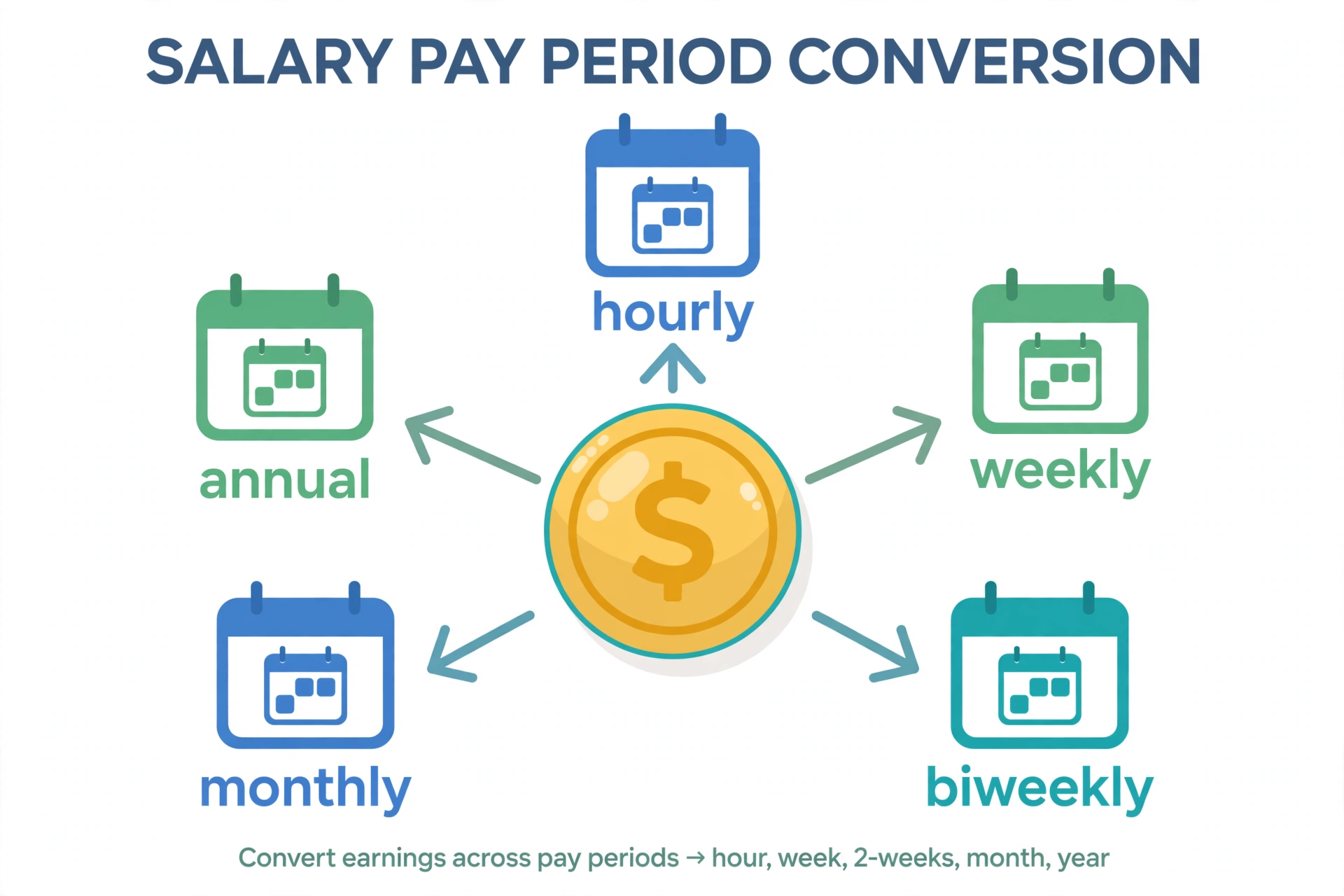
Convert your pay between hourly, weekly, biweekly, monthly and annual amounts - and see what your time is really worth per hour, including overtime.
Formula
Annual pay = pay amount × pay periods per year: hourly × hours per week × 52, weekly × 52, biweekly × 26, monthly × 12. Going the other way: hourly rate = annual pay ÷ (hours per week × 52), and overtime = hourly rate × 1.5.
Quick mental math: at 40 hours a week, every $1 an hour is about $2,080 a year. So $25 an hour is roughly $52,000 a year, and $50 an hour is roughly $104,000.
Worked example
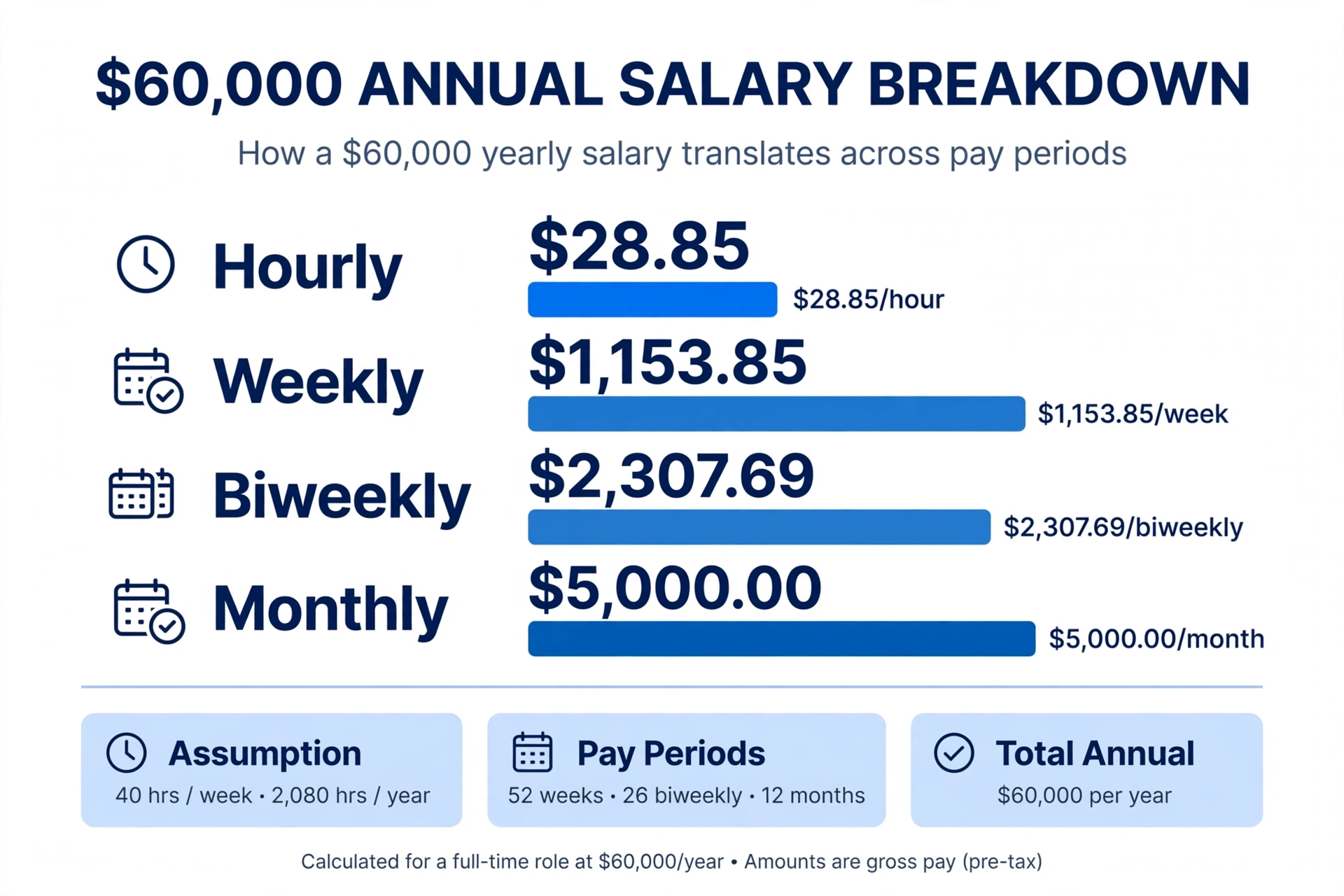
A $60,000 annual salary at 40 hours a week: hourly = $60,000 / (40 x 52) = $28.85 per hour. Weekly = $60,000 / 52 = $1,153.85. Biweekly = $60,000 / 26 = $2,307.69. Monthly = $60,000 / 12 = $5,000. Overtime rate = $28.85 x 1.5 = $43.27 per hour.
How to use the salary calculator
Enter your gross pay, pick the pay period, and set your weekly hours. The calculator restates your pay across hourly, weekly, biweekly, monthly and annual periods, plus your overtime rate.
The three fields
- Salary amount — your gross pay in dollars, before taxes and deductions.
- Pay period — per hour, per week, every 2 weeks, per month, or per year.
- Hours per week — defaults to 40 for full-time; change it for part-time or long-hour roles.
What it does not do
It converts gross pay only and does not subtract income tax, Social Security, Medicare, insurance or retirement contributions. Your take-home pay will be lower. Planning what to do with the salary? The compound interest calculator shows what steady saving from that pay can grow into, and the loan EMI calculator helps you budget a monthly loan payment against it.
Common salaries at a glance
At the standard full-time schedule of 40 hours a week, 52 weeks a year:
| Annual | Hourly | Weekly | Biweekly | Monthly |
|---|---|---|---|---|
| $40,000 | $19.23 | $769.23 | $1,538.46 | $3,333.33 |
| $50,000 | $24.04 | $961.54 | $1,923.08 | $4,166.67 |
| $60,000 | $28.85 | $1,153.85 | $2,307.69 | $5,000.00 |
| $75,000 | $36.06 | $1,442.31 | $2,884.62 | $6,250.00 |
| $100,000 | $48.08 | $1,923.08 | $3,846.15 | $8,333.33 |
| $150,000 | $72.12 | $2,884.62 | $5,769.23 | $12,500.00 |
Reading it the other way: $15 an hour is $31,200 a year, $20 is $41,600, $25 is $52,000 and $50 is $104,000.
Adjusting for your real schedule
Not everyone works 40 hours a week, 52 weeks a year — and the schedule changes the answer. A 37.5-hour week is common in offices and healthcare: it gives 1,950 hours a year, which raises a $60,000 salary from $28.85 to $30.77 an hour.
| Hours per week | $60,000 as hourly pay |
|---|---|
| 30 | $38.46 |
| 37.5 | $30.77 |
| 40 | $28.85 |
| 45 | $25.64 |
| 50 | $23.08 |
Unpaid time off matters too. $80,000 spread over 52 paid weeks is $38.46 an hour, but over 48 paid weeks it is $41.67. If some weeks are unpaid, compare offers using the hourly figures so the schedules do not distort the comparison.
Gross pay vs take-home pay
The calculator shows gross pay: earnings before anything is taken out. Take-home (net) pay is what reaches your bank account after federal and state income tax, Social Security and Medicare, plus health insurance, retirement and other deductions.
As a rough rule, take-home pay lands around 70–80% of gross for a typical US employee, but your tax bracket, state, filing status and benefits all move the number. Use this page to compare offers in gross terms, then check a pay stub or payroll estimate for the net figure.
Salary vs hourly: comparing job offers
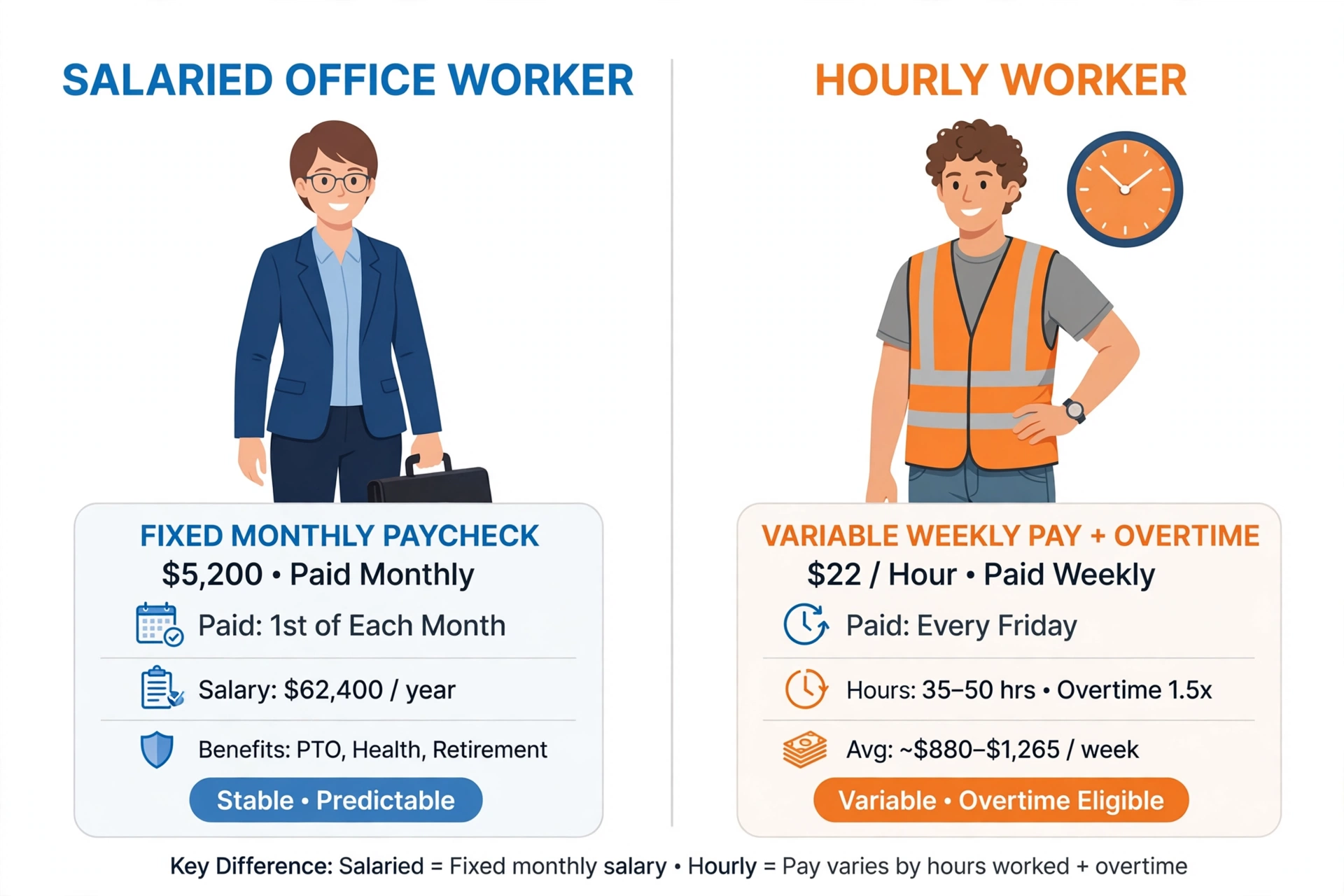
A $52,000 salary and a $25-an-hour job look identical on paper at 40 hours a week — until the schedule, overtime and benefits differ. Convert both offers to an hourly equivalent with the calculator above, then weigh the trade-offs:
| Factor | Salaried | Hourly |
|---|---|---|
| Overtime pay | Usually exempt — no overtime | Usually 1.5× after 40 hrs/week |
| Paycheck | Same every period | Varies with hours worked |
| Paid time off | Usually included | Often unpaid |
| Benefits | Usually included | Varies by employer |
An hourly role with regular overtime can out-earn a slightly higher salary. A salaried role usually wins on predictability and paid time off.
Frequently asked questions
How much is $25 an hour a year?
At 40 hours a week, $25 an hour is $25 x 2,080 = $52,000 a year in gross pay, or about $4,333 a month and $1,000 a week before taxes.
What is a $60,000 salary in hourly pay?
Divide by 2,080 (40 hours x 52 weeks): $60,000 / 2,080 = $28.85 an hour. That is $1,153.85 a week, $2,307.69 biweekly and $5,000 a month.
How do I convert my annual salary to an hourly rate?
Divide your annual salary by your total working hours per year (hours per week x 52). For a standard 40-hour week that is $60,000 / 2,080 = $28.85 an hour. Use your actual hours if your schedule differs.
How much is my biweekly paycheck on a $60,000 salary?
Divide the annual salary by 26 pay periods: $60,000 / 26 = $2,307.69 per biweekly paycheck, before taxes and deductions.
How is overtime pay calculated?
In the US, non-exempt employees are typically paid 1.5 times their regular hourly rate (time-and-a-half) for hours beyond 40 in a week. At $28.85 an hour, the overtime rate is $43.27 an hour.
Does this calculator include taxes?
No. It converts gross pay only - earnings before income tax, Social Security, Medicare and other deductions. Take-home pay is usually around 70-80% of gross for a typical employee, depending on the situation.
How many working hours are in a year?
A standard full-time year is 2,080 hours (40 hours per week x 52 weeks). A 37.5-hour week gives 1,950 hours instead.
Should I take the salaried job or the hourly job?
Convert both offers to an hourly equivalent with the calculator above, then compare overtime rules, paid time off and benefits. An hourly role with regular overtime can out-earn a slightly higher salary, while salary usually wins on predictability.
Related calculators

Loan EMI Calculator
Estimate your monthly loan payment from amount, rate and term.
Use calculatorCompound Interest Calculator
See how your savings grow with compounding interest over time.
Use calculator
Percentage Calculator
Find what P% of any number is — instant answers with the formula shown.
Use calculator