Temperature Converter: °C, °F, Kelvin & More
Convert between Celsius, Fahrenheit, Kelvin, Rankine, Réaumur, Delisle and Newton. Enter a value, pick your units, and this free temperature converter shows the result with the exact formula it used — and rejects any value below absolute zero.
Conversion formulas are standard physics definitions. Calculator logic tested with verified worked examples. Last reviewed: October 2026. Our methodology
Temperature conversion formulas
Every conversion on this page goes through Celsius as the hub: your value is first converted to degrees Celsius, then from Celsius to the target unit. These are the six formulas from Celsius to each other scale.
- Fahrenheit: °F = °C × 9/5 + 32
- Kelvin: K = °C + 273.15
- Rankine: °R = (°C + 273.15) × 9/5
- Réaumur: °Ré = °C × 4/5
- Delisle: °De = (100 − °C) × 3/2
- Newton: °N = °C × 33/100
To go the other way, each formula is simply inverted: °C = (°F − 32) × 5/9, °C = K − 273.15, °C = (°R − 491.67) × 5/9, °C = °Ré × 5/4, °C = 100 − °De × 2/3, and °C = °N × 100/33.
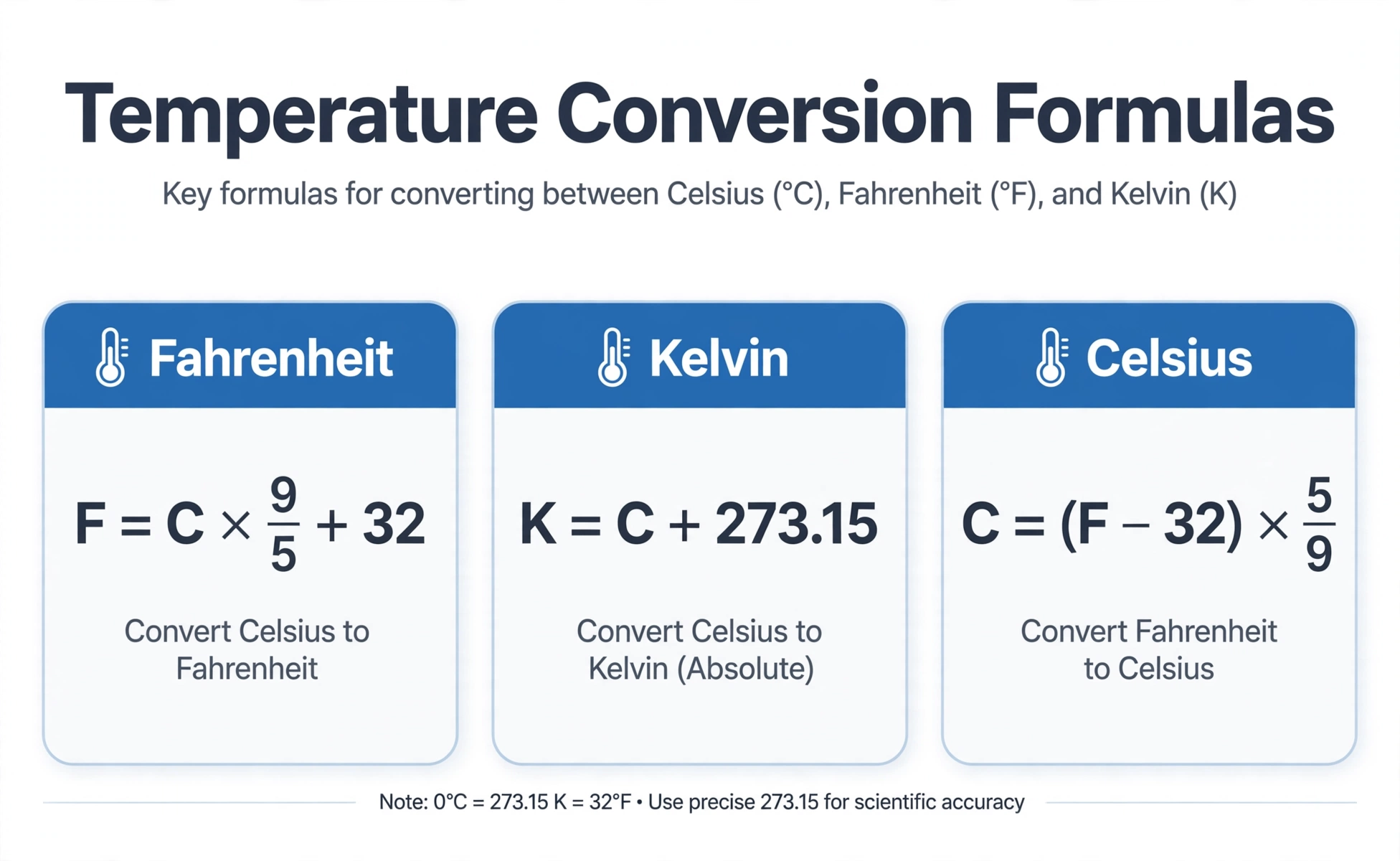
Sources: Celsius defined relative to the kelvin (t/°C = T/K − 273.15, exact) per the BIPM SI Brochure; Rankine, Réaumur, Delisle and Newton scales by their standard historical definitions; see also the NIST Guide for the Use of the International System of Units (SP 811).
Worked example
Convert 25 °C to Fahrenheit. Multiply by 9/5 and add 32: 25 × 1.8 = 45, then 45 + 32 = 77 °F — a warm spring day.
The reverse trip works the same way. Convert 98.6 °F (normal body temperature) to Celsius: subtract 32 to get 66.6, multiply by 5/9, and you land on 37 °C. Converting 37 °C back gives 98.6 °F again, which is how you can sanity-check any temperature conversion: the round trip must return your starting value.
How to use the temperature converter
- Enter the temperature. Type the number you want to convert, such as 100. Decimals and negative numbers are fine.
- Pick the units. Choose the scale you are converting from and the one you are converting to — Celsius, Fahrenheit, Kelvin, Rankine, Réaumur, Delisle or Newton.
- Press Calculate. You get the converted value plus the exact formula used, for example °F = 100 × 9/5 + 32 = 212 °F.
Unlike a length converter, where every value is physically possible, temperature has a hard floor: the calculator rejects anything below absolute zero (−273.15 °C) instead of returning a meaningless number. Converting a scale to itself simply returns your value unchanged.
Absolute zero and why it matters
Absolute zero — 0 kelvin, or −273.15 °C — is the lowest temperature that can exist. Temperature is a measure of how much atoms and molecules jiggle, and at absolute zero that motion reaches its quantum-mechanical minimum. You can get arbitrarily close in a lab (physicists have reached billionths of a degree above it), but the third law of thermodynamics says you can never quite get there, and you can never go below it.
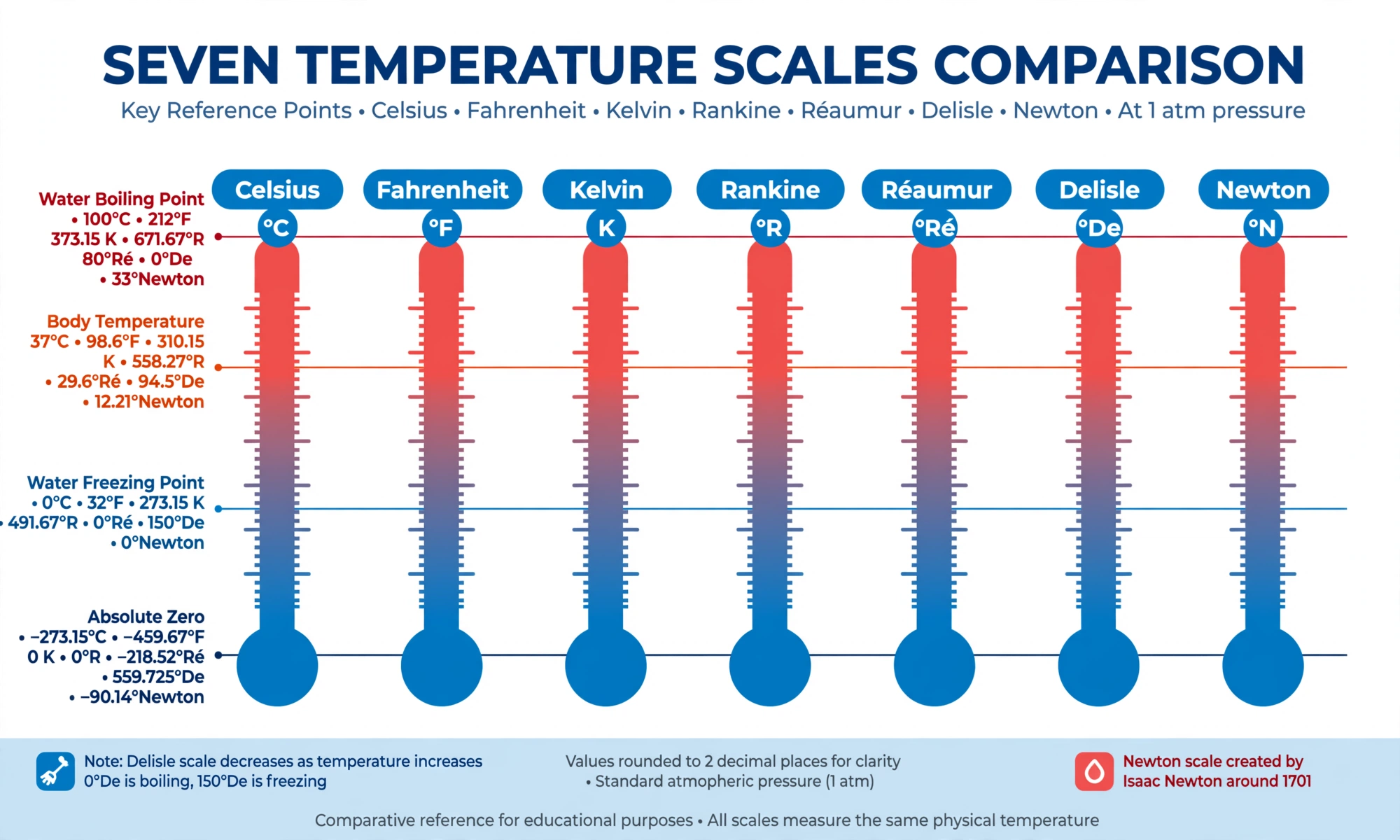
This is why the calculator treats −273.15 °C as a hard boundary. A conversion that lands below it — say, −300 °C — is not a cold temperature waiting to be converted; it is a value that cannot exist in this universe, so the honest answer is an error, not a number. Note that Delisle is the odd one out on the diagram: it counts down from boiling, so larger Delisle numbers mean colder temperatures.
Where each scale is used
Seven scales survive because different jobs needed different tools. Celsius won everyday life almost everywhere, Fahrenheit held on in the United States, and the absolute scales — Kelvin and Rankine — rule science and engineering, where starting from zero makes the math cleaner.
| Scale | Zero point | One degree equals | Used for |
|---|---|---|---|
| Celsius (°C) | Water freezes | 1 K | Daily life, weather and cooking in most of the world |
| Fahrenheit (°F) | Historical brine mixture | 5/9 K | Daily life and weather in the United States |
| Kelvin (K) | Absolute zero | 1 °C | Science, physics and engineering worldwide |
| Rankine (°R) | Absolute zero | 1 °F | US thermodynamics and heat-engine engineering |
| Réaumur (°Ré) | Water freezes | 1.25 °C | Historical Europe; still seen in some dairy and cheese making |
| Delisle (°De) | Water boils (inverted) | 2/3 °C | Historical Russia; proposed by Joseph-Nicolas Delisle in 1732 |
| Newton (°N) | Water freezes | ≈ 3.03 °C | Historical; devised by Isaac Newton around 1700 |
The Réaumur, Delisle and Newton scales are museum pieces today, but they still show up in old texts, antique instruments and trivia — which is why a complete converter covers them. If you are converting measurements for a recipe or a shipment, you may also need our weight converter for kilograms, pounds and ounces.
Everyday reference points in all seven units
Four landmarks anchor every scale: absolute zero, the freezing point of water, human body temperature and the boiling point of water. Memorize the Celsius column and the rest follow from the formulas.
| Reference point | °C | °F | K | °R | °Ré | °De | °N |
|---|---|---|---|---|---|---|---|
| Absolute zero | −273.15 | −459.67 | 0 | 0 | −218.52 | 559.725 | −90.14 |
| Water freezes | 0 | 32 | 273.15 | 491.67 | 0 | 150 | 0 |
| Body temperature | 37 | 98.6 | 310.15 | 558.27 | 29.6 | 94.5 | 12.21 |
| Water boils | 100 | 212 | 373.15 | 671.67 | 80 | 0 | 33 |
Two rows are worth a second look. Delisle reads 0 at boiling and 150 at freezing — it runs backwards. And the Kelvin and Rankine columns hit exactly 0 at absolute zero, which is what makes them "absolute" scales: 200 K is genuinely twice as hot as 100 K, a statement that makes no sense in Celsius or Fahrenheit. Checking an unfamiliar row by hand is quick work with a scientific calculator and the formulas above.
Frequently asked questions
How do I convert Celsius to Fahrenheit?
Multiply the Celsius value by 9/5 (1.8) and add 32. For example, 25 °C × 9/5 + 32 = 77 °F. To go the other way, subtract 32 and multiply by 5/9.
What is absolute zero?
Absolute zero is 0 kelvin (−273.15 °C, −459.67 °F), the lowest temperature that can exist. At that point molecular motion reaches its minimum, and the laws of thermodynamics forbid anything colder.
What is the Rankine scale?
Rankine is the Fahrenheit-sized version of Kelvin: an absolute scale that starts at absolute zero, where each degree Rankine equals one degree Fahrenheit. It is used in US engineering thermodynamics, especially heat-engine calculations.
What is the Réaumur scale?
Réaumur sets 0 °Ré at the freezing point of water and 80 °Ré at boiling, so each degree Réaumur is 1.25 °C. It was widely used in parts of Europe in the 18th and 19th centuries and still appears in some cheese and dairy traditions.
Why does the Delisle scale run backwards?
Delisle chose 0 °De at the boiling point of water and 150 °De at freezing, so the numbers rise as things get colder. It was proposed by French astronomer Joseph-Nicolas Delisle in 1732 and used in Russia for about a century.
What is the Newton temperature scale?
Isaac Newton proposed a scale around 1700 with 0 °N at the freezing point of water and 33 °N at boiling, so each degree Newton is about 3.03 °C. It never caught on but survives as a historical curiosity.
Why can't a temperature be below −273.15 °C?
Because −273.15 °C is absolute zero, the point where molecular motion reaches its minimum. Going colder would require less-than-zero thermal motion, which physics does not allow — so this converter rejects such values instead of converting them.
Which temperature scale should I use?
Use Celsius for everyday life in most of the world, Fahrenheit if you are in the United States, and Kelvin for any science or engineering work. Rankine fits US engineering thermodynamics; Réaumur, Delisle and Newton are only needed for historical texts and antique instruments.
Related calculators

Length Converter
Convert mm, cm, m, km, inches, feet, yards and miles in one step, with the exact factor behind every result.
Use calculatorWeight Converter
Convert between kilograms, grams, pounds, ounces, stone and tons instantly, with a full conversion table.
Use calculator
Scientific Calculator
Evaluate trig, logarithm, power and root expressions with a full scientific keypad.
Use calculator