Weight Converter: Kilograms, Pounds, Ounces and More
Convert weight between eight metric and imperial units — kilograms, grams, milligrams, pounds, ounces, stone, tonnes and US tons. Enter a value, pick the units, and get the answer plus a full conversion table for your value across every unit.
The weight conversion formula
Every conversion goes through kilograms as the common step: first convert your value to kilograms, then convert kilograms to the target unit.
- Kilograms = value × (kilograms per "from" unit)
- Result = kilograms ÷ (kilograms per "to" unit)
The "kilograms per unit" figures are exact international definitions — for example, one pound is defined as exactly 0.45359237 kg, and one ounce as exactly 0.028349523125 kg.
Worked example
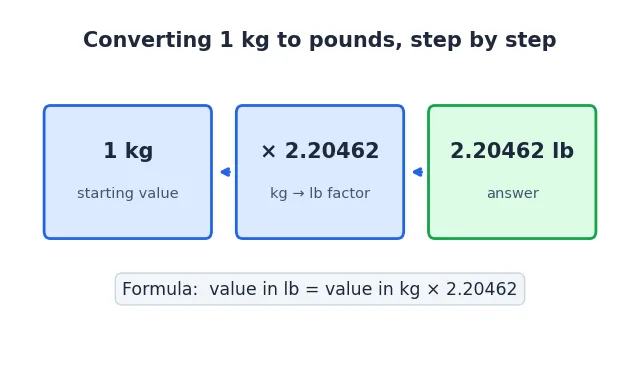
Convert 1 kg to pounds. Kilograms = 1 × 1 = 1 kg. Pounds = 1 ÷ 0.45359237 = 2.20462 lb. The full table for the same value also shows 1,000 g, 35.274 oz, 0.15747 st and 0.001 t.
How to use the weight converter
One value and two dropdowns are all it takes. The result appears instantly with the target unit highlighted in a full table, so you can compare at a glance.
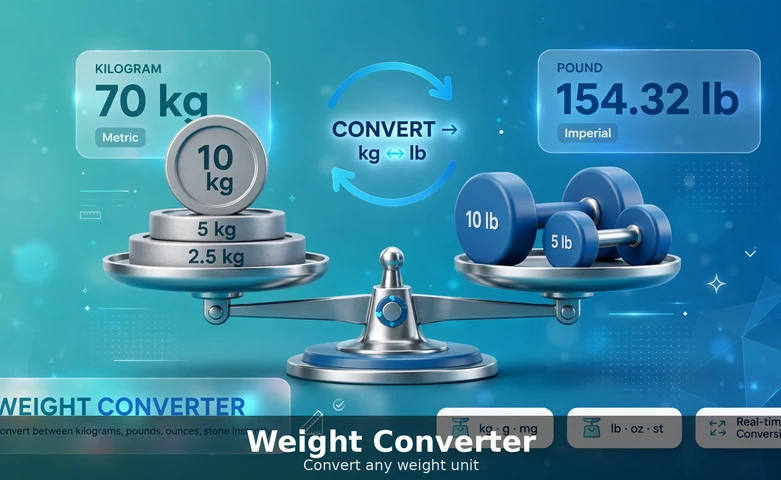
Step by step
- Enter the value. Decimals are fine — 2.5 kg works as well as 2500 g.
- Choose the "from" unit. The unit your number is currently in.
- Choose the "to" unit. Pounds is preselected, since kg-to-lb is the most common conversion.
- Press Calculate. Read the headline result, then scan the full table.
Converting length too?
Weight answers "how heavy"; for "how long" or "how far" you need a different set of units entirely. A length converter handles millimetres through miles with the same instant table layout.
Metric versus imperial weight units
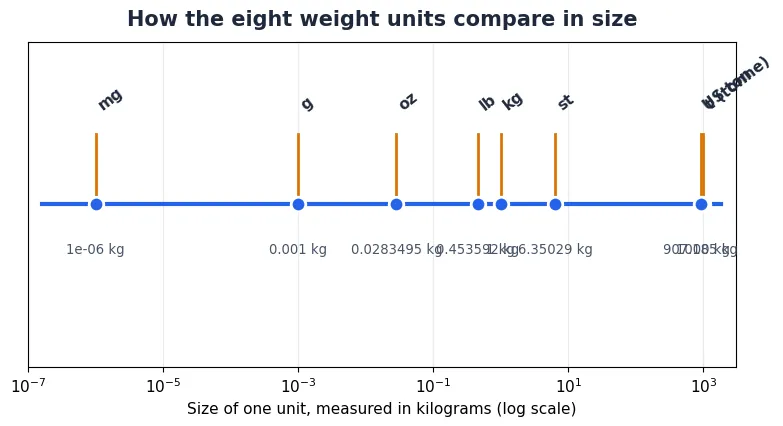
Metric units scale by powers of ten — 1,000 grams make a kilogram, 1,000 kilograms make a tonne. Imperial units grew from historical trade measures: 16 ounces make a pound, 14 pounds make a stone.
The eight units compared
| Unit | Symbol | Equals in kg | System |
|---|---|---|---|
| Milligram | mg | 0.000001 | Metric |
| Gram | g | 0.001 | Metric |
| Ounce | oz | 0.028349523125 | Imperial |
| Pound | lb | 0.45359237 | Imperial |
| Kilogram | kg | 1 | Metric (base) |
| Stone | st | 6.35029318 | Imperial (UK) |
| Tonne (metric ton) | t | 1,000 | Metric |
| US ton | ton | 907.18474 | US customary |
Weight and body measurements
Scales in the UK often report body weight in stone and pounds, while most of the world uses kilograms. Health tools standardise on kilograms — a BMI calculator, for example, expects your weight in kg — so this converter is the bridge between your bathroom scale and the health charts.
Precision, rounding and exact definitions
The converter uses exact definitions (1 lb = 0.45359237 kg) rather than rounded approximations like 0.45, so results stay accurate through chained conversions. Display rounding is separate: large values show 2 decimals, small values show up to 6, which keeps tables readable without hiding precision.
How many decimals do you need?
| Conversion | Everyday use | Technical use |
|---|---|---|
| kg → lb | 2.2 lb | 2.20462 lb |
| g → oz | 0.04 oz | 0.035274 oz |
| kg → st | 0.16 st | 0.157473 st |
| t → US ton | 1.10 ton | 1.10231 ton |
Authoritative definitions
Unit definitions are maintained by national measurement institutes. The US National Institute of Standards and Technology (NIST) Office of Weights and Measures publishes the reference standards behind the metric–imperial relationships used here.
Common conversions at a glance
These are the conversions people look up most often, rounded for quick reading. Use the calculator above for exact values.
Quick reference table
| From | To | Multiply by |
|---|---|---|
| 1 kg | pounds | 2.20462 |
| 1 kg | ounces | 35.274 |
| 1 lb | kilograms | 0.453592 |
| 1 lb | ounces | 16 |
| 1 oz | grams | 28.3495 |
| 1 st | kilograms | 6.35029 |
| 1 tonne | kilograms | 1,000 |
| 1 US ton | kilograms | 907.185 |
Remembering the direction
The easy mistake is multiplying when you should divide. A quick sanity check helps: a kilogram is heavier than a pound, so kg → lb must give a bigger number (1 → 2.2). If your answer looks backwards — 0.45 lb for 1 kg — you divided instead of multiplying.
Frequently asked questions
How many pounds are in a kilogram?
One kilogram equals 2.20462 pounds. The exact definition is 1 lb = 0.45359237 kg, so you divide kilograms by 0.45359237 (or multiply by 2.20462) to get pounds.
How many grams are in a kilogram?
Exactly 1,000 grams. The metric system scales by powers of ten: 1 kg = 1,000 g = 1,000,000 mg. This is why metric conversions never need awkward fractions.
What is a stone in weight?
A stone is an imperial unit equal to 14 pounds, or 6.35029318 kg. It is still widely used in the UK and Ireland for body weight — someone described as '11 stone' weighs 154 lb or about 69.85 kg.
What is the difference between a tonne and a US ton?
A tonne (metric ton) is 1,000 kg. A US ton (short ton) is 2,000 lb, which is 907.18474 kg. So a tonne is about 10% heavier than a US ton — mixing them up matters for freight and engineering.
How do I convert ounces to grams?
Multiply ounces by 28.3495. One ounce is defined as exactly 28.349523125 g. So 8 oz (a common cup measure for solids) is about 226.8 g.
How accurate is this weight converter?
It uses exact international definitions (1 lb = 0.45359237 kg, 1 oz = 28.349523125 g), so the arithmetic is exact. Displayed values are rounded for readability — 2 to 6 decimals depending on size — which is more than enough for cooking, shipping and everyday use.
Why does 1 kg show as 2.20462 lb and not 2.2 lb?
2.2 is a rounded approximation; 2.20462 is the fuller value. For a single conversion the difference is tiny, but the extra decimals stop small errors from compounding when you convert large amounts or chain several conversions.
Related calculators
Length Converter
Convert between millimeters, centimeters, meters, kilometers, inches, feet, yards and miles.
Use calculator
BMI Calculator
Check your Body Mass Index from height and weight, with your healthy range.
Use calculatorCalorie (BMR/TDEE) Calculator
Find your daily calorie needs: BMR, TDEE, goal targets and macros in grams.
Use calculator