Calorie (BMR/TDEE) Calculator
Find your daily calorie needs: BMR, TDEE, goal targets and macros in grams.
Formula
Mifflin-St Jeor (default): men BMR = 10 × weight(kg) + 6.25 × height(cm) − 5 × age + 5; women BMR = 10 × weight(kg) + 6.25 × height(cm) − 5 × age − 161. TDEE = BMR × activity multiplier (1.2, 1.375, 1.55, 1.725 or 1.9). Advanced adds the Revised Harris-Benedict and Katch-McArdle formulas.
Worked example
Man, 35, 80 kg, 180 cm, moderately active: BMR = 10×80 + 6.25×180 − 5×35 + 5 = 800 + 1,125 − 175 + 5 = 1,755 cal/day. TDEE = 1,755 × 1.55 = 2,720 cal/day to maintain. A −500 goal gives 2,220 cal/day (about 1 lb/week).
How to use the calorie calculator

This calorie calculator estimates how many calories your body burns in a day, then turns that into a daily target for your goal. It takes under a minute. "Calorie" and "kcal" mean the same thing here.
Quick start (Simple mode)
- Pick a unit system. Imperial (lb, ft/in) or metric (kg, cm).
- Enter age, sex, height and weight. If you want context for those numbers first, the BMI calculator takes the same height and weight inputs.
- Choose the activity level that matches your real week. Pick what you actually did over the last month, not what you plan to do.
- Read your TDEE. That is the estimated number of calories you burn per day, so eating it should keep your weight steady.
What Advanced mode adds
- BMR formula choice: Mifflin-St Jeor (default), Revised Harris-Benedict (1984), or Katch-McArdle, which uses body fat %.
- Goal: maintain, mild loss (−250), loss (−500), extreme loss (−750), mild gain (+250) or gain (+500) calories per day.
- Macro split: balanced 30/40/30, high protein 40/30/30, low carb 30/20/50, keto-style 25/5/70, or a custom split (protein/carbs/fat).
- Target weight (optional): unlocks a week-by-week projection timeline.
Results include your daily calorie target, BMR, TDEE, protein, carbs and fat in grams, and a goal-comparison table or weight projection.
BMR formulas compared: Mifflin-St Jeor vs Harris-Benedict vs Katch-McArdle
BMR formulas, side by side
BMR is the energy your body uses at rest. Each formula below estimates it in a slightly different way. The numbers use one example man: 35 years old, 80 kg, 180 cm, and 20% body fat for Katch-McArdle.
| Formula | Inputs | Example man (cal/day) | Best for |
|---|---|---|---|
| Mifflin-St Jeor (default) | Age, sex, height, weight | 1,755 | Most people; no body fat needed |
| Revised Harris-Benedict (1984) | Age, sex, height, weight | 1,825 | Cross-checking Mifflin-St Jeor with a second equation |
| Katch-McArdle | Lean body mass (weight and body fat %) | 1,752 | People who know their body fat percentage reliably |
The math
- Mifflin-St Jeor: men 10W + 6.25H − 5A + 5; women 10W + 6.25H − 5A − 161 (W = kg, H = cm, A = years). Example: 10×80 + 6.25×180 − 5×35 + 5 = 1,755.
- Revised Harris-Benedict: men 88.362 + 13.397W + 4.799H − 5.677A; women 447.593 + 9.247W + 3.098H − 4.330A. Example: 1,825.
- Katch-McArdle: 370 + 21.6 × lean body mass. At 20% body fat, lean mass is 64 kg, so 370 + 21.6×64 = 1,752.
The three results sit 73 calories apart, well inside the ±10% error these estimates carry. For a second view, MyTDEECalculatorPro has a side-by-side comparison of the three BMR formulas.
Which one to choose
Start with Mifflin-St Jeor. It needs only the basics and doesn't depend on a guess about your body.
Switch to Katch-McArdle only if your body fat figure comes from a source you trust. It ignores age, sex and height, so a poor body fat estimate carries straight into your result.
From BMR to TDEE: activity multipliers explained
BMR vs TDEE
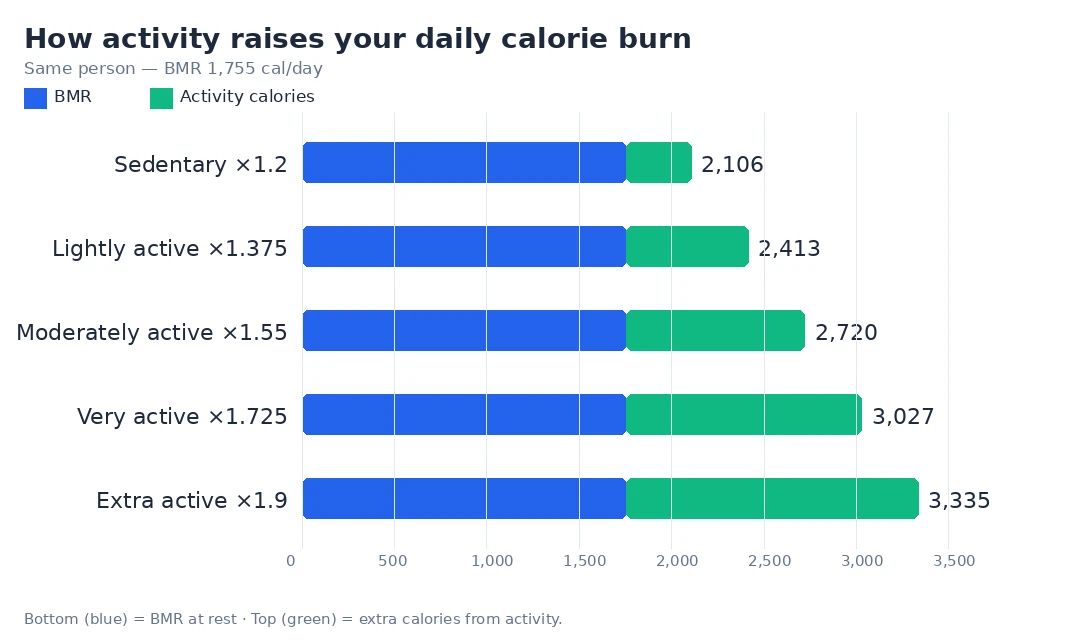
BMR is what you burn lying still. TDEE is what you burn in a full day: BMR plus walking, working, exercise and digesting food. The formula is simple: TDEE = BMR × activity multiplier.
| Activity level | Multiplier | In plain English | Example man's TDEE |
|---|---|---|---|
| Sedentary | ×1.2 | Mostly sitting, little exercise | 2,106 |
| Lightly active | ×1.375 | Light exercise a few days a week | 2,413 |
| Moderately active | ×1.55 | Moderate exercise most days | 2,720 |
| Very active | ×1.725 | Hard exercise most days | 3,027 |
| Extra active | ×1.9 | Very hard exercise or a physical job plus training | 3,335 |
Activity is the noisiest input
Your BMR comes from measurements. Your activity level comes from your own judgment, and that's where most of the error enters. Three gym sessions a week plus a desk job is not "very active."
If you're torn between two levels, pick the lower one. Then compare your actual weight trend over a few weeks and adjust.
Eating at your BMR is not a small deficit
For the example man, eating at his BMR means 1,755 calories against a 2,720 TDEE. That is a 965-calorie daily gap, about 35% below maintenance. By the usual 3,500-calorie rule it works out to nearly 2 lb a week, far more than the −500 setting.
The more active you are, the bigger that gap gets. Set goals from TDEE, not BMR. FitnessVolt also publishes a TDEE vs BMR explained page if you want another take.
Setting a calorie goal: deficits, macros and safe minimums
Goal offsets
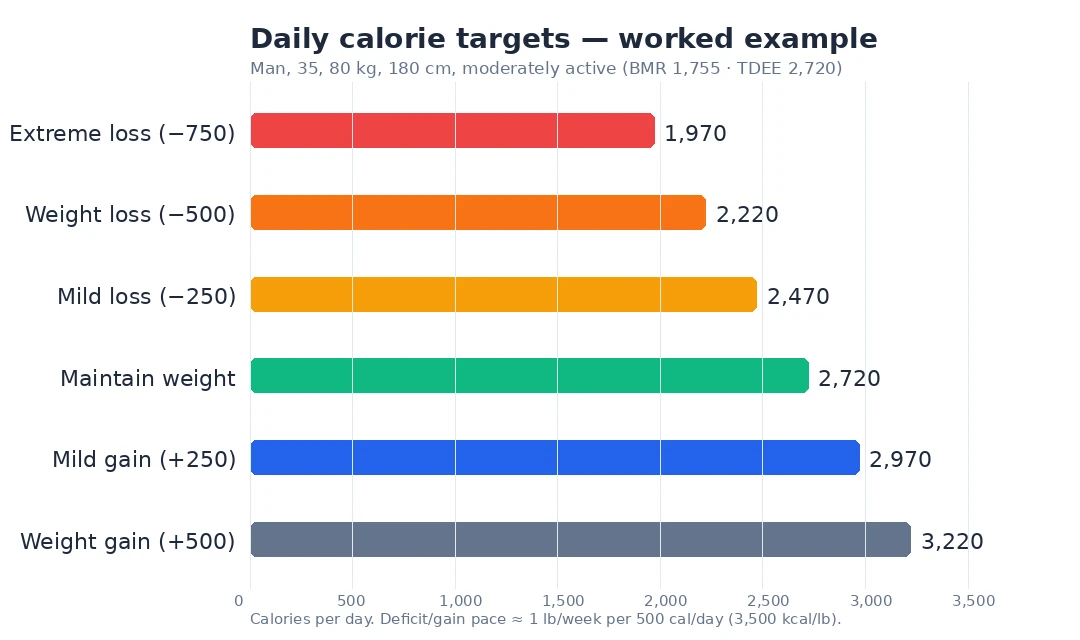
The calculator subtracts or adds a fixed number of calories to your TDEE. Here is the example man (TDEE 2,720):
| Goal | Offset | Daily target |
|---|---|---|
| Extreme loss | −750 | 1,970 |
| Loss | −500 | 2,220 |
| Mild loss | −250 | 2,470 |
| Maintain | 0 | 2,720 |
| Mild gain | +250 | 2,970 |
| Gain | +500 | 3,220 |
The 3,500-calorie rule, and its limits
A common rule of thumb says about 3,500 calories equals one pound of body weight. A 500-calorie daily deficit adds up to 3,500 a week, or roughly 1 lb. A 250-calorie deficit is about half a pound.
Real bodies are not perfectly linear. As you lose weight your TDEE drops, and your body can adapt by burning less. Treat the weekly projection as a guide, not a promise.
Macro math
Calories per gram: protein 4, carbs 4, fat 9. Each macro's grams = (target calories × its percentage) ÷ 100 ÷ calories per gram.
Example: the −500 target of 2,220 calories on the balanced 30/40/30 split (protein/carbs/fat).
- Protein: 2,220 × 30% = 666 calories ÷ 4 = 166.5, shown as 167 g.
- Carbs: 2,220 × 40% = 888 calories ÷ 4 = 222 g.
- Fat: 2,220 × 30% = 666 calories ÷ 9 = 74 g.
If you tweak a split by hand, you can use the percentage calculator to work out what share of your calories comes from protein. The presets are starting points, not personalized nutrition advice.
Safe minimums
The calorie calculator shows a safety warning if your target falls below 1,500 calories a day for men or 1,200 for women. Targets below those floors need medical supervision.
These tools also can't account for medical conditions, medications, pregnancy or metabolic adaptation.
These are estimates, not medical advice — if you have a medical condition, take medication, or are pregnant, talk to a clinician or dietitian before changing how you eat.
Frequently asked questions
How many calories should I eat per day to lose weight?
Subtract 250 to 500 calories from your TDEE, which usually works out to about half a pound to one pound of loss per week. For a 35-year-old man with a TDEE of 2,720, a 500-calorie deficit means 2,220 calories a day.
What is the difference between BMR and TDEE?
BMR is the energy your body uses at complete rest. TDEE is BMR multiplied by an activity factor to cover your whole day. In the example, a BMR of 1,755 calories becomes a TDEE of 2,720 at a moderately active ×1.55.
Which BMR formula is most accurate?
No single formula is right for everyone; all three are population estimates, typically within ±10% of lab-measured BMR. Mifflin-St Jeor is the default here because it needs only age, sex, height and weight, while Katch-McArdle can suit you if you know your body fat percentage reliably.
How do I calculate my macros in grams?
Multiply your calorie target by each macro's percentage, then divide by calories per gram: 4 for protein and carbs, 9 for fat. At 2,220 calories on a 30/40/30 split, that gives 167 g protein, 222 g carbs and 74 g fat.
Why am I not losing weight eating at my BMR?
A stall usually comes from tracking errors, an overstated activity level, or metabolic adaptation rather than the BMR number itself. Eating at BMR is already a large deficit for most active people, so recheck your logging and inputs before cutting further.