Paint Calculator: How Much Paint Does Your Room Need?
Enter your room's size, the doors and windows, and how many coats you plan to apply. This free paint calculator works out the paintable wall area, the exact gallons needed, and how many gallons to buy — rounded up so you never run short.
Formulas verified against standard finance references. Calculator logic tested with verified worked examples. Last reviewed: October 2026. Our methodology
How the paint math works
The estimate runs on four pieces of arithmetic. Measure the room, subtract what you will not paint, then convert the square footage into gallons using the coverage printed on the can.
- Wall area: 2 × (length + width) × ceiling height. A rectangular room has four walls; this totals them all.
- Openings: doors × 20 sq ft + windows × 15 sq ft. An average interior door covers about 3 × 6.8 feet, an average window about 3 × 5 feet.
- Paintable area: wall area − openings (+ length × width if you are painting the ceiling too).
- Gallons needed: paintable area × coats ÷ coverage per gallon. Then round up to whole gallons, because stores do not sell fractions of a can.
- Quarts equivalent: gallons to buy × 4. Useful when a project needs less than one full gallon.
Worked example
Take a room that is 12 × 15 feet with an 8-foot ceiling, one door, two windows, one coat of paint, and a coverage of 350 sq ft per gallon.
- Wall area: 2 × (12 + 15) × 8 = 432 sq ft
- Openings: 1 × 20 + 2 × 15 = 50 sq ft
- Paintable area: 432 − 50 = 382 sq ft
- Gallons needed: 382 ÷ 350 = 1.091 gallons
- Gallons to buy: round 1.091 up = 2 gallons (8 quarts)
You would buy 2 gallons, not 1.091, since paint is sold by the whole can. The extra becomes your touch-up supply.
How to use the paint calculator
Measure with a tape measure at floor level — do not guess. Measure each wall's length, the room's width, and the ceiling height in feet, then follow these steps.
Step by step
- Enter the room length, width and ceiling height in feet. These three are required.
- Count the doors and windows. Defaults are 1 door and 2 windows; each door subtracts 20 sq ft and each window 15 sq ft.
- Set the number of coats. The default is 2, the standard for a fresh color change.
- Set the paint coverage from your paint can label. The default of 350 sq ft per gallon works for most interior latex paints.
- Choose whether to include the ceiling. Ceiling paint adds length × width to the paintable area.
- Press Calculate. Read the paintable area, exact gallons needed, gallons to buy, and the quart equivalent underneath.

How much area does one gallon of paint cover?
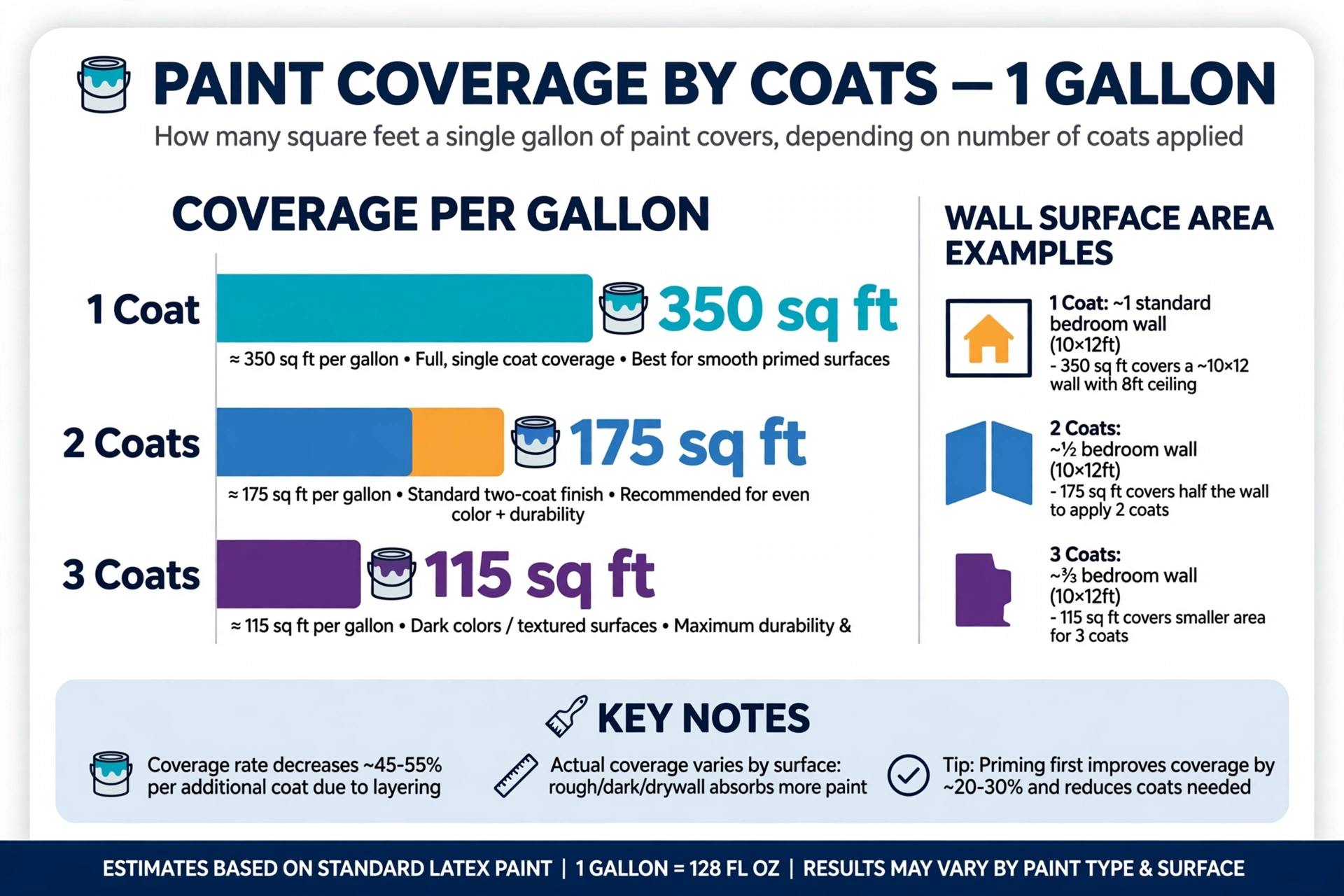
Coverage is printed on every paint can and its technical data sheet, usually as a range. The number that matters is the coverage of the paint you actually bought — but if the can is not in your hands yet, these manufacturer-typical ranges are a safe starting point.
| Paint and surface | Typical coverage per gallon | Notes |
|---|---|---|
| Interior latex, smooth or previously painted walls | 350–400 sq ft | The default 350 sits at the safe end of this range |
| Interior latex, textured or porous walls | 250–350 sq ft | Rough surfaces drink more paint; premium lines like Benjamin Moore Aura still sit around 350–400 |
| Ceiling paint | 350–400 sq ft | Flat sheen hides imperfections, so one or two coats is enough |
| Primer | ~400 sq ft | Bare drywall and patched spots should be primed first |
The safest move is to type the number from your own can's label into the calculator. Manufacturer figures depend on surface texture, porosity, sheen and application method, and thick-film paints cover less per gallon by design.
Once you know the gallon count, the project becomes a shopping trip. A budget calculator helps you fit the paint, primer, rollers and tape into a single project budget before you buy anything. For a deeper look at published coverage figures, see this Benjamin Moore paint cost guide, which lists coverage on smooth versus textured walls.
Doors, windows and coats: the three variables that matter
Room size sets the baseline, but three choices move the answer most: how many doors and windows you subtract, how many coats you apply, and whether the ceiling joins the project.
Standard opening areas
| Opening | Typical size | Area subtracted |
|---|---|---|
| Interior door | 3 × 6.8 ft | 20 sq ft |
| Average window | 3 × 5 ft | 15 sq ft |
| Closet door (sliding) | 4 × 6.8 ft | ~27 sq ft — count as one door plus a bit extra |
Coats
One coat covers a touch-up or a same-color refresh on walls in good shape. Two coats is the professional standard for a color change — the first coat builds hide, the second builds depth and durability. A third coat is rarely needed unless you are covering a dark color with a light one, and each coat adds the full paintable area to the gallons calculation, so it is the biggest lever you control.
Ceilings
Painting the ceiling adds length × width in one step. A 12 × 15 room gains 180 sq ft — at two coats and 350 coverage that is roughly one extra gallon on its own. If the ceiling just needs freshening, it takes fewer coats than the walls, so consider calculating it as a separate project.
Tips for buying the right amount
The calculator rounds up for a reason: paint is sold in whole gallons, and a mid-project store run breaks the workflow. A few habits keep the estimate honest.
- Buy the rounded-up number, not the exact number. That 1.091 gallons becomes 2 gallons — the spare quart or so is your touch-up supply for years.
- Add 10% if the walls are textured or damaged. The calculator uses the exact math; your walls may drink a little more than the label promises.
- Prime bare drywall and patches first. Primer is cheaper per gallon than topcoat and stops thirsty spots from flashing through the finish. Coverage figures for primers and topcoats differ — one paint coverage reference compiles the current manufacturer data sheets side by side.
- Keep one unopened can sealed. Stores accept returns of unopened cans, so slight overbuying costs nothing if the plan stays flexible.
- Write the formula on the can. Brand, line, sheen and color code — touch-ups two years from now need the exact mix.
- Mind the recoat time. Most latex paints are dry to the touch in an hour and ready for the second coat in 1–2 hours; rushing it ruins the finish. If you are scheduling the job, a time duration calculator helps you plan coat spacing and drying windows across rooms.
Frequently asked questions
How do you calculate how much paint you need for a room?
Calculate the wall area as 2 × (length + width) × ceiling height, subtract about 20 sq ft per door and 15 sq ft per window, then divide by the paint coverage in sq ft per gallon and multiply by the number of coats. Round the result up to whole gallons. For a 12 × 15 room with an 8-foot ceiling, 1 door, 2 windows and 1 coat at 350 coverage, that is (432 − 50) ÷ 350 = 1.091 gallons, so you buy 2 gallons.
How many square feet does a gallon of paint cover?
Most interior latex paints cover 350 to 400 sq ft per gallon on smooth, previously painted walls. Textured or porous walls drop to roughly 250 to 350 sq ft per gallon, and ceiling paint covers about 350 to 400 sq ft per gallon. Always use the coverage printed on your paint can label for the final number.
Should I subtract doors and windows when calculating paint?
Yes. Subtract about 20 sq ft for each standard interior door and about 15 sq ft for each average window. In a typical bedroom this removes 50 to 80 sq ft — enough to change the answer by a quart or more. The spare paint becomes your touch-up supply.
How many coats of paint should I apply?
Two coats is the standard for a color change: the first coat builds hide and the second builds depth and durability. One coat is enough for a same-color refresh on walls in good shape. Each extra coat adds the full paintable area to your gallons, so coat count is the biggest lever on the estimate.
How much extra paint should I buy?
Buy the rounded-up whole-gallon number the calculator gives you. Rounding up is already the buffer — it guarantees you will not run out mid-coat. If your walls are textured or damaged, add about 10 percent on top before rounding. Keep one sealed can for touch-ups; unopened cans can usually be returned.
Do I need primer too?
Prime bare drywall, patched spots and drastic color changes before painting. Primer is cheaper per gallon than topcoat and stops thirsty spots from flashing through the finish. This calculator covers topcoat only — calculate primer separately at about 400 sq ft per gallon.
How much paint do I need for the ceiling?
Ceiling paintable area is simply length × width. A 12 × 15 room adds 180 sq ft, which at 2 coats and 350 sq ft per gallon is about 1.03 gallons — roughly one extra gallon. Select the ceiling option in the calculator and it adds this area automatically.