Budget Calculator: Plan Your Monthly Budget
A budget is simply a plan for your money: what comes in, what goes out, and what is left over. Enter your monthly take-home income and your spending across the categories below, and this free budget calculator will total your expenses, show your leftover cash, calculate your savings rate, and compare your spending to the popular 50/30/20 rule.
Formulas verified against standard finance references. Calculator logic tested with verified worked examples. Last reviewed: October 2026. Our methodology
How the budget math works
A budget runs on simple arithmetic. Add up everything you spend in a month, subtract it from your take-home income, and the result — positive or negative — tells you whether your plan works.
- Total expenses: the sum of every category you enter, including savings. Paying yourself first is still money leaving the spending pool.
- Leftover: monthly income − total expenses. A positive number is a surplus you can save or redirect; a negative number is a shortfall to fix.
- Category share: category amount ÷ monthly income × 100, so each expense shows up as a slice of your pay.
- Savings rate: monthly savings ÷ monthly income × 100. This is the number financial planners watch most closely.
Sources: Consumer Financial Protection Bureau — budgeting guidance; Federal Trade Commission (consumer.gov) — budget worksheet.
Worked example
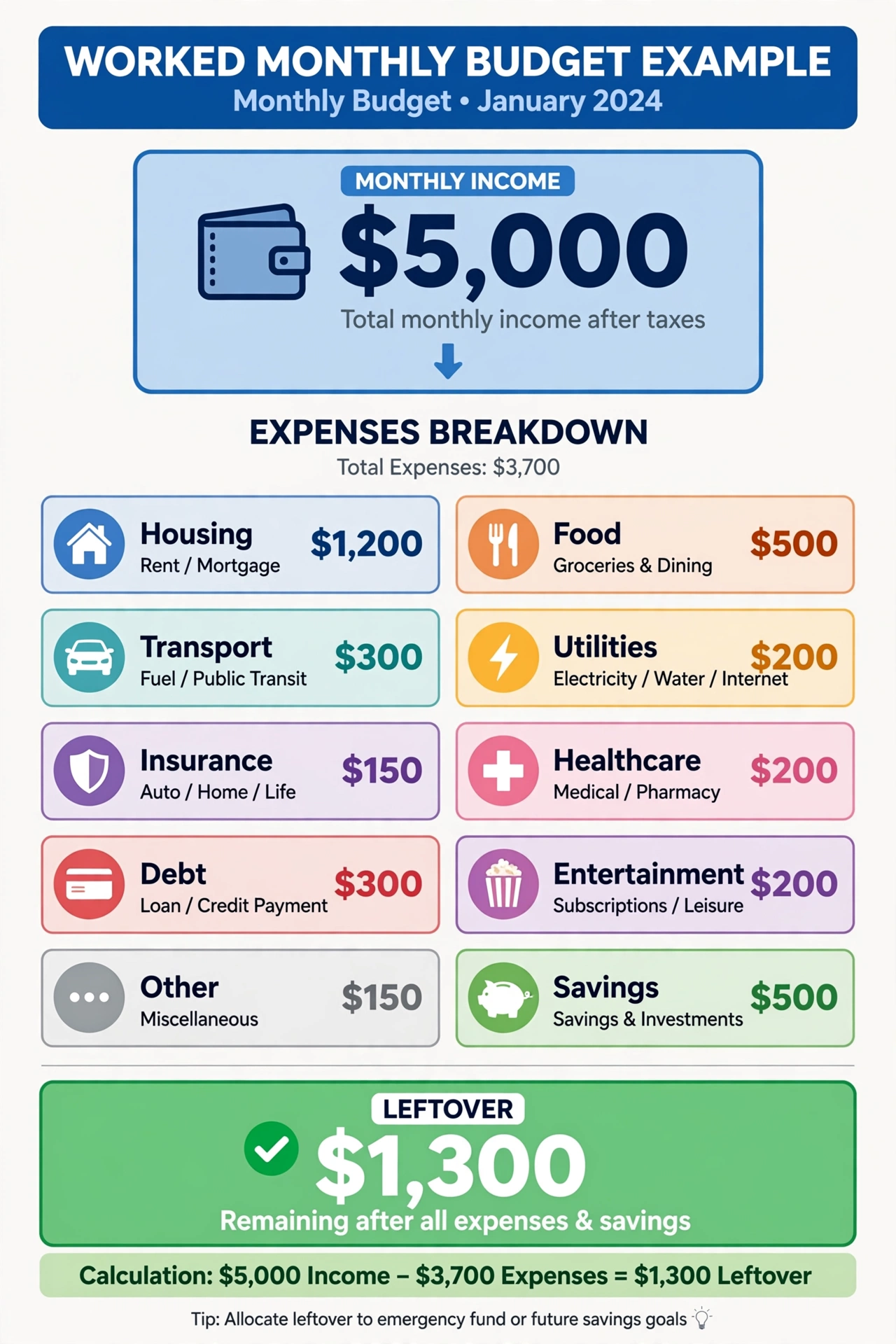
Take a monthly take-home income of $5,000. Suppose the expenses are: housing $1,200, food $500, transportation $300, utilities $200, insurance $150, healthcare $200, debt payments $300, entertainment $200, and other expenses $150 — a total of $3,200 — plus $500 of planned savings. Total allocated is $3,700, so the leftover is $5,000 − $3,700 = $1,300. The savings rate is $500 ÷ $5,000 × 100 = 10%.
Grouped for the 50/30/20 check: needs are housing, transportation, food, utilities, insurance, healthcare and debt payments — $2,850, or 57% of income. Wants are entertainment and other — $350, or 7%. Savings are $500, or 10%. That is $150 above the 50% needs target, with $1,300 still unallocated — a healthy position with room to raise savings.
How to use the budget calculator
Use your take-home pay — the amount that actually lands in your account after taxes and deductions — not your gross salary. Then work through each expense group with your best estimate of a typical month.
Step by step
- Enter your monthly take-home income. If your pay varies, use a conservative average of the last three months.
- Fill in each expense category. Leave any category at zero if it does not apply to you.
- Enter your planned monthly savings. Treat it as a fixed bill to yourself, not as whatever happens to be left.
- Press Calculate. Read your leftover, savings rate, the per-category breakdown and the 50/30/20 comparison underneath.
The 50/30/20 rule, explained
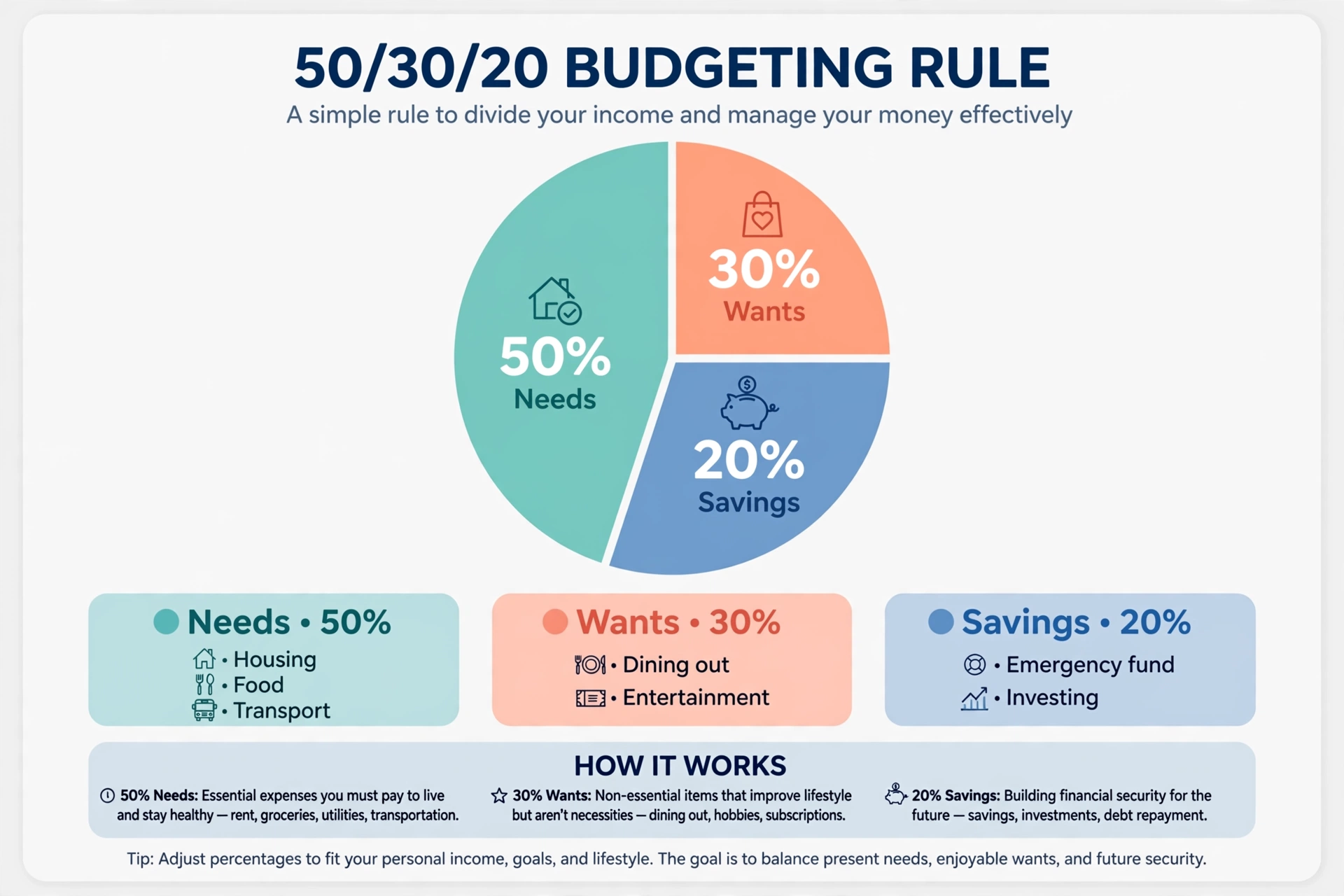
The 50/30/20 rule, popularized by Senator Elizabeth Warren in the book All Your Worth, is a starting framework: about 50% of after-tax income for needs, 30% for wants, and 20% for savings and extra debt payments. It is a guideline, not a law — households in expensive cities often spend more than 50% on needs, and that is fine as long as the overall math still balances.
| Slice | Target | What counts |
|---|---|---|
| Needs | 50% | Housing, utilities, groceries, transport, insurance, minimum debt payments, healthcare |
| Wants | 30% | Dining out, entertainment, hobbies, subscriptions, shopping beyond the basics |
| Savings | 20% | Emergency fund, retirement accounts, investments, extra debt payoff |
If the 20% savings slice looks out of reach today, start smaller: a savings goal calculator turns an abstract percentage into a concrete monthly amount for a specific target, which is far easier to commit to.
Where budgets usually break
Most budgets fail in the same few places. Small recurring charges are the classic leak: subscriptions, delivery fees and ride-shares that each feel trivial but quietly add up to hundreds a month. The second is irregular bills — car insurance paid twice a year, holiday spending, annual memberships — that ambush a month planned only for regular expenses.
| Category | Typical range | Watch for |
|---|---|---|
| Housing | 25–35% of take-home | Above 35% every month is a red flag for most households |
| Transportation | 10–15% | Car payment plus insurance, fuel and maintenance together |
| Food | 10–15% | Groceries plus dining out combined, not separately |
| Savings | 10–20% | Aim for 20%; start lower and raise it gradually |
| Debt payments | Under 10% | Minimum payments only — extra payoff counts as savings |
The Consumer Financial Protection Bureau publishes free budgeting worksheets and a spending tracker that pair well with this calculator when you want to compare your actual spending against the plan.
Making the budget stick
A budget you never look at is just a wish. Review yours once a month, move the savings transfer to payday so it happens automatically, and give every leftover dollar a job before the month starts rather than after it ends.
- Automate savings. A transfer that happens on payday cannot be spent first.
- Review monthly, not daily. One calm review beats constant worrying.
- Trial every cut for one month. Cancel, cook, or carpool for 30 days and keep only the cuts you did not miss.
- Keep a small buffer. Budget $50–$100 as miscellaneous so surprises do not break the plan.
Once the monthly budget balances, the next question is what the surplus should do. A retirement calculator shows how even modest monthly savings compound into serious money over decades.
Frequently asked questions
What is a budget?
A budget is a plan for your money over a set period, usually a month. It lists your expected income, your planned spending by category, and what should be left over. Its job is to make sure spending and saving happen on purpose instead of by accident.
How do you calculate a monthly budget?
Add up your monthly take-home income, then add up every expense category — housing, food, transport, utilities, insurance, healthcare, debt payments, entertainment, other, and savings. Subtract total expenses from income. The result is your leftover: positive means a surplus, negative means a shortfall.
What is the 50/30/20 rule?
The 50/30/20 rule suggests dividing after-tax income into roughly 50% for needs (housing, food, transport, bills), 30% for wants (dining out, entertainment, hobbies), and 20% for savings and extra debt payments. It is a starting guideline, not a strict law — adjust it to your cost of living.
What is a good savings rate?
Financial planners commonly suggest saving around 20% of take-home pay, including retirement contributions and extra debt payments. If that is out of reach, any consistent rate beats none — start at 5–10% and raise it each time your income grows.
Should I budget with gross or take-home income?
Use take-home income — the amount that actually reaches your account. Budgeting with gross salary overstates what you can spend, because taxes and deductions are already spoken for before you see the money.
What should I do if my expenses are higher than my income?
First, separate needs from wants and cut wants temporarily. Next, look for one big win — housing and transport are usually the largest levers. If the shortfall persists after trimming, the income side needs attention: overtime, a raise, or additional income.
How often should I update my budget?
Review it once a month and rebuild it whenever something structural changes — a new rent, a new job, a new debt, or a new savings goal. A budget that does not reflect your current life stops being useful.
Related calculators
Savings Goal Calculator
Set a savings target and find the monthly amount needed to reach it.
Use calculator
Retirement Calculator
Project how your savings grow into retirement over time.
Use calculator
Emergency Fund Calculator
Find the emergency fund size that fits your monthly expenses.
Use calculator