Retirement Calculator: How Much Will You Have?
Estimate your retirement nest egg in seconds. Enter your current age, savings, monthly contribution and expected return to see your projected total, its value in today's dollars, and your estimated monthly retirement income. Free, private, no sign-up needed.
How the retirement calculator works
Enter six numbers and the calculator projects your retirement savings using compound growth. It assumes your monthly contributions grow at a steady annual return, compounded monthly, until your retirement age.
The results show four things: your total savings at retirement, what that amount is worth in today's dollars (after inflation), how much came from your contributions versus investment growth, and your estimated monthly retirement income using the 4% safe withdrawal rule.

The formula behind the calculation
The calculator uses the future value formula for compound interest with regular contributions:
Future value = current savings x (1 + r)^n + monthly contribution x (((1 + r)^n - 1) / r)
Where r is the monthly return (annual return / 12 / 100) and n is the total number of months until retirement. The "today's dollars" figure divides the future value by (1 + inflation rate)^years to remove the effect of rising prices. To explore compounding on its own, try the compound interest calculator, which shows how any lump sum grows over time.
Worked example: Age 30, retiring at 65, $10,000 saved, $500/month, 7% return, 3% inflation. Over 35 years (420 months), the $10,000 grows to about $115,062 and the monthly contributions grow to about $900,527 — a total of roughly $1,015,589. In today's dollars that is about $360,923, and the 4% rule suggests roughly $3,385/month of retirement income.
Retirement savings benchmarks by age
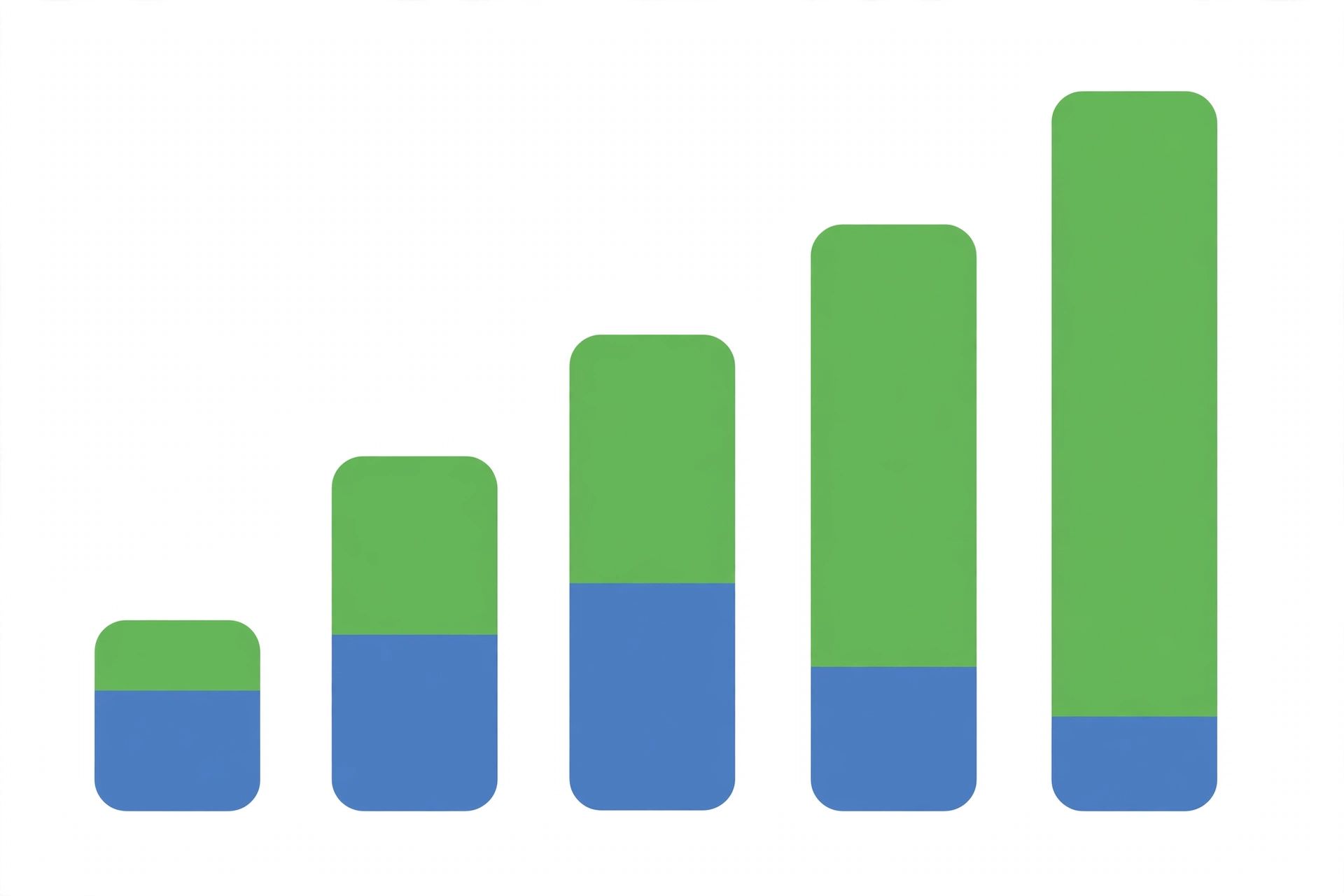
Financial planners often suggest saving a multiple of your annual income by certain ages. These income-multiple benchmarks are published by Fidelity in their retirement savings guidelines. They are common targets, not rules — your situation may differ. Not sure what your income multiple looks like? The salary calculator converts your pay between hourly, monthly, and annual figures so you can find your number.
| Age | Suggested savings | Example at $60,000 income |
|---|---|---|
| 30 | 1x annual income | $60,000 |
| 40 | 3x annual income | $180,000 |
| 50 | 6x annual income | $360,000 |
| 60 | 8x annual income | $480,000 |
Behind on these numbers? Do not panic. Increasing your monthly contribution, even by a small amount, compounds dramatically over time. Try raising your contribution in the calculator above to see the effect.
The power of starting early
Starting five years earlier can be worth hundreds of thousands of dollars, even with the same monthly contribution. Here is what $500/month at 7% return grows to by age 65:
| Start age | Years saving | Total contributed | Value at 65 |
|---|---|---|---|
| 25 | 40 | $240,000 | $1,279,768 |
| 30 | 35 | $210,000 | $900,527 |
| 35 | 30 | $180,000 | $609,985 |
| 40 | 25 | $150,000 | $393,722 |
Starting at 25 instead of 35 costs an extra $60,000 in contributions but produces about $670,000 more at retirement. Time in the market beats timing the market.
5 tips to boost your retirement savings
- Capture the full employer match. If your employer matches 401(k) contributions, contribute at least enough to get the full match — it is an instant 50-100% return. Annual contribution limits apply, so check the current IRS cap when planning.
- Increase contributions with every raise. Save half of each pay increase. You will not feel the difference in your paycheck, but your future self will.
- Keep fees low. A 1% annual fee can erase hundreds of thousands over 30 years. Prefer low-cost index funds where available.
- Do not cash out when changing jobs. Rolling your balance into a new account preserves decades of compounding. Cashing out triggers taxes, penalties, and lost growth.
- Revisit your plan yearly. Run this calculator once a year with updated numbers. Small course corrections early beat big sacrifices late.
Small, consistent increases beat occasional big jumps. Automating a yearly 1% contribution increase is one of the simplest ways to stay on track without lifestyle shock.
Frequently asked questions
How much should I have saved for retirement by age 40?
A common benchmark is 3 times your annual income by 40. At a $60,000 salary, that is about $180,000. These are guidelines, not requirements — consistent saving matters more than hitting an exact multiple.
What is a good annual return to assume?
For a stock-heavy portfolio, 6-8% per year is a common long-term planning assumption, based on long-run historical stock market returns. More conservative portfolios (more bonds) might use 4-5%. Using 7% is a reasonable middle ground for illustration — but remember past performance does not guarantee future results.
What is the 4% rule?
The 4% rule suggests withdrawing 4% of your savings in the first year of retirement, then adjusting for inflation each year after. It comes from widely cited historical market research on safe withdrawal rates. It is a rule of thumb, not a guarantee — actual safe withdrawals depend on market conditions and your lifespan. Vanguard publishes retirement withdrawal guidance worth reviewing before you plan around it.
How does inflation affect my retirement savings?
Inflation erodes purchasing power. At 3% annual inflation, $1,000,000 in 35 years buys what about $355,000 buys today. This calculator shows both the nominal total and the inflation-adjusted "today's dollars" value so you see the real picture.
Is $1 million enough to retire?
It depends on your spending. Using the 4% rule, $1 million supports about $40,000 per year ($3,333/month) before taxes. If your retirement expenses are below that and you have other income like Social Security or a pension, $1 million can be enough. Add your estimated Social Security benefit to your projected income for a fuller picture.
Should I include my employer match in monthly contributions?
Yes. Enter your total monthly savings including the employer match, since that money also compounds in your account. For example, if you contribute $400 and your employer adds $200, enter $600.
What if I start saving late?
Starting late means you need to save more each month to reach the same goal, but it is still worth it. Someone starting at 45 with $1,000/month at 7% can still build over $500,000 by 65. The "cost of waiting" section in your results shows exactly what delay costs.
Related calculators

Compound Interest Calculator
See how your savings grow with compounding interest over time.
Use calculatorSalary Calculator
Convert pay between hourly, weekly, biweekly, monthly and annual - plus your overtime rate.
Use calculatorLoan EMI Calculator
Estimate your monthly loan payment from amount, rate and term.
Use calculator