Emergency Fund Calculator: Find Your Savings Target
An emergency fund is cash set aside for true surprises — a job loss, a medical bill, an urgent car repair. Enter your monthly essential expenses and how many months of coverage you want, and this emergency fund calculator gives you a clear savings target, shows how much you still need to save, and tracks your funded percentage.
The emergency fund formula
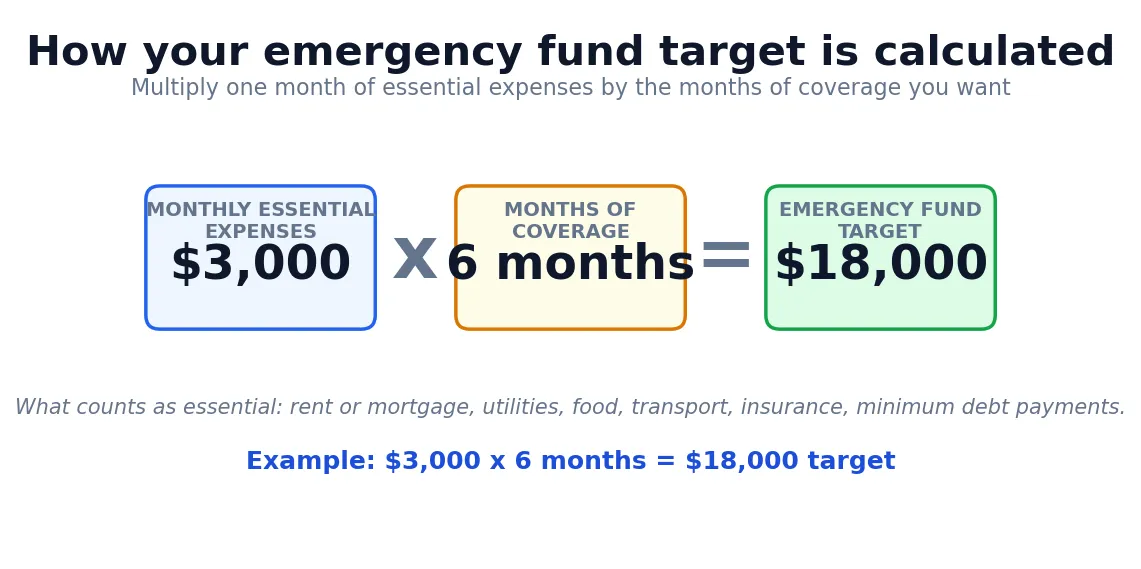
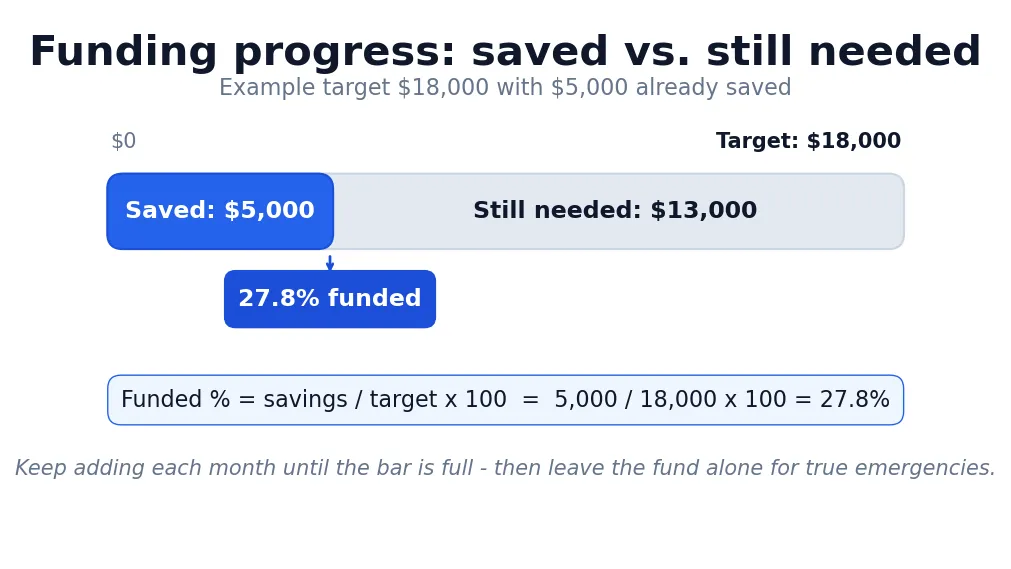
Your target is one month of essential expenses multiplied by the months of coverage you want. What you still need is the target minus what you have already saved (never less than zero), and your funded percentage is your savings divided by the target.
- Target = monthly essential expenses × months of coverage
- Still needed = target − current savings (minimum 0)
- Funded % = current savings ÷ target × 100
Worked example
Take $3,000 of monthly essential expenses and a 6-month coverage goal. The target is $3,000 × 6 = $18,000. If you already have $5,000 saved, you still need $18,000 − $5,000 = $13,000, and you are $5,000 ÷ $18,000 × 100 = 27.8% funded.
How to use the emergency fund calculator
The calculator needs three numbers. Getting the first one right matters most: your monthly essential expenses are the bills you must pay even if your income stopped tomorrow.
Step by step
- Add up one month of essential expenses. Include rent or mortgage, utilities, groceries, transport, insurance premiums and minimum debt payments. Leave out dining out, subscriptions and shopping.
- Choose your months of coverage. Six months is the default and suits most households; pick 3 if your income is very stable, 9 or 12 if it is not.
- Enter your current emergency savings. Count only money you could reach within a few days. Leave it at 0 if you are starting from scratch.
- Press Calculate. You get your target, how much is still needed, your funded percentage and how many months your current savings would cover.
What counts as essential
Essential means survival, not comfort. A $200 streaming and subscription stack is not essential; the $1,500 rent payment is. When in doubt, ask: would skipping this bill for three months cause real harm? If yes, it belongs in the total.
People often overestimate here because they use total spending instead of essential spending. Using the leaner number gives you a target you can actually reach — and a fund that covers what matters.
How many months should you save?
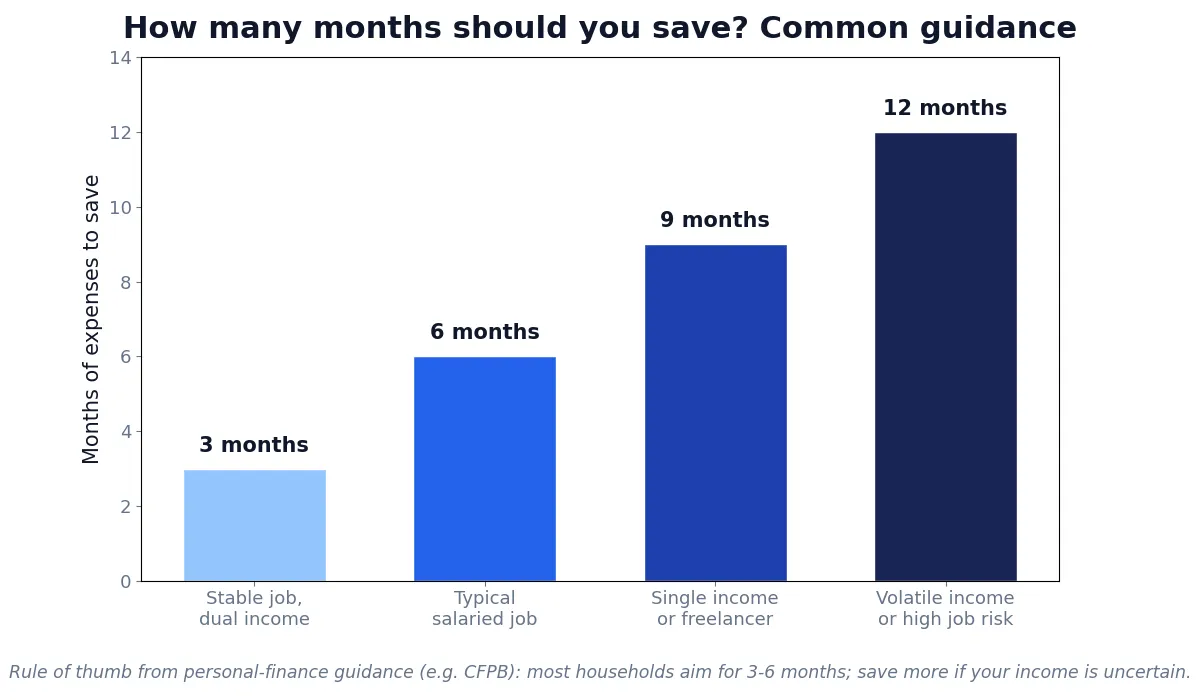
The widely repeated guidance is 3 to 6 months of essential expenses. The right number for you depends on how quickly you could replace lost income. The Consumer Financial Protection Bureau suggests tailoring the goal to your situation rather than chasing a single number — see their essential guide to building an emergency fund for strategies by circumstance.
Recommended months by situation
| Your situation | Suggested coverage | Why |
|---|---|---|
| Stable job, dual income | 3 months | Two earners and steady work make long income gaps unlikely |
| Typical salaried job | 6 months | The standard recommendation for most households |
| Single income or freelancer | 9 months | One income stream means one point of failure |
| Volatile income or high job risk | 12 months | Irregular pay needs a bigger buffer between good months |
When the standard advice does not fit
These are rules of thumb, not requirements. If you have high fixed costs like a large mortgage, lean toward the higher end. If you could move in with family in a crisis, the lower end may be honest. What matters is that the number reflects your real life, not someone else's.
A smaller fund you actually build beats a perfect fund you never start. If 6 months feels impossible, start with a one-month starter fund and expand it from there.
Build your fund with a monthly plan
A target only helps if it turns into a habit. Divide your "still needed" number by a monthly amount you can sustain, and you get a finish date. Saving $500 a month toward a $13,000 gap, for example, closes it in 26 months.
Example: where the $3,000 monthly number comes from
| Expense | Monthly amount |
|---|---|
| Rent or mortgage | $1,500 |
| Utilities (power, water, internet, phone) | $200 |
| Groceries | $600 |
| Transport (fuel, transit, insurance) | $300 |
| Health and other insurance | $200 |
| Minimum debt payments | $200 |
| Total essential expenses | $3,000 |
Make the saving automatic
The most reliable method is an automatic transfer on payday, before the money can be spent. Even $100 a month builds the habit, and you can raise it when income rises. Windfalls — tax refunds, bonuses, cash gifts — are good accelerants: send at least half straight to the fund.
If you are juggling several goals at once, such as a vacation and a house deposit alongside the emergency fund, a savings goal calculator can split one monthly amount across multiple targets so the emergency fund still gets its share.
Rebuild after you use it
Using the fund is not failure — that is what it is for. After a withdrawal, treat rebuilding as the top savings priority until you are back at your target. Pause optional goals first; the safety net comes before the nice-to-haves.
Where to keep your emergency fund
An emergency fund must be reachable within days and must not lose value when markets fall. That rules out stocks, crypto and long lock-in deposits. The usual answer is a separate savings account — ideally a high-yield one — that you can access without fees or penalties.
Good places for the money
- High-yield savings account. Earns interest, federally insured in the US up to applicable limits, and reachable in a day or two.
- Money market account. Similar safety and access, sometimes with check-writing.
- A second checking account. Works if you want instant access, though it usually earns little or no interest.
Keep it separate from daily money
Put the fund in its own account, not mixed with bill money. Separation has two benefits: you always know exactly how funded you are, and you are less tempted to borrow from it for non-emergencies. Name the account "Emergency fund" so every login reminds you of its job.
Do not raid long-term savings
Without an emergency fund, a surprise bill often gets paid from the worst possible source — a credit card at high interest, or retirement savings with taxes and penalties attached. Keeping the safety net intact protects the compounding on your long-term plans, which is why a retirement calculator assumes that money stays invested for decades. Build the emergency fund first, then leave both accounts alone to do their jobs.
Frequently asked questions
How much should I keep in an emergency fund?
Common personal-finance guidance is 3 to 6 months of essential monthly expenses. Save 3 months if your job is stable and your household has two incomes, 6 months for a typical salaried job, and 9 to 12 months if you are a freelancer, a single earner, or your income is volatile. Use the calculator above with your own numbers rather than someone else's rule.
What counts as an essential monthly expense?
Essential expenses are the bills you must pay even with no income: rent or mortgage, utilities, groceries, transport, insurance premiums and minimum debt payments. Dining out, subscriptions, shopping and entertainment are not essential. Using the leaner essential total gives you a target you can actually reach.
Where should I keep my emergency fund?
In a separate, easily reachable account — usually a high-yield savings account or money market account you can access within a few days without fees or penalties. Do not keep it in stocks, crypto or long lock-in deposits, where it can lose value or be hard to reach exactly when you need it.
Should I pay off debt or build an emergency fund first?
Do both in stages, a widely recommended order: first save a small starter fund of about one month of expenses, then attack high-interest debt, then expand the fund to your full target. The starter fund stops the next surprise from going straight onto a credit card while you pay debt down.
How long will it take to reach my target?
Divide your still-needed amount by what you can save each month. If you need $13,000 more and save $500 a month, that is 26 months. Automatic transfers on payday make the timeline real — the calculator shows your funded percentage so you can watch progress month to month.
What counts as a real emergency?
A real emergency is urgent, unexpected and necessary: job loss, a medical bill, an urgent car or home repair. A sale, a vacation, holiday gifts and predictable bills like annual insurance are not emergencies. If you can plan for it, save for it separately instead of touching the fund.
What should I do when my fund reaches 100%?
Stop adding to it and redirect that monthly amount to your next goal — investing, extra debt payments or a specific savings target. Keep the fund itself intact in its separate account, and rebuild it as your top priority any time you have to draw from it.