Savings Goal Calculator: Your Monthly Savings Plan
Find out exactly how much to save each month to hit your savings target — with your starting balance, interest rate and deadline factored in.
How the savings goal calculator works
A savings goal calculator works backward from your target: it takes the amount you want to have, subtracts what your current savings will grow to, and spreads the rest over equal monthly deposits. Enter four numbers — your goal, what you have saved now, the annual interest rate, and how many years you have — and it tells you the monthly amount to save.
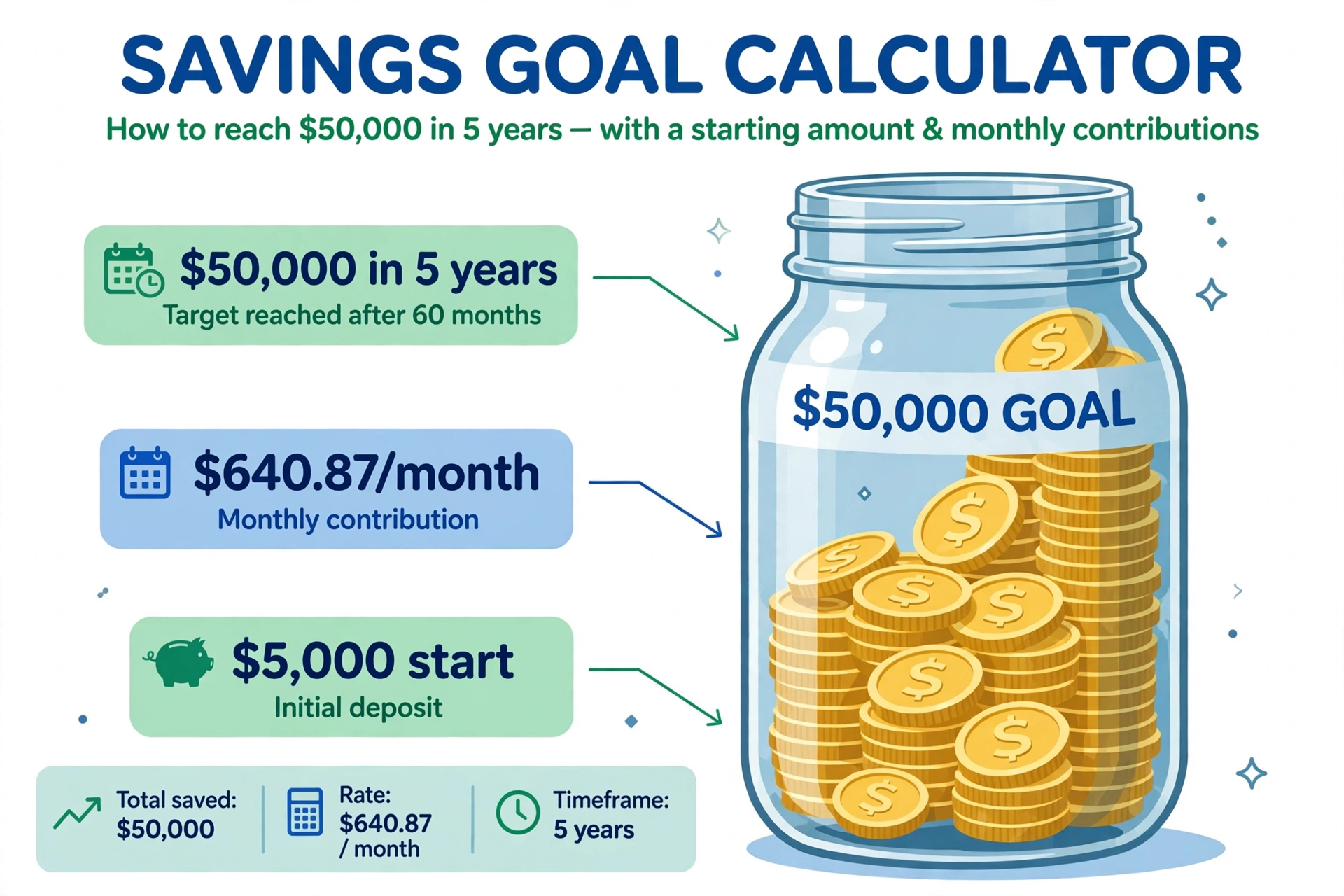
The calculator assumes you deposit the same amount at the end of every month and that interest compounds monthly at a fixed rate. That keeps the math transparent: the same inputs always give the same plan.
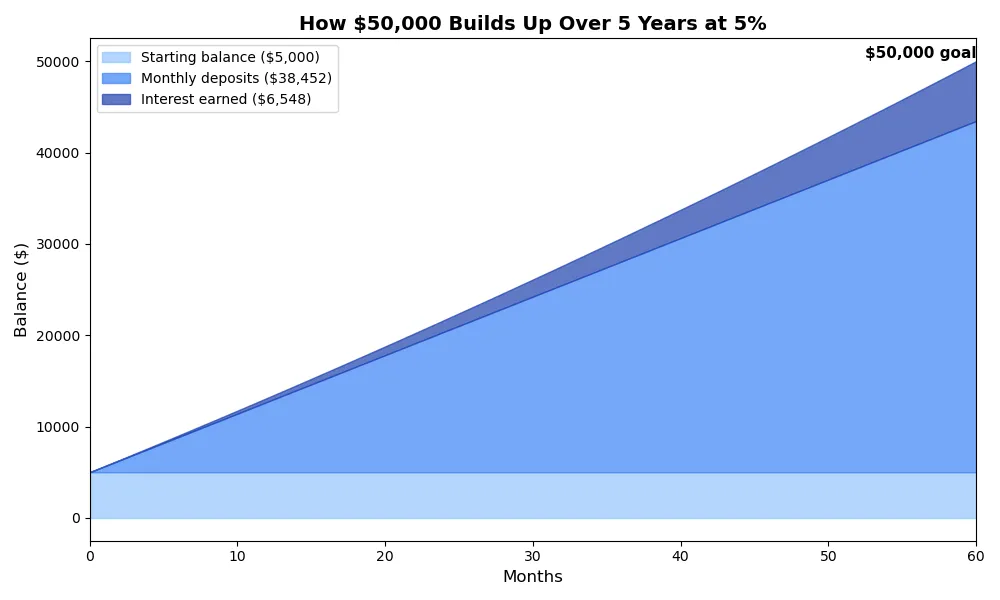
Interest does real work in this plan. At a 5% annual rate, a $50,000 goal over five years needs about $640.87 a month from a $5,000 start — less than the $750 a month you would need with no interest at all. To see how interest compounds on its own, try our compound interest calculator.
The savings goal formula
The monthly deposit comes from the future value of an annuity formula, rearranged to solve for the payment:
PMT = (FV − PV × (1 + r)n) × r ÷ ((1 + r)n − 1)
| Symbol | Meaning | Example |
|---|---|---|
| PMT | Monthly deposit needed | $640.87 |
| FV | Your savings goal | $50,000 |
| PV | Current savings | $5,000 |
| r | Monthly interest rate (annual ÷ 12) | 0.004167 |
| n | Number of months | 60 |
The formula first grows your current savings to the end date — PV × (1 + r)n — then computes the monthly deposits whose future value covers the remaining gap. If the rate is 0%, it simply divides the gap by the number of months.
The US Securities and Exchange Commission publishes free savings goal worksheets that use the same annuity math, which is a good cross-check for any result here.
Worked example
Goal: $50,000 in 5 years, starting with $5,000, at 5% annual interest compounded monthly.
- Monthly rate: r = 0.05 ÷ 12 = 0.004167; months: n = 60
- Current savings grow to: 5,000 × (1.004167)60 = $6,416.79
- Remaining gap: 50,000 − 6,416.79 = $43,583.21
- Monthly deposit: 43,583.21 × 0.004167 ÷ ((1.004167)60 − 1) = $640.87
| Component | Amount |
|---|---|
| Starting savings | $5,000.00 |
| Monthly deposits (60 × $640.87) | $38,452.33 |
| Interest earned | $6,547.67 |
| Total at 5 years | $50,000.00 |
How your interest rate changes the plan
The same $50,000 goal with $5,000 saved and 5 years to go needs very different monthly deposits depending on the rate:
| Annual rate | Monthly deposit | Interest earned |
|---|---|---|
| 0% | $750.00 | $0.00 |
| 2% | $709.38 | $2,437.50 |
| 5% | $640.87 | $6,547.67 |
| 8% | $578.14 | $10,311.60 |
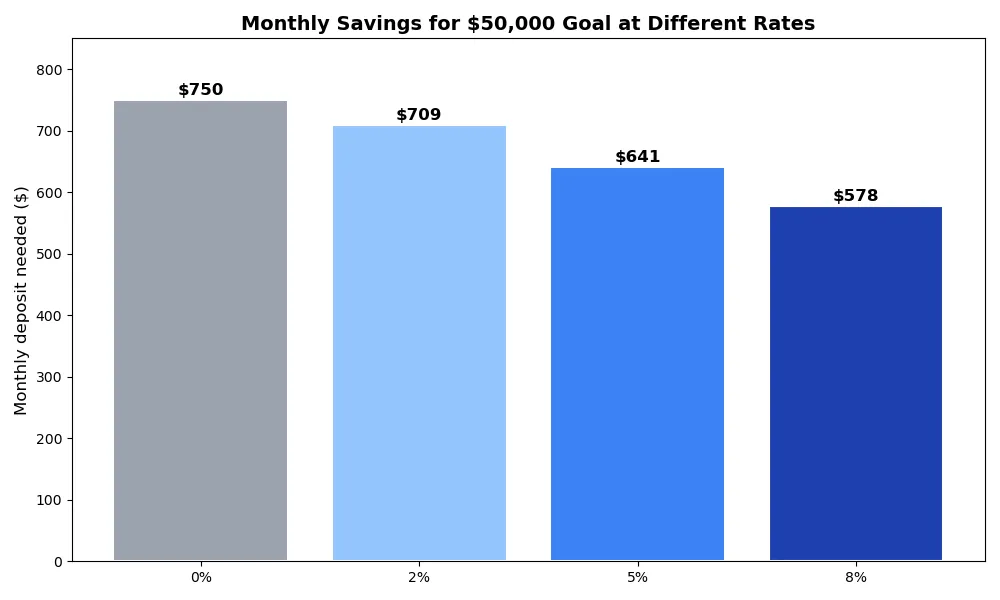
Use a realistic rate for where the money will sit: a high-yield savings account rate for short goals, or a conservative investment return for multi-year goals. Overestimating the rate is the most common way a savings plan falls short.
5 tips to reach your savings goal faster
- Automate the deposit. A recurring transfer on payday removes the decision — and the temptation to skip a month.
- Start with what you have. Even a small current balance compounds over the full timeframe, cutting the monthly amount.
- Raise deposits with raises. Direct half of every pay increase to savings; your lifestyle stays the same while the goal gets closer.
- Shorten the timeline carefully. Fewer years mean higher monthly deposits but less interest earned — rerun the numbers before committing.
- Put long-term goals to work. Money you will not touch for years can earn more in investments than in cash savings. Our investment calculator shows how lump sums and monthly contributions grow together.
Frequently asked questions
How is the monthly savings amount calculated?
With the future value of an annuity formula: PMT = (FV - PV x (1+r)^n) x r / ((1+r)^n - 1), where FV is your goal, PV is current savings, r is the monthly rate, and n is months. For a $50,000 goal with $5,000 saved at 5% over 5 years, the monthly deposit is $640.87.
What if I already have some savings?
Enter it as your current savings. It grows with interest over the full timeframe, so it reduces the monthly deposit. In the $50,000 example, the $5,000 starting balance saves about $109 a month versus starting from zero.
What interest rate should I use?
Use a realistic rate for where the money will sit: a high-yield savings account rate for short-term goals, or a conservative long-run investment return for multi-year goals. Overestimating the rate is the most common reason savings plans fall short.
What happens if I skip a month of saving?
You fall behind by roughly one monthly deposit plus its lost compounding. To catch up, divide the missed amount (grown slightly with interest) over the remaining months and add it to your deposit, or extend the timeframe.
Should I save the same amount every month?
Equal monthly deposits are the simplest plan and what this calculator assumes. If your income varies, you can still use the result as a monthly average target and save more in good months to cover lean ones.
How does compound interest help my savings goal?
Interest earns interest on top of your deposits, so part of your goal is funded by growth rather than your own money. At 5% over 5 years, interest contributes about $6,548 toward a $50,000 goal — roughly 13% of the total.
How is this different from a budget calculator?
A budget calculator tracks where your money goes each month. A savings goal calculator works backward from a future target to tell you how much of that budget must be saved. Use both: the budget finds the money, this calculator sets the savings target.