Investment Calculator: Project Your Future Wealth
Estimate your retirement nest egg in seconds. Enter your current age, savings, monthly contribution and expected return to see your projected total, its value in today's dollars, and your estimated monthly retirement income. Free, private, no sign-up needed.
How the investment calculator works
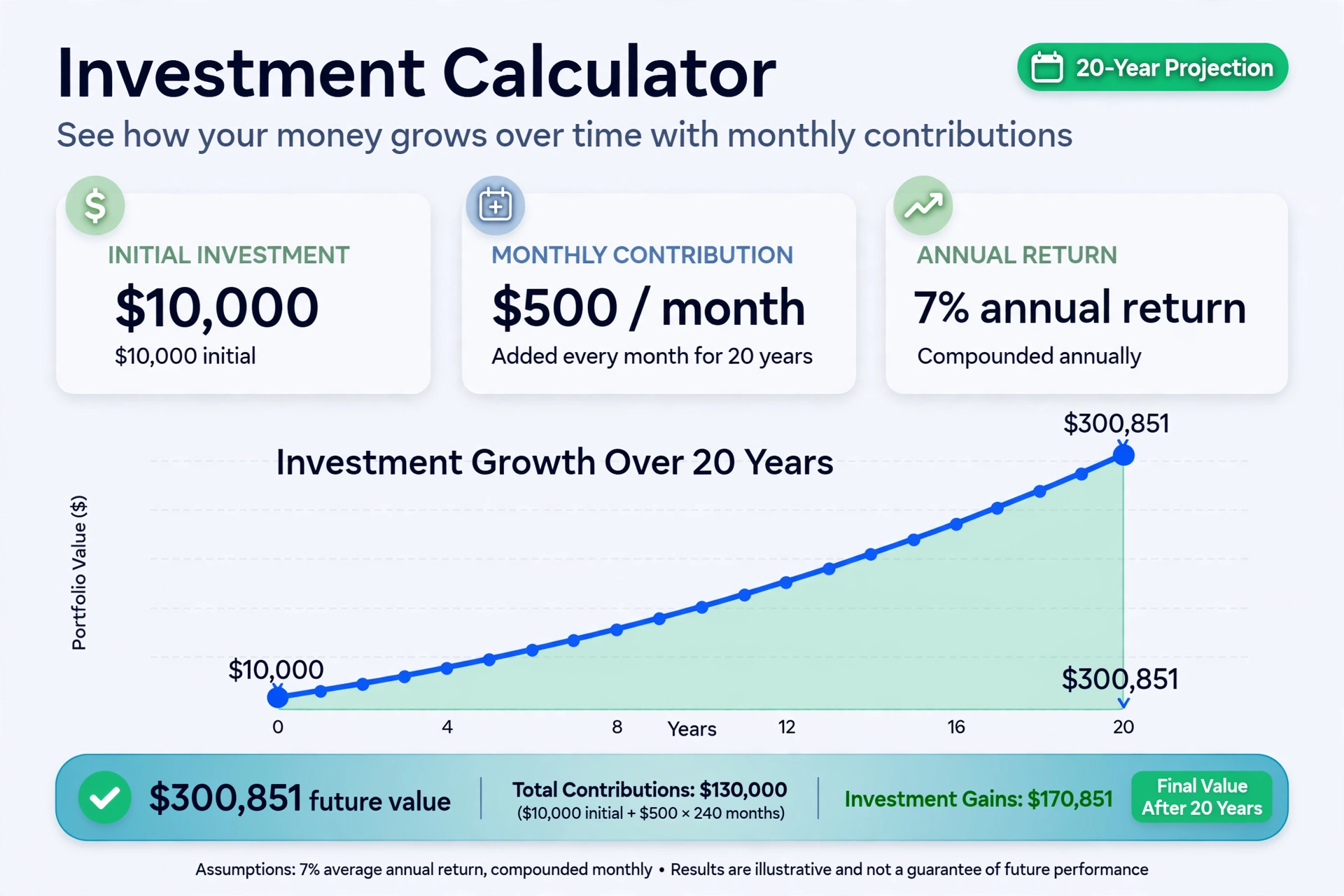
Enter your starting amount, how much you will add each month, your expected annual return, and how many years you plan to invest. The calculator projects your portfolio's future value using monthly compounding. It also breaks down how much of the final amount came from your own contributions versus compound growth, so you can see the true power of staying invested.
The formula behind the calculation
The future value combines two parts: growth of your initial lump sum, and growth of your monthly contributions. With a monthly rate r and n months:
FV = P × (1+r)n + PMT × (((1+r)n − 1) / r)
Where P is the initial investment, PMT is the monthly contribution, r is the monthly rate (annual return ÷ 12), and n is the total number of months. If you want to understand compounding in isolation, try our compound interest calculator.
Worked example
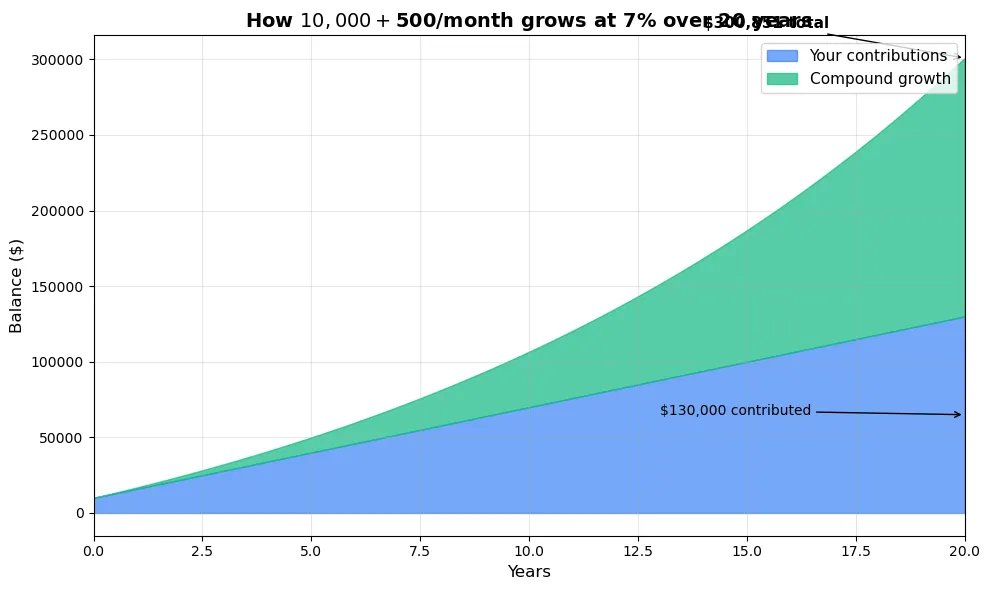
Suppose you invest $10,000 today, add $500 every month, earn 7% per year, and stay invested for 20 years:
| Measure | Amount |
|---|---|
| Initial investment | $10,000.00 |
| Monthly contributions (240 × $500) | $120,000.00 |
| Total you put in | $130,000.00 |
| Compound growth earned | $170,850.72 |
| Future value | $300,850.72 |
Notice that growth ($170,851) exceeds your total contributions ($130,000). That is compounding doing the heavy lifting in the later years.
Lump sum vs monthly contributions
Which matters more: starting with a large amount, or contributing steadily? The table below compares three approaches over 20 years at 7%:
| Approach | You put in | Future value |
|---|---|---|
| $10,000 once, nothing monthly | $10,000 | $40,388 |
| $0 upfront, $500/month | $120,000 | $260,463 |
| $10,000 + $500/month | $130,000 | $300,851 |
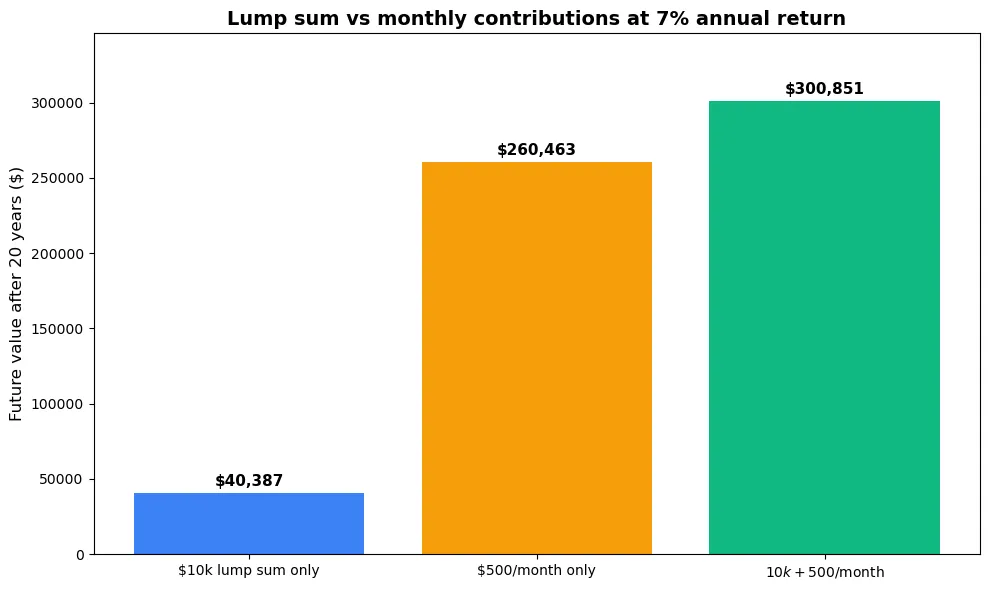
Steady monthly investing beats a one-time lump sum for most people, because consistent contributions add up. Combining both gives the best result. If you are investing specifically for retirement, our retirement calculator adds inflation adjustment and monthly income projections.
5 tips to grow your investments
- Start early. Every extra year of compounding matters more than a slightly higher return.
- Automate contributions. Monthly transfers remove emotion and keep you consistent.
- Keep fees low. A 1% annual fee can erase nearly a third of returns over 30 years.
- Stay diversified. Spread across asset classes instead of betting on single stocks.
- Do not panic-sell. Market drops are when compounding buys assets at a discount.
Frequently asked questions
What is a good annual return to assume?
US stocks have averaged about 10% per year before inflation over the long run, roughly 7% after inflation. A diversified portfolio assumption of 6-8% nominal is common for planning. Use a lower number for conservative estimates.
Does this account for inflation?
No, the projection is in nominal dollars. To see purchasing power, subtract expected inflation (around 2-3%) from your return assumption. For inflation-adjusted retirement planning, see our retirement calculator.
What about taxes and fees?
The calculator shows pre-tax, pre-fee growth. Real accounts lose some return to expense ratios, advisory fees, and taxes on gains. Reduce your assumed return by your total fee drag for a more realistic figure.
Is monthly or yearly compounding used?
Monthly. Contributions are added each month and growth compounds monthly, which matches how most brokerage and retirement accounts work.
Can I model irregular contributions?
The calculator assumes a fixed monthly amount. For irregular contributions, use your average monthly amount as an approximation.
Why is growth more than half the total?
Compounding accelerates over time: early contributions earn returns for the longest, and those returns earn their own returns. In long horizons, growth often exceeds total contributions.
Where can I learn more about investing basics?
The U.S. Securities and Exchange Commission publishes free investor education, including compound interest examples, at investor.gov.
Related calculators

Compound Interest Calculator
See how your savings grow with compounding interest over time.
Use calculatorSalary Calculator
Convert pay between hourly, weekly, biweekly, monthly and annual - plus your overtime rate.
Use calculatorLoan EMI Calculator
Estimate your monthly loan payment from amount, rate and term.
Use calculator