Savings Calculator: How Your Savings Will Grow
Enter your starting amount, monthly contribution, annual interest rate, and years, and see your future balance, total contributions, and interest earned.

Formulas verified against standard references. Calculator logic tested with verified worked examples. Last reviewed: October 2026. Our methodology
How Compound Interest Grows Savings
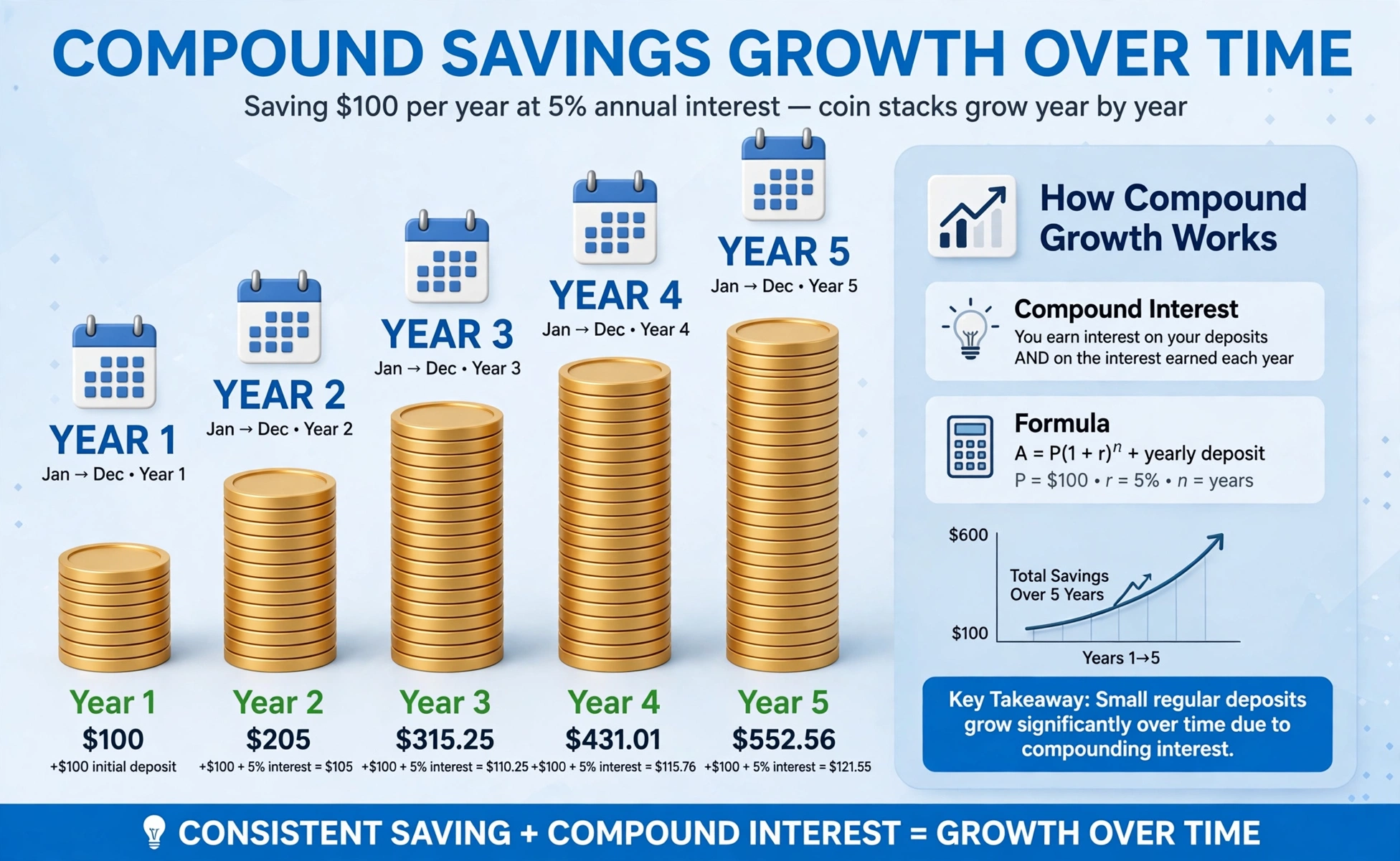
Compound interest means you earn interest not only on your deposits but also on interest already earned. Each month, the balance grows by the monthly rate, and the next month's interest is calculated on the larger balance. Over years, that snowball effect does most of the work, which is why starting early beats saving larger amounts later.
With monthly compounding, the monthly rate is the annual rate divided by 12. A 5 percent annual rate compounds at about 0.4167 percent per month. The future value formula combines the growth of the starting deposit with the growth of every monthly contribution, each earning interest for the months remaining after it is paid in.
The Formula, Step by Step
The future value of the starting deposit is the deposit times (1 plus monthly rate) to the power of the number of months. The future value of the monthly contributions is the monthly amount times ((1 plus monthly rate) to the power of months, minus 1) divided by the monthly rate. Add the two parts for the final balance.
For $1,000 at 5 percent for 10 years, the deposit alone grows to about $1,647. For a compound interest calculator with different compounding periods, the same idea applies with the rate and periods adjusted to match the compounding frequency.
| Part | Formula | 10-year example at 5% |
|---|---|---|
| Starting deposit | P x (1 + r) to the power n | $1,000 grows to $1,647 |
| Monthly contributions | PMT x (((1 + r) to the power n - 1) / r) | $100 a month grows to $15,528 |
| Total | Sum of both parts | $17,175 |
Worked Example: $100 a Month for 10 Years
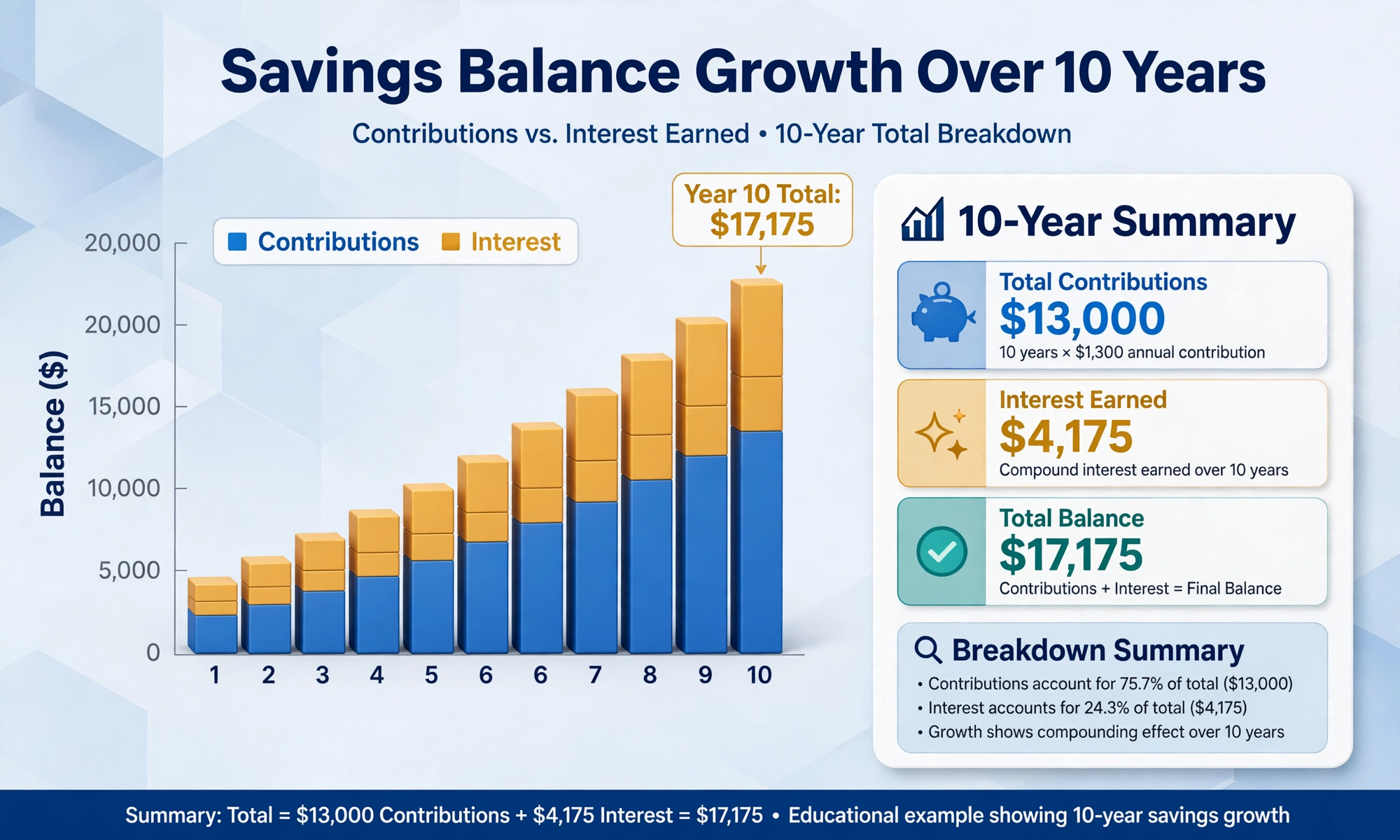
Start with $1,000, add $100 at the end of each month, earn 5 percent a year compounded monthly, and save for 10 years, which is 120 months. The starting deposit grows to $1,647.01, and the contributions grow to $15,528.23, giving a final balance of $17,175.24.
You paid in $13,000 in total: the $1,000 start plus 120 payments of $100. The remaining $4,175.24 is interest earned. That split is the key insight of the calculator: after 10 years, nearly a quarter of the balance came from interest, not from your pocket.
| Item | Amount |
|---|---|
| Starting deposit | $1,000 |
| Monthly contributions (120 x $100) | $12,000 |
| Total paid in | $13,000 |
| Interest earned | $4,175.24 |
| Final balance | $17,175.24 |
Why Time Matters More Than Timing
Doubling the monthly contribution doubles the contribution part of the balance, but doubling the time more than doubles it, because every extra year adds both new contributions and interest on a larger balance. Saving $100 a month for 20 years at 5 percent ends far above twice the 10-year balance, even though you paid in only twice as much.
That is why small, regular contributions beat waiting for a large lump sum. A habit of $100 a month started today usually beats $200 a month started years later, because the earlier money has more compounding periods. The calculator shows this clearly: change only the years and watch the interest share grow.
Common Mistakes
The most common mistake is entering the annual rate as a monthly rate, or forgetting to divide by 12, which inflates the result twelvefold. A second mistake is counting contributions at the start of each month while using an end-of-month formula, which slightly understates the balance. A third is ignoring fees, taxes, and inflation, which all reduce the real value of the result.
A fourth mistake is comparing a savings balance with a loan balance directly. Savings interest is usually taxed as income, while loan interest is a cost, so the two sides of a personal balance sheet need different treatment. Use this calculator for planning, and check the exact terms with your bank.
Practical Uses
Use the calculator to set a monthly target for a goal: a holiday, a car deposit, an emergency fund, or a house deposit. Work backwards by trying monthly amounts until the final balance reaches the goal in the time available. For an emergency fund, aim for three to six months of essential spending, held where it can be withdrawn quickly.
For retirement, the same formula applies over decades, where the interest share dominates. A realistic rate matters more than optimism: use a conservative rate, such as 4 to 5 percent for a savings account projection, and treat higher market returns as a bonus, not a plan.
Frequently asked questions
How much will $100 a month grow to in 10 years at 5%?
With $1,000 to start, $100 a month at 5% compounded monthly for 10 years gives $17,175.24, of which $4,175.24 is interest.
What is compound interest?
Interest earned on both your deposits and on interest already earned. Each period, interest is calculated on the growing balance, so growth accelerates over time.
Does this calculator include taxes or fees?
No. It shows the balance before taxes, fees, and inflation. Actual bank results will be lower after those deductions.
What happens if the interest rate is zero?
The balance is simply the starting deposit plus all contributions, with no interest earned.
Are contributions made at the start or end of the month?
This calculator assumes end-of-month contributions. Start-of-month contributions would give a slightly higher balance.
How do I save for a specific goal?
Enter your starting amount, rate, and years, then try different monthly amounts until the final balance reaches your goal.
Why does starting early matter so much?
Because every extra year adds both new contributions and interest on a larger balance. Time in the account beats timing the market for regular savers.
Related calculators

Compound Interest Calculator
See how your savings grow with compound interest over time.
Use calculatorRetirement Calculator
Project your retirement nest egg from age, savings, and contributions.
Use calculatorSalary Calculator
Convert pay between hourly, weekly, monthly, and yearly amounts.
Use calculator