Deck Calculator: Plan Your Deck Materials
Guessing your lumber order is how deck builds end up with three extra trips to the lumber yard. Enter your deck dimensions, board width, the gap between boards, your joist spacing and a waste allowance, and this free deck calculator will estimate the number of deck boards, joists, deck screws and total linear feet of decking you need to buy.
Formulas verified against standard deck construction references. Calculator logic tested with verified worked examples. Last reviewed: October 2026. Our methodology
How the deck material math works
Decking boards run the full length of the deck, side by side, each separated by a small gap. Joists run underneath at right angles, spaced evenly along the length. Once you see that layout, every formula on this page follows from it.
- Deck boards: ceiling of (deck width in inches) ÷ (board width + gap). Dividing the width by one board-plus-gap unit tells you how many units fit across the deck; the ceiling rounds up so the last row is covered.
- Joists: ceiling of (deck length in inches) ÷ joist spacing, plus 1. The extra joist closes the far end of the frame, the same way wall studs always need one more than the length divided by spacing.
- Deck screws: boards × joists × 2. Every place a board crosses a joist gets two screws, one near each edge of the board, to keep it from cupping.
- Linear feet of decking: boards × deck length × (1 + waste ÷ 100). This is the number you actually order, since boards are sold by the linear foot.
| Input | Unit | Typical value | What it changes |
|---|---|---|---|
| Deck length | ft | 12–20 | Joist count, linear feet of decking |
| Deck width | ft | 8–16 | Board count |
| Board width | in | 5.5 (5/4x6) | Wider boards mean fewer boards, more waste per cut |
| Board gap | in | 0.25 | Larger gaps slightly reduce the board count |
| Joist spacing | in | 16 | Tighter spacing means more joists and screws |
| Waste | % | 10 | Linear feet of decking only, not joists or screws |
Sources: American Wood Council — residential wood deck design; standard deck material estimation methods used by building material suppliers.
Worked example
Take a deck that is 16 ft long and 12 ft wide, built with 5.5 in decking boards, a 0.25 in gap, joists at 16 in on center, and a 10% waste allowance. Enter those values above and the calculator returns:
| Material | Quantity | How it was calculated |
|---|---|---|
| Deck boards | 26 | ceil(12 × 12 ÷ (5.5 + 0.25)) = ceil(25.04) |
| Joists | 13 | ceil(16 × 12 ÷ 16) + 1 = 12 + 1 |
| Deck screws | 676 | 26 × 13 × 2 screws per intersection |
| Linear feet of decking | 457.6 ft | 26 × 16 × 1.10 |
The deck covers 192 sq ft. At 457.6 linear feet of 16 ft boards, that is 28.6 board-lengths — so you would round up to 29 boards at 16 ft when ordering, since lumber is sold in whole boards. The 10% waste covers ripped cuts along the house wall, end cuts and the occasional bad board in the pile.
How to use the deck calculator
Measure the deck footprint first. Length is the direction the joists run; width is the direction the decking boards run. If you are replacing boards on an existing frame, measure the actual deck surface, not the frame underneath.
Step by step
- Enter deck length and width in feet. Use the outside dimensions of the finished deck surface.
- Set board width and gap. The defaults (5.5 in board, 0.25 in gap) match standard 5/4x6 decking. Switch to 7.25 in if you are using 2x8 boards.
- Set joist spacing. 16 in on center is standard; use 12 in for diagonal patterns.
- Set your waste allowance. 10% suits rectangular decks; raise it for angled cuts and complex shapes.
- Press Calculate. Read your board, joist and screw counts plus the linear feet of decking to order.

Choosing board width, gap, and joist spacing
Board width is a trade-off between looks and waste. Wider boards cover the deck with fewer pieces and fewer seams, which many builders prefer for large decks, but every angled cut wastes more material than it would on a narrow board. The most common residential decking, 5/4x6, has a 5.5 in face and hits a practical middle ground.
The 1/4 in gap between boards is not cosmetic: it drains rain through the deck surface and gives boards room to swell in humidity. Gaps much smaller than that clog with leaves and trap moisture against the joists, which shortens the life of the framing.
Joist spacing controls stiffness. At 16 in on center, 5/4 decking feels solid underfoot and meets code for most residential decks. Drop to 12 in on center when boards run diagonally — the effective span across the joists gets longer on the diagonal — or when you want a stiffer feel for a hot tub or heavy furniture.
Once the material list is set, the next question is what it will cost. A budget calculator helps you slot the lumber, fasteners and delivery charges into the rest of the project plan before you place the order.
Reading your material takeoff
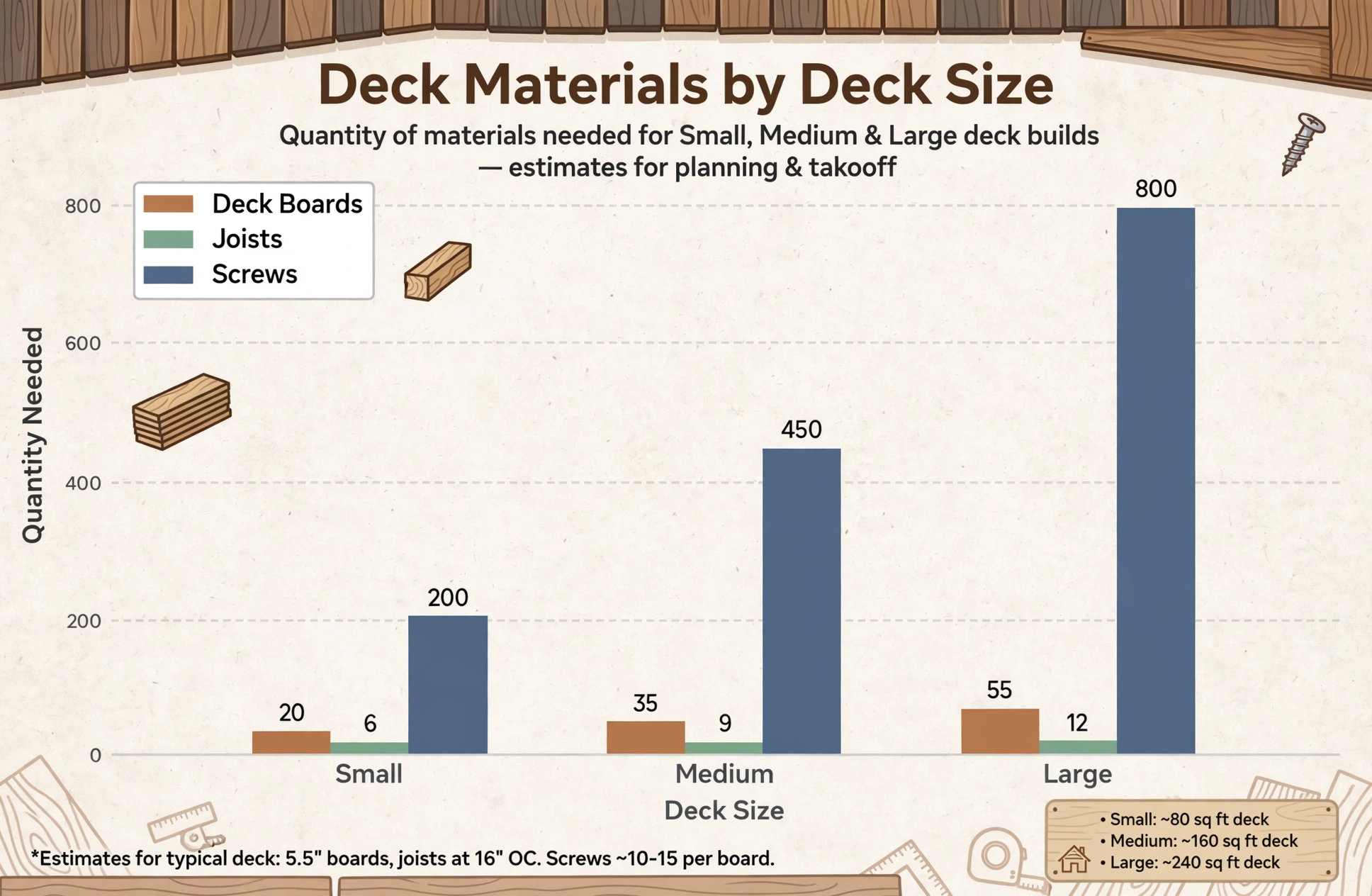
The board count is the headline number, but buy it in whole boards. Lumber yards sell decking in set lengths — typically 8, 10, 12, 14 and 16 ft — so divide your linear feet by the board length you plan to buy and round up. A 457.6 linear foot order at 16 ft boards becomes 29 boards, not 28.
The joist count covers the structural frame but not the extras: the ledger board along the house, rim joists around the perimeter, posts, beams and stair stringers all need their own lumber. Add those to the list before heading to the yard.
Screws are the quiet budget surprise. Two screws per board per joist means even a modest deck needs several hundred, and deck screws must be rated for outdoor use — coated or stainless steel — or they will bleed rust streaks down the boards within a season.
| Board | Face width | Common use |
|---|---|---|
| 5/4x6 | 5.5 in | Standard residential decking, joists at 16 in on center |
| 2x6 | 5.5 in | Heavier decking for docks, ramps and high-traffic decks |
| 2x8 | 7.25 in | Wide-plank look, fewer seams on large decks |
| Composite board | 5.5 in typical | Low maintenance; check the maker for maximum joist spacing |
For structural questions beyond the material count — how far a given joist can safely span at your spacing — the joist span tables are the reference builders use: the deck joist span chart lays out maximum spans by lumber size and spacing, and the American Wood Council deck design guide covers the prescriptive residential framing rules in full. This calculator estimates quantities only; always confirm framing against your local building code.
Deck sizes, waste, and buying tips
Waste is where deck estimates go wrong. A plain rectangular deck with straight runs wastes little: end cuts, one ripped board along the house wall and the odd warped board from the pile. Ten percent covers that comfortably. As soon as boards run diagonally or the deck wraps a corner, every board ends in an angled offcut and 15% is the safer number.
- Order boards in the longest length your deck allows. Fewer butt joints means fewer seams and less waste — a 16 ft deck built with 16 ft boards needs no end joints at all.
- Buy the joists separately. Joists are structural lumber (2x8 or larger), priced and graded differently from decking boards; the calculator counts them but the order is separate.
- Round screws up to full boxes. Deck screws are sold by the box or bucket, so 676 screws becomes a 1,000-count box with spares for repairs.
- Add a delivery charge to the budget. A full deck lumber order is heavy and long; delivery is usually cheaper than multiple trailer trips.
Big decks are a serious purchase, and many homeowners spread the cost rather than paying cash. If you are considering that route, a loan calculator shows the true monthly cost of financing the lumber before you commit.
Frequently asked questions
How many deck boards do I need?
Divide your deck width in inches by the board width plus the gap, and round up. For example, a 12 ft wide deck (144 in) with 5.5 in boards and a 1/4 in gap needs ceil(144 / 5.75) = 26 boards. Each board runs the full length of the deck, and a waste factor of around 10% covers cuts and mistakes.
How do you calculate the number of joists for a deck?
Divide the deck length in inches by the joist spacing, round up, and add one for the rim joist at the far end. A 16 ft deck (192 in) with joists spaced 16 in on center needs ceil(192 / 16) + 1 = 13 joists.
How many screws do I need per deck board?
Plan on two screws at every point where a board crosses a joist. Multiply the number of boards by the number of joists by 2. A deck with 26 boards and 13 joists needs 26 x 13 x 2 = 676 deck screws.
What waste factor should I use for decking?
Add 10% for a simple rectangular deck with straight board runs. Raise it to 15% or more for diagonal patterns, picture-frame borders, or decks with angles and cutouts, where offcuts pile up faster.
What is the standard gap between deck boards?
A 1/4 in gap is the common standard for 5/4x6 decking. It lets rain drain through and gives boards room to expand in heat and humidity. Smaller gaps clog with debris and trap moisture against the framing.
What is the standard joist spacing for a deck?
16 in on center is the standard residential spacing for 5/4 decking. Use 12 in on center for diagonal board patterns or thinner decking, and never exceed 24 in on center, since the boards will flex and feel spongy underfoot.
How do I convert decking to linear feet?
Multiply the number of boards by the deck length, then add your waste factor: boards x length x (1 + waste). A deck needing 26 boards at 16 ft with 10% waste takes 26 x 16 x 1.10 = 457.6 linear feet of decking.