Circle Calculator: Radius, Diameter, Area, Circumference
Enter any one circle measurement, radius, diameter, circumference, or area, and get the other three instantly, with the formulas that connect them.
Formulas verified against standard references. Calculator logic tested with verified worked examples. Last reviewed: October 2026. Our methodology
How a Circle Is Measured
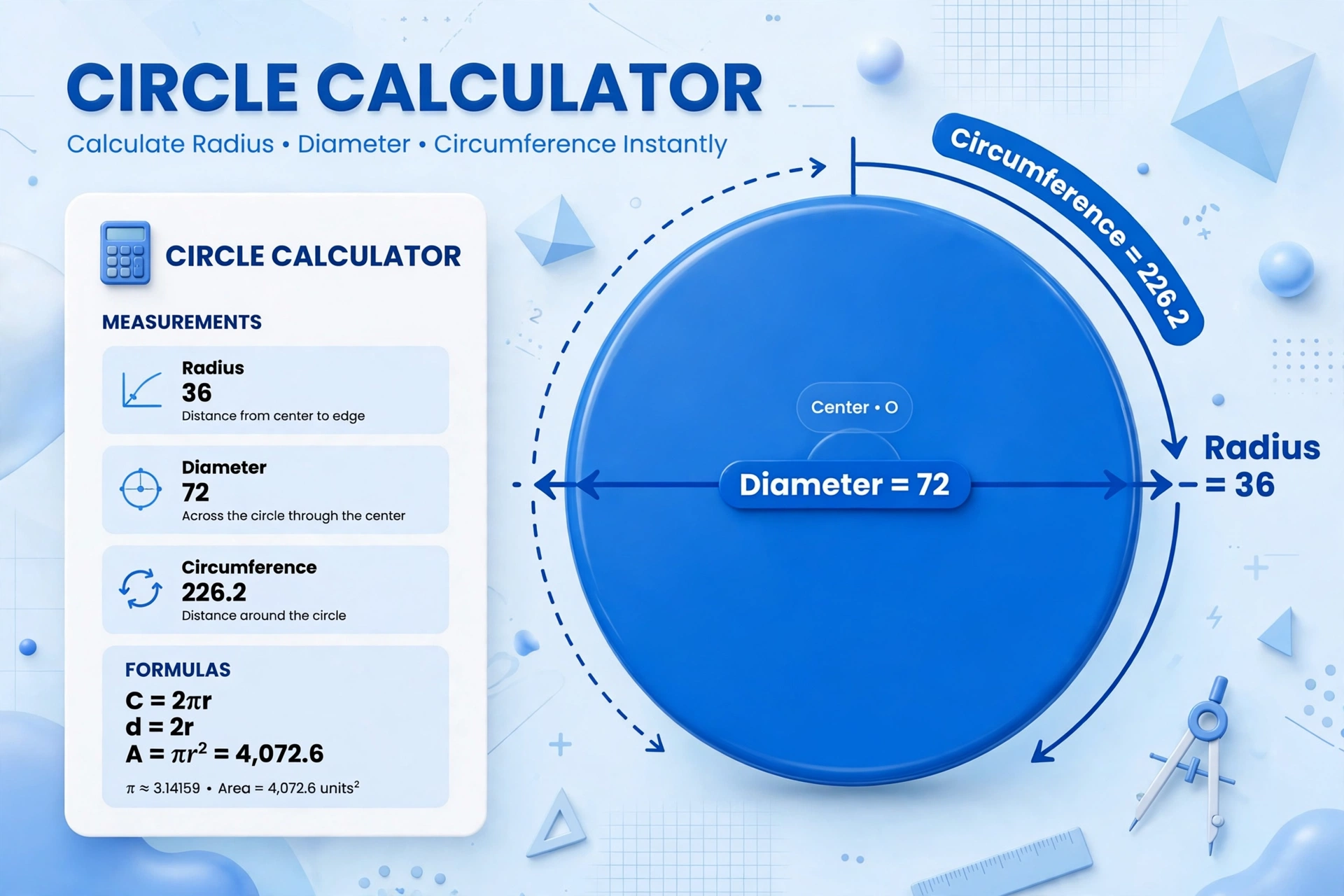
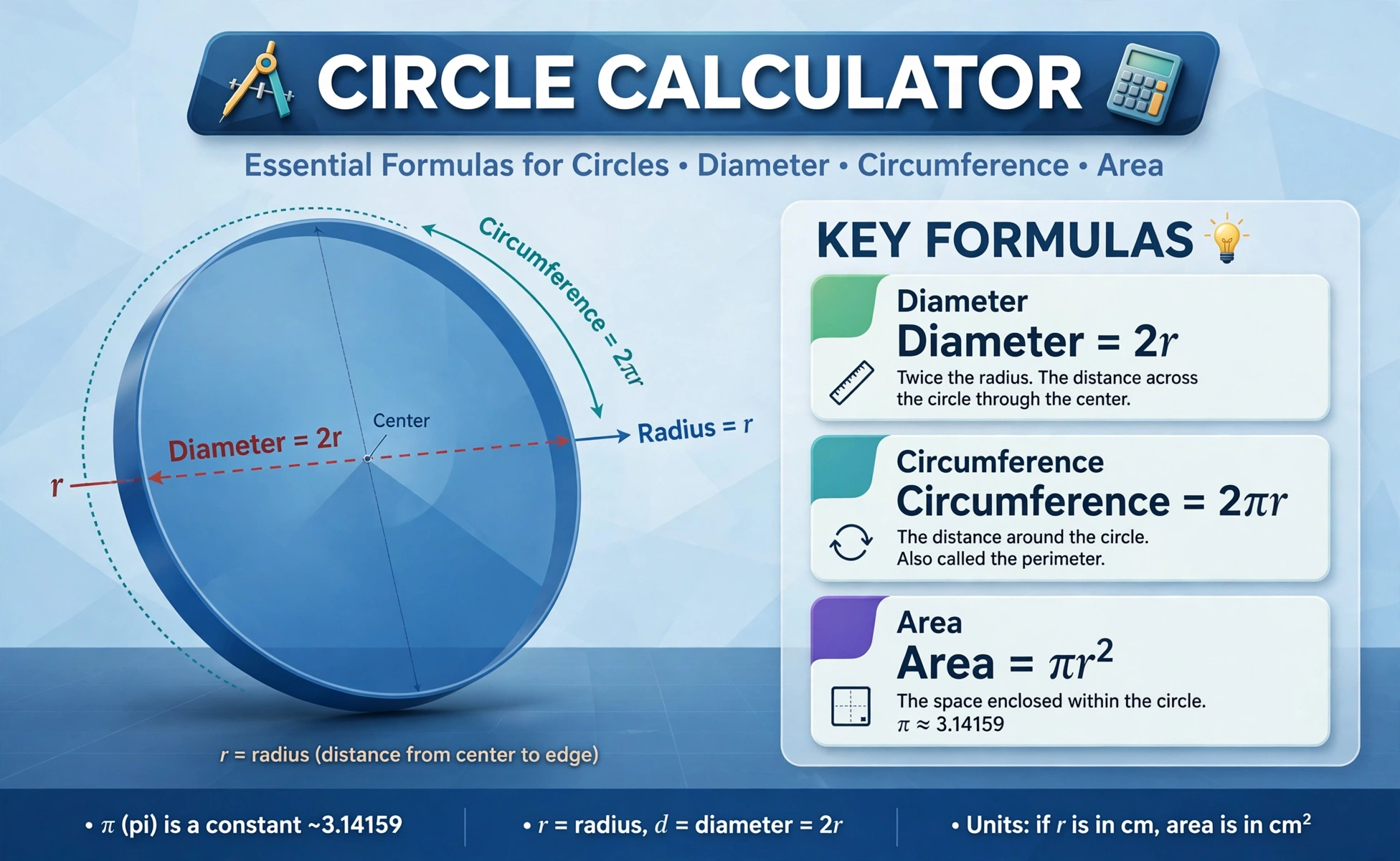
A circle is fully described by one number, because its radius, diameter, circumference, and area are locked together by pi. The radius is the distance from the center to the edge. The diameter is twice the radius, running straight through the center. The circumference is the distance around the edge, and the area is the space inside.
That lockstep relationship is what makes this calculator possible: give it any one of the four values and it can recover the other three. Measure a round table across the middle and you have the diameter. Wrap a tape around a tree trunk and you have the circumference. Either way, the rest follows.
For three-sided shapes, a triangle calculator works from sides and angles instead.
The Circle Formulas
Diameter equals 2 times radius. Circumference equals 2 times pi times radius, which is the same as pi times diameter. Area equals pi times radius squared. Pi itself is the ratio of any circle's circumference to its diameter, about 3.14159, and it is the same for every circle, large or small.
Working backward is just algebra. Radius from diameter is diameter divided by 2. Radius from circumference is circumference divided by 2 pi. Radius from area is the square root of area divided by pi. This calculator applies the right inversion for whichever value you enter.
| Known value | Radius from it | Then |
|---|---|---|
| Radius r | r | Diameter 2r, area pi r squared |
| Diameter d | d / 2 | Circumference pi d |
| Circumference C | C / (2 pi) | Area pi r squared |
| Area A | Square root of (A / pi) | Diameter 2r |
Worked Examples
Example 1: radius 5. Diameter is 10, circumference is 2 times pi times 5, which is 31.4159, and area is pi times 25, which is 78.5398. Example 2: diameter 10. Radius is 5, so circumference and area match example 1, as they must, since it is the same circle.
Example 3: circumference 31.4159. Radius is 31.4159 divided by 2 pi, which is 5, so diameter is 10 and area is 78.5398. Example 4: area 78.5398. Radius is the square root of 78.5398 divided by pi, which is 5.
| Given | Radius | Diameter | Circumference | Area |
|---|---|---|---|---|
| Radius 5 | 5 | 10 | 31.4159 | 78.5398 |
| Diameter 10 | 5 | 10 | 31.4159 | 78.5398 |
| Circumference 31.4159 | 5 | 10 | 31.4159 | 78.5398 |
| Area 78.5398 | 5 | 10 | 31.4159 | 78.5398 |
Circles You Already Know
A standard pizza is often 12 inches across, so its radius is 6 inches and its area is about 113.1 square inches. A 16 inch pizza has radius 8 and area about 201.1 square inches, which is not a third more but nearly 78 percent more, because area grows with the square of the radius. That square growth surprises people every time.
A running track, a bicycle wheel, and a tree trunk all follow the same formulas. A wheel with a 26 inch diameter travels pi times 26, about 81.68 inches, per revolution, which is how odometers turn wheel turns into distance.
| Object | Diameter | Circumference | Area |
|---|---|---|---|
| 12 inch pizza | 12 | 37.6991 | 113.0973 |
| 16 inch pizza | 16 | 50.2655 | 201.0619 |
| 26 inch wheel | 26 | 81.6814 | 530.9292 |
Common Mistakes
The most common mistake is mixing radius and diameter: using the diameter where the formula asks for radius doubles the circumference error and quadruples the area error, because area squares the radius. Always check which one you measured before entering it.
Another mistake is using diameter squared for area, or forgetting to square at all. Area is pi times radius squared, not pi times radius, and not pi times diameter. A third mistake is rounding pi to 3 too early: use 3.14159 or the calculator's pi until the final step, then round once.
When to Use a Circle Calculator
Use it for anything round: pizzas, wheels, pipes, tanks, garden beds, tree trunks, and round tables. Plumbers size pipes by diameter, gardeners size round beds by area for soil, and bakers size pans by diameter, with area telling them how much batter a pan actually holds.
For right triangles, which also use pi-free geometry, a Pythagorean theorem calculator finds a missing side. Use this circle calculator whenever the shape is round and one measurement is known.

Frequently asked questions
How do I find the area of a circle?
Multiply pi by the radius squared. For radius 5, area is pi times 25, which is 78.5398.
How do I find the circumference of a circle?
Multiply pi by the diameter, or 2 times pi times the radius. For radius 5, circumference is 31.4159.
What is the difference between radius and diameter?
Radius runs from the center to the edge, and diameter runs straight through the center, so diameter is always twice the radius.
What is pi?
The ratio of a circle's circumference to its diameter, about 3.14159, the same for every circle.
Can I find the radius from the area?
Yes. Radius is the square root of area divided by pi. For area 78.5398, radius is 5.
Why does doubling the radius quadruple the area?
Area depends on radius squared, so doubling the radius multiplies area by 2 squared, which is 4.
What units should I use?
Any length unit works, as long as you use the same unit throughout. Area comes out in square units of that unit.