Triangle Calculator: Sides, Angles and Area
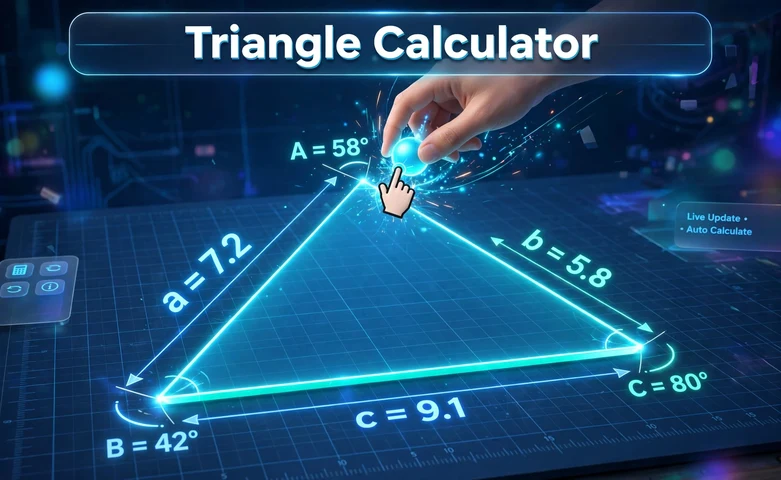
Know the three sides of a triangle but need the area and the angles? Enter all three sides (SSS) and this free triangle calculator applies Heron's formula and the law of cosines — or switch to base-and-height mode for a quick area.
Formulas verified against standard references. Calculator logic tested with verified worked examples. Last reviewed: October 2026. Our methodology
The formulas this calculator uses
Two modes, three classic formulas — pick the one that matches what you measured:
- Perimeter: P = a + b + c — the distance around the triangle.
- Heron's formula (three sides): s = (a + b + c) ÷ 2, then Area = √[s(s − a)(s − b)(s − c)].
- Base and height: Area = ½ × base × height.
- Law of cosines (angles from sides): A = arccos[(b² + c² − a²) ÷ 2bc], and likewise for B and C.
| What you know | What the calculator returns |
|---|---|
| Three sides (SSS) | Area, perimeter, semiperimeter, all three angles, triangle type, inradius, circumradius |
| Base and height | Area only (perimeter needs all three sides) |
Heron's formula has been in use for nearly two thousand years — it gives the area without ever measuring a height, which is why surveyors still reach for it. Read the Heron's formula walkthrough for worked diagrams of the same two-step process.
Worked example
A triangular plot has sides 3 m, 4 m and 5 m.
Perimeter: 3 + 4 + 5 = 12 m. Semiperimeter: 12 ÷ 2 = 6 m. Area (Heron): √[6 × (6−3) × (6−4) × (6−5)] = √36 = 6 m².
Angles (law of cosines): A = arccos[(16 + 25 − 9) ÷ 40] = arccos(0.8) ≈ 36.87°. B = arccos[(9 + 25 − 16) ÷ 30] = arccos(0.6) ≈ 53.13°. C = 180° − 36.87° − 53.13° = 90°. Since 3² + 4² = 5², this is a scalene right triangle — confirmed.
How to use the triangle calculator
Choose the mode that matches the measurements you actually have.
Step by step
- Select "Three sides (SSS)" or "Base and height". Use SSS when you measured all three edges; use base and height for a quick area.
- Enter positive numbers. In SSS mode the three sides must satisfy the triangle inequality (the two shorter sides together longer than the longest) — the calculator tells you when they don't.
- Press Calculate. SSS mode returns the area, perimeter, all three angles in degrees, the triangle type, and the inradius and circumradius.
- Read the working. Every result shows the substitutions, so you can follow or copy the math.
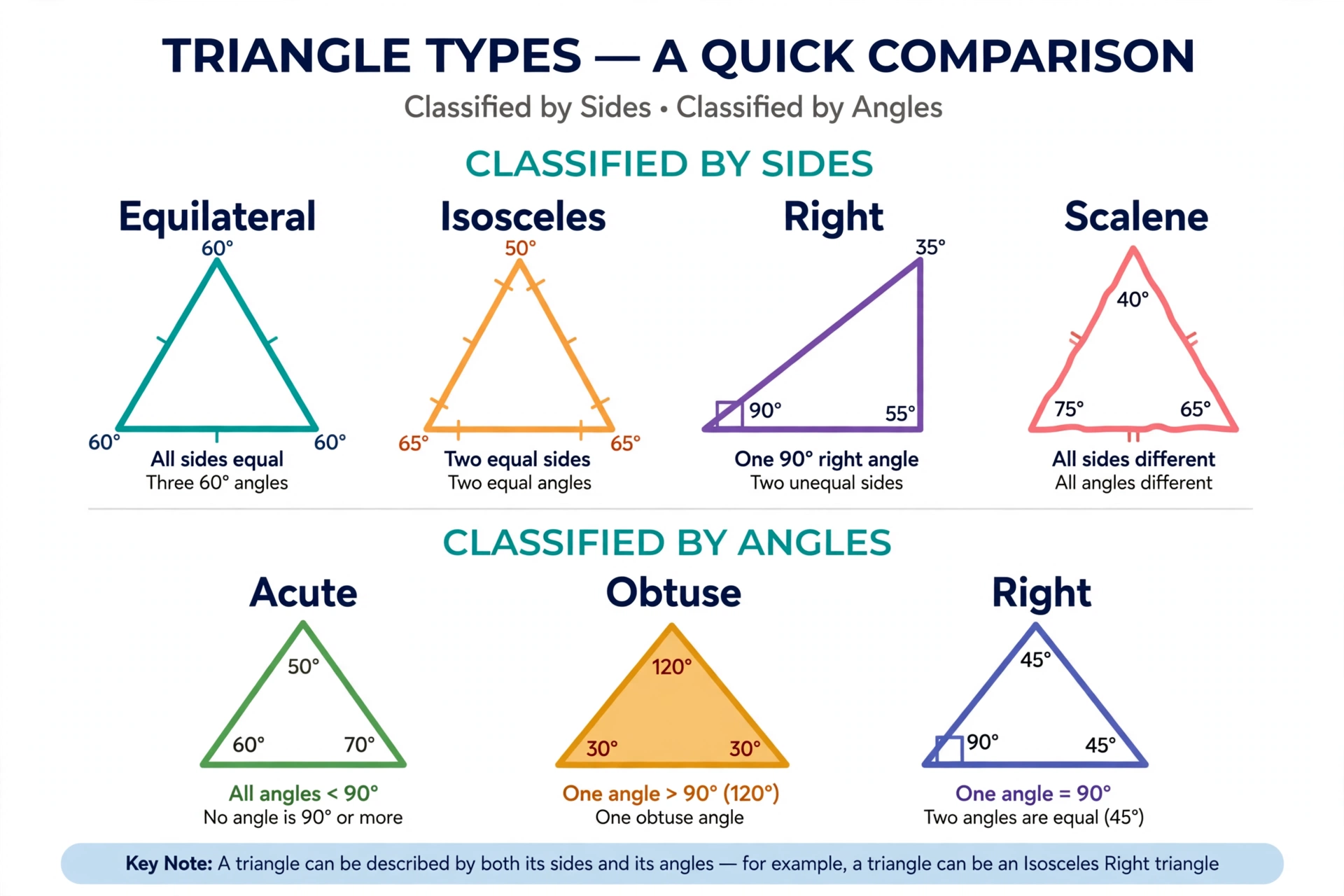
Triangle types at a glance
The calculator names your triangle automatically. Two independent classifications:
| By sides | Meaning |
|---|---|
| Equilateral | All three sides equal; all angles 60° |
| Isosceles | Exactly two sides equal; two angles equal |
| Scalene | No sides equal; no angles equal |
| By angles | Meaning |
|---|---|
| Acute | Every angle under 90° |
| Right | One angle exactly 90° (like 3-4-5) |
| Obtuse | One angle over 90° |
Every triangle has at least two acute angles — a second right or obtuse angle would already use up the 180° available.
The triangle inequality: can these sides make a triangle?
Not every three lengths can close into a triangle. The triangle inequality requires all three of these to hold:
- a + b > c
- a + c > b
- b + c > a
Sides of 2, 3 and 6 fail: 2 + 3 = 5, which is not greater than 6, so no triangle exists. The calculator checks all three conditions before running Heron's formula and explains exactly which one failed, so a typo is easy to spot.
Angles, inradius and circumradius from three sides
Once the area and angles are known, the bonus measures follow with no extra input:
- Inradius r = Area ÷ s — the radius of the largest circle that fits inside the triangle.
- Circumradius R = (a × b × c) ÷ (4 × Area) — the radius of the circle passing through all three corners.
- Angle check: the three angles always sum to 180° in plane geometry — a quick sanity check on any answer.
Angles are reported in degrees, the unit surveyors and builders actually work with. If you need radian output or want to double-check a sine, cosine or arccos step by hand, a scientific calculator evaluates trigonometric expressions directly.
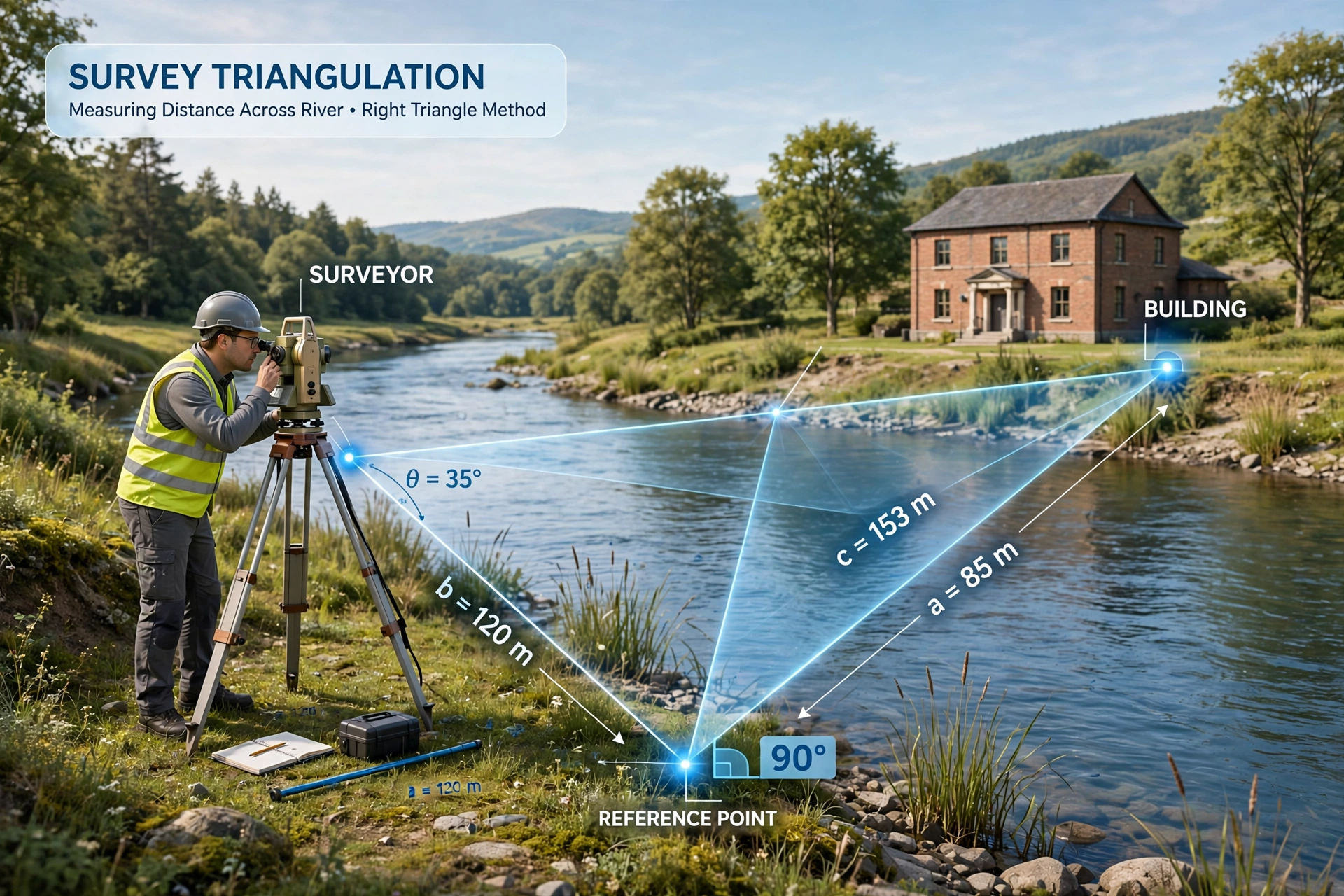
Triangular plots are the classic Heron's-formula use case in land surveying — surveyors measure the three edges between stakes rather than a perpendicular height. Once you have the area in one unit, an area converter turns it into square feet, square meters, acres or hectares.
Frequently asked questions
How do I find the area of a triangle from three sides?
Use Heron's formula. First find the semiperimeter s = (a + b + c) ÷ 2, then Area = √[s(s − a)(s − b)(s − c)]. For sides 3, 4, 5: s = 6 and Area = √36 = 6.
How does the calculator find the angles from the sides?
It rearranges the law of cosines: A = arccos[(b² + c² − a²) ÷ 2bc], and likewise for B. The third angle is 180° minus the other two. All angles are shown in degrees.
Why does the calculator say my sides can't form a triangle?
The three lengths break the triangle inequality: the two shorter sides together must be longer than the longest side (a + b > c, a + c > b, b + c > a). Check for a typo — one wrong digit usually causes this.
Can I find the area from just the base and height?
Yes. Switch the calculator to base-and-height mode and use Area = ½ × base × height. Note that perimeter and angles can't be found from base and height alone — those need all three sides.
Do the angles of a triangle always add up to 180°?
Yes, in ordinary plane geometry. The calculator's angle check always shows them summing to 180° (tiny rounding aside), which is a good way to verify the result.
How can I tell if a triangle is a right triangle?
Check whether a² + b² = c² for the three sides (longest side as c). The calculator does this check for you and reports the triangle type, including right, acute and obtuse.
What units can I enter?
Any length unit — inches, feet, meters, centimeters — as long as you use the same unit for every side. The area comes back in square units of that unit.
Related calculators
Area Converter
Convert square feet, acres, hectares, square meters and more.
Use calculator
Scientific Calculator
Evaluate trig, logarithm, power and root expressions with a full scientific keypad. Free and instant.
Use calculator
Percentage Calculator
Find what P% of any number is — instant answers with the formula shown.
Use calculator