Volume Calculator: Find the Volume of Any Shape
Pick a shape, enter its dimensions, and get its volume with the formula shown, plus the same volume in liters and cubic feet for practical use.

Formulas verified against standard references. Calculator logic tested with verified worked examples. Last reviewed: October 2026. Our methodology
What Volume Measures
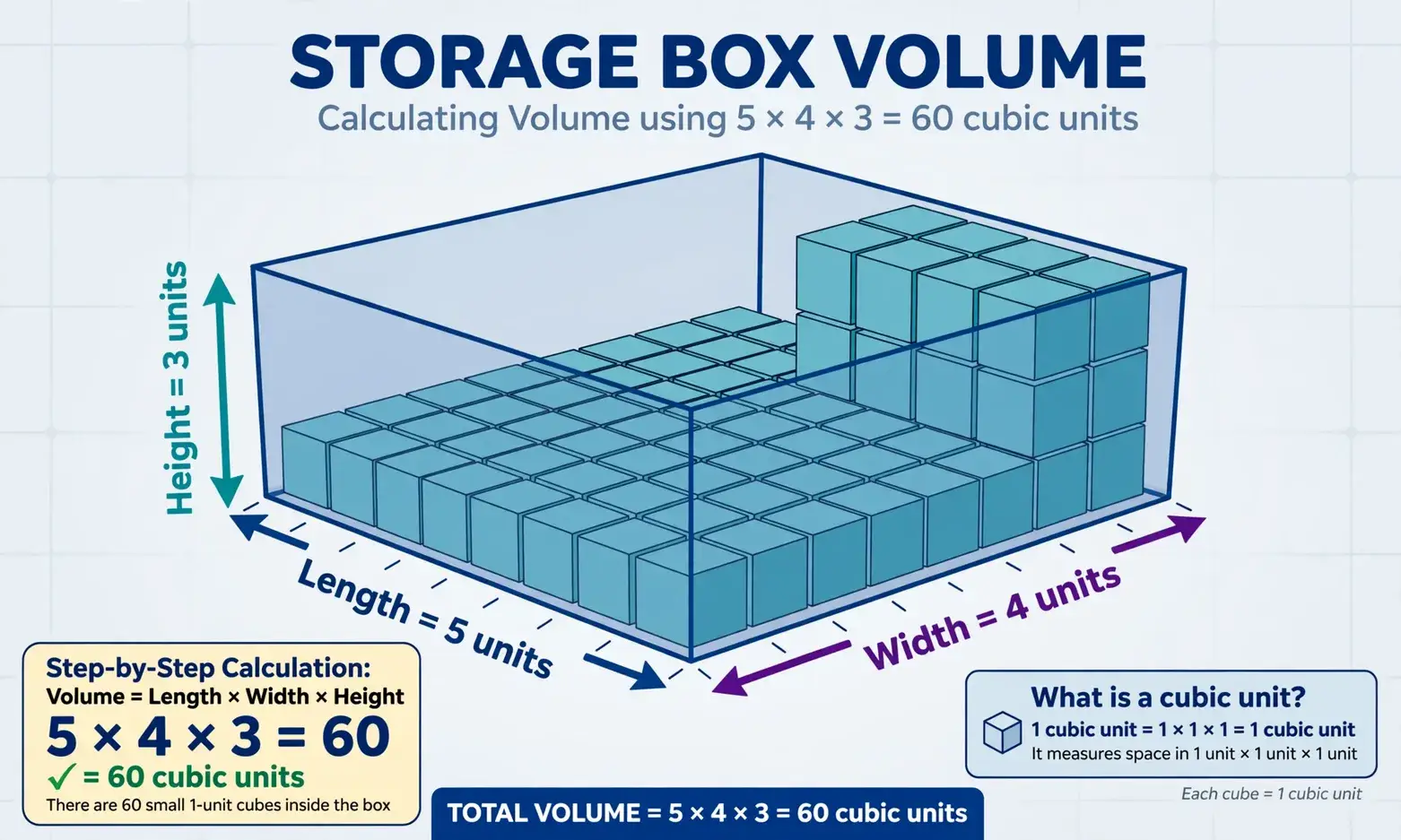
Volume measures how much three-dimensional space a shape takes up, in cubic units. A box 5 units long, 4 units wide, and 3 units high holds 60 cubic units, because it fits 5 by 4 by 3 unit cubes inside it. The unit follows the input: feet in gives cubic feet out, centimeters in gives cubic centimeters out.
That unit rule is the most common source of errors. Mixing feet for length and inches for height gives a meaningless number, so convert all dimensions to the same unit before calculating. For a related one-dimensional change, a length converter converts feet, inches, meters, and centimeters before you start.
Formulas for the Four Shapes
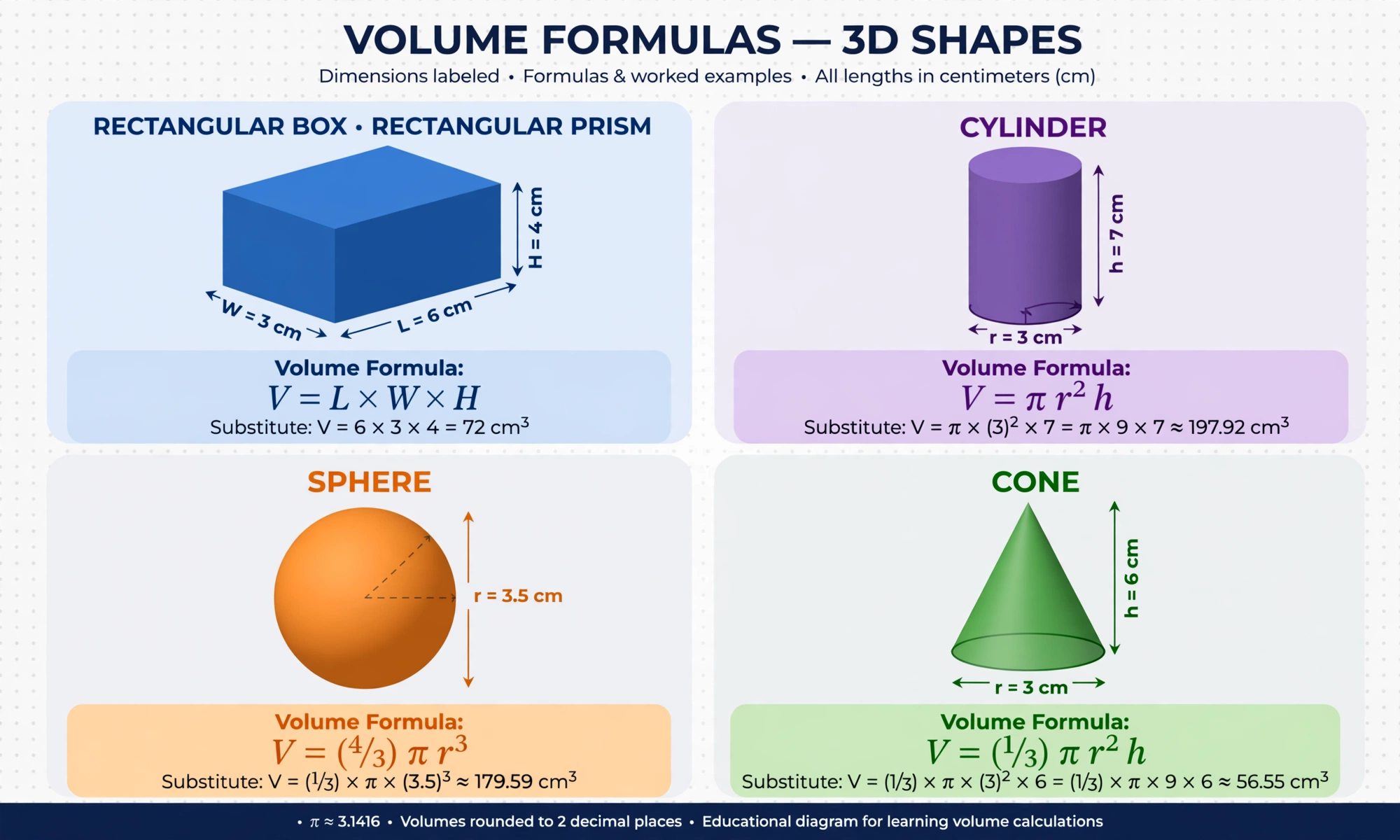
Each shape has its own formula, but all four come from the same idea: a base area times a height, with a correction for round or pointed shapes. A box multiplies all three sides. A cylinder multiplies the circular base area, pi times radius squared, by its height. A sphere uses four thirds times pi times radius cubed, and a cone is exactly one third of the cylinder with the same base and height.
The cone result is worth remembering: filling a cone takes one third as much material as filling the cylinder around it. That is why a cone and a cylinder with the same radius and height have volumes in a 1 to 3 ratio, and it is a useful check on any cone answer.
| Shape | Formula | Example |
|---|---|---|
| Box | length x width x height | 5 x 4 x 3 = 60 |
| Cylinder | pi x r squared x h | r = 2, h = 5 gives 62.83 |
| Sphere | (4/3) x pi x r cubed | r = 3 gives 113.10 |
| Cone | (1/3) x pi x r squared x h | r = 2, h = 6 gives 25.13 |
Worked Examples
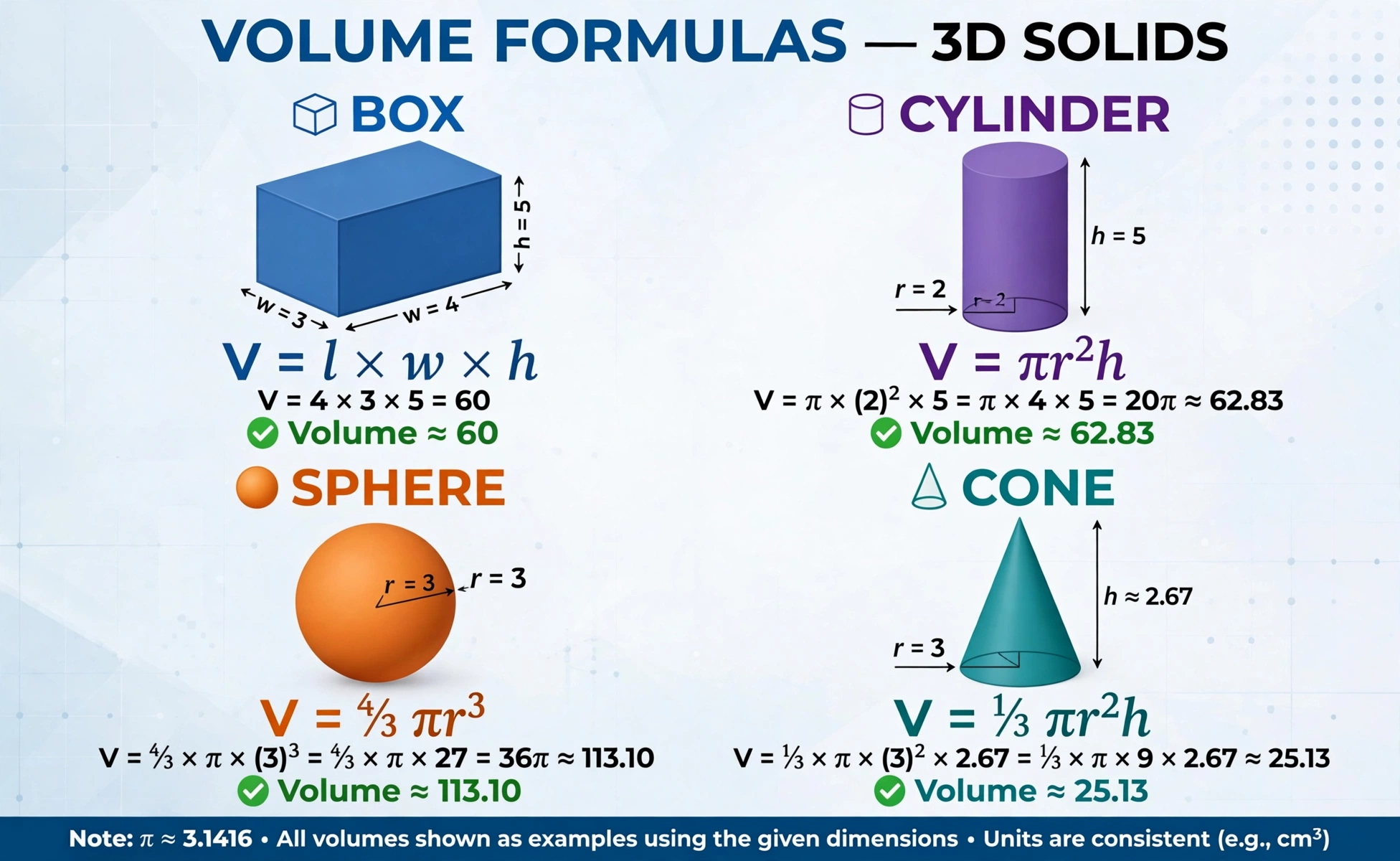
Example 1, box: a storage box 5 ft long, 4 ft wide, and 3 ft high has volume 5 x 4 x 3 = 60 cubic feet. Example 2, cylinder: a tank with radius 2 ft and height 5 ft has volume pi x 4 x 5 = 62.83 cubic feet, or about 1,779 liters, since one cubic foot is 28.3168 liters.
Example 3, sphere: a ball with radius 3 units has volume (4/3) x pi x 27 = 113.10 cubic units. Example 4, cone: a cone with radius 2 and height 6 has volume (1/3) x pi x 4 x 6 = 25.13 cubic units, exactly one third of the 75.40 cubic units of its cylinder.
| Shape | Dimensions | Volume |
|---|---|---|
| Box | 5 x 4 x 3 | 60 |
| Cylinder | r = 2, h = 5 | 62.83 |
| Sphere | r = 3 | 113.10 |
| Cone | r = 2, h = 6 | 25.13 |
Cubic Units and Conversions
One cubic foot equals 1,728 cubic inches, because a foot is 12 inches and 12 cubed is 1,728. One cubic foot also equals 28.3168 liters, and one cubic meter equals 1,000 liters and 35.3147 cubic feet. For water, one liter weighs about one kilogram, so a volume in liters doubles as an approximate water weight in kilograms.
When ordering material, convert first and calculate second. A concrete or soil order in cubic yards needs cubic feet divided by 27, since a yard is 3 feet and 3 cubed is 27. Calculating in mixed units and converting at the end is where most ordering mistakes happen.
| From | To | Multiply by |
|---|---|---|
| Cubic feet | Liters | 28.3168 |
| Cubic feet | Cubic yards | 0.037037 |
| Cubic meters | Liters | 1,000 |
| Cubic inches | Cubic feet | 0.0005787 |
Common Mistakes
The most common mistake is entering a diameter where a radius is needed, which quadruples the answer for cylinders, spheres, and cones, because radius is squared in the formula. If a tank is 4 ft across, its radius is 2 ft, not 4 ft. A second mistake is mixing units, such as feet for length and inches for width.
A third mistake is forgetting the one third in the cone formula or the four thirds in the sphere formula. A fourth is reporting a volume in square units: volume is always cubic, so the unit must carry the cube, as in cubic feet, not square feet.
Practical Uses
Volume decides storage, shipping, and material orders. Boxes and rooms use the box formula, tanks and pipes use the cylinder formula, balls and domes use the sphere formula, and funnels and conical roofs use the cone formula. Paint, concrete, soil, and water are all bought by volume, so a correct calculation saves both money and a second delivery.
For a building project, calculate the volume in the unit the supplier uses, add a small waste allowance for spillage and uneven ground, and round up to the supplier's unit, such as whole cubic yards or whole bags. An exact-looking decimal is less useful than a rounded-up order that covers the job.
Frequently asked questions
What is the volume of a box 5 by 4 by 3?
60 cubic units. Multiply length times width times height: 5 x 4 x 3 = 60.
How do you find the volume of a cylinder?
Multiply pi times radius squared times height: V = pi x r squared x h. For radius 2 and height 5, that is 62.83 cubic units.
Is volume measured in square units or cubic units?
Cubic units. Length, width, and height multiply together, so the result is cubic feet, cubic meters, or cubic centimeters, never square feet.
What is the difference between a sphere and a cone formula?
A sphere is (4/3) x pi x r cubed, while a cone is (1/3) x pi x r squared x h. The cone is one third of the cylinder with the same base and height.
How many liters are in a cubic foot?
28.3168 liters. Multiply cubic feet by 28.3168 to get liters, and divide liters by 28.3168 to get cubic feet.
Should I enter radius or diameter?
Radius. If you only know the diameter, halve it first. Entering a diameter as the radius quadruples the volume for round shapes.
How do I convert cubic feet to cubic yards?
Divide by 27. A cubic yard is 3 feet on each side, and 3 cubed is 27, so 54 cubic feet is 2 cubic yards.