Trapezoid Calculator
Find the area of a trapezoid from its two parallel bases and the height between them. Enter the three lengths to get the area, the midsegment and the steps. Free, no sign-up, everything runs in your browser.
Formula: Area = (a + b) ÷ 2 × h, where a and b are the two parallel bases and h is the perpendicular height.

Formulas verified against standard references. Calculator logic tested with verified worked examples. Published: November 8, 2026 | Last updated: November 8, 2026. Fact-checked: November 8, 2026. Our methodology
How to Use the Trapezoid Calculator
Getting an answer takes three quick steps. The tool finds the area of a trapezoid from its two parallel sides and the height between them.
- Enter the two parallel sides, base a and base b, in the first two fields. It does not matter which one you call a and which one you call b.
- Enter the height, the straight distance between the two bases measured at a right angle. Pick the unit you measured in.
- Press Calculate, or press Enter. The area appears first and large, with the midsegment length and the step-by-step math below. Press Reset to clear the form and start over.
The Trapezoid Area Formula
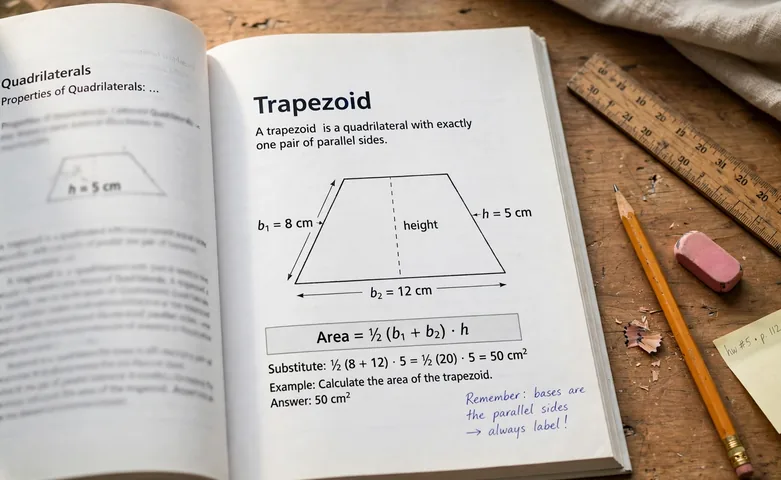
The area of a trapezoid is A = (a + b) ÷ 2 × h. Each symbol means one thing, and the height is the part most people get wrong.
a and b are the lengths of the two parallel sides, called the bases. h is the height, the perpendicular distance between those bases. The area comes out in square units, so lengths in cm give an area in cm².
The formula is the same as the midsegment times the height, because (a + b) ÷ 2 is the midsegment, the line joining the midpoints of the two non-parallel sides. The formula is the standard geometry definition used in school textbooks and by the triangle calculator for the shape it is most often compared with.
Worked Example: Bases 5 and 8, Height 4
A trapezoid has bases of 5 cm and 8 cm and a height of 4 cm. Here is exactly what the calculator does.
- Add the two bases: 5 + 8 = 13.
- Divide by 2 to get the average base: 13 ÷ 2 = 6.5. This is the midsegment.
- Multiply by the height: 6.5 × 4 = 26.
The area is 26 cm². As a second check, bases of 10 cm and 6 cm with a height of 4 cm give (10 + 6) ÷ 2 × 4 = 8 × 4 = 32 cm².
Why the Formula Works
Think of the trapezoid as a rectangle with a triangle cut off one end and stuck on the other. The average of the two bases is the length of the rectangle that has the same area, so multiplying that average by the height gives the area directly.
Another way to see it is to join a second copy of the trapezoid upside down to the first. Together they form a parallelogram with a base of a + b and a height of h, so its area is (a + b) × h. One trapezoid is half of that parallelogram, which is where the divide by 2 comes from. Both views give the same formula, and the tool uses the average-base form because it is the easiest to check by hand.
Common Trapezoid Mistakes
Using a slanted side as the height is the most common error. The height is the straight distance between the bases, measured at a right angle. In a trapezoid with slanted legs, that distance is always shorter than the slanted side, so using the leg overstates the area.
Forgetting the half is next. Adding the bases and multiplying by the height without dividing by 2 doubles the correct answer. The half is what turns the sum of two bases into their average.
Adding the legs instead of the bases is a third trap. Only the two parallel sides go into a + b. The legs never enter the area formula at all, which is why the tool does not ask for them. If you need the distance around the shape, the perimeter calculator covers that with all four sides.
Trapezoid vs Parallelogram and Triangle
A trapezoid becomes a parallelogram when the two bases are equal, because then both pairs of opposite sides are parallel. The formula still works. With a = b = 10 and h = 5, the area is (10 + 10) ÷ 2 × 5 = 50, which is exactly the parallelogram area of base times height.
A triangle is half a parallelogram too, so the two formulas are cousins. A triangle with base b and height h has area b × h ÷ 2, while a trapezoid averages two bases before multiplying by the height. The circle calculator covers the other shape most homework sets pair with trapezoids.

Frequently asked questions
What is a trapezoid?
A trapezoid is a four-sided shape with at least one pair of parallel sides. The two parallel sides are called the bases, and the distance between them is the height. In the UK the same shape is called a trapezium.
Which sides of a trapezoid are the bases?
The two sides that run parallel to each other. They are usually drawn at the top and the bottom, but any parallel pair counts. The non-parallel sides are called the legs and do not enter the area formula.
Do I use the slanted side as the height?
No. The height is the perpendicular distance between the two bases, measured at a right angle. The slanted side is longer than the height, so using it would overstate the area.
What units is the area in?
Square units of whatever unit you measured in. Bases and height in cm give an area in cm squared, and bases and height in feet give an area in square feet. Keep all three lengths in the same unit.
Can the two bases be equal?
Yes. When the bases are equal, the trapezoid is a parallelogram, and the formula gives base times height, which is the parallelogram area. A rectangle is the special case where the height equals the side length.
How do I find the height if I only know the area?
Rearrange the formula to h = 2 times the area divided by (a plus b). For an area of 26 and bases of 5 and 8, the height is 52 divided by 13, which is 4.
Related calculators

Triangle Calculator
Find the area of a triangle from base and height.
Use calculatorCircle Calculator
Find the area and circumference of a circle.
Use calculatorPerimeter Calculator
Find the distance around any shape.
Use calculatorVolume Calculator
Find the volume of common 3D shapes.
Use calculatorPythagorean Theorem Calculator
Find the missing side of a right triangle.
Use calculatorSquare Footage Calculator
Work out the square footage of a room.
Use calculator