Small Business Shipping Cost Calculator

Work out the true cost of shipping a package for your small business. Enter the weight and size, the carrier rate, packaging and packing time, and the calculator shows the cost per package, the batch total and whether the price you charge covers it.

The actual weight of the packed box, in pounds.

The longest side of the box, in inches.

The second side of the box, in inches.

The third side of the box, in inches.

The flat carrier charge for the service you use, before weight. Check your carrier rate card.

What the carrier charges per billable pound. The default $0.50 is a typical small parcel rate.

Box, tape, labels and fill for one package. Enter 0 if packaging is already in the carrier rate.

Minutes to pick, pack and label one package. Enter 0 to leave labor out.

What an hour of packing time costs you, including wages and on-costs.

How many identical packages you ship in this batch.

What the customer pays for shipping per package. Enter 0 for free shipping or to skip the margin check.

Formula: cost per package = carrier base rate + (billable weight x per-pound rate) + packaging cost + (packing minutes / 60 x hourly labor rate), where billable weight is the larger of actual weight and dimensional weight, and dimensional weight = length x width x height / 166.

How to Use the Small Business Shipping Cost Calculator

Shipping costs more than the postage label. This calculator adds the carrier charge, the weight charge, the box and packaging, and the time it takes to pack the order, then checks the total against the price you charge the customer. Use it before you set a flat shipping rate or offer free shipping.

  1. Enter the package weight in pounds and its length, width and height in inches.
  2. Enter the carrier base rate for the service you use and the charge per pound.
  3. Enter the packaging cost per package, including the box, tape, labels and fill.
  4. Enter the packing time in minutes and your hourly labor rate.
  5. Enter how many packages you ship and the price you charge the customer per package, then press Calculate or press Enter. The cost per package appears first and large, with the batch total and your margin below.
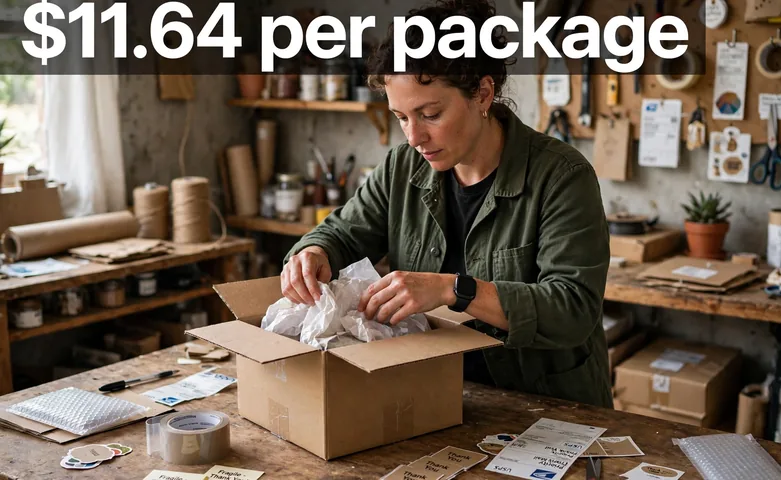
A photo of a small business owner packing a cardboard shipping box with tissue paper on a wooden table in a small workshop
A 5 lb box measuring 12 by 10 by 8 inches costs $11.64 to ship, all in.

The Small Business Shipping Cost Formula

Carriers charge for the larger of the real weight and the dimensional weight, because a big light box takes up van space. Dimensional weight in pounds is length x width x height in inches divided by 166, which is the divisor most domestic parcel carriers use. FedEx uses 139 for some services, so your carrier may charge slightly more than this estimate.

Cost per package = carrier base rate + (billable weight x per-pound rate) + packaging cost + (packing minutes / 60 x hourly labor rate). Total shipping cost = cost per package x number of packages. Margin = (price charged per package x number of packages) - total shipping cost. Our unit price calculator compares two package sizes the same way, and our break-even calculator shows how many orders you need to cover your fixed costs.

Worked Example: 20 Packages at $12.00 Charged Each

A small shop ships 20 identical packages. Each weighs 5 lb, measures 12 by 10 by 8 inches, and the carrier base rate is $4.50 with a $0.50 charge per pound. Packaging costs $1.25 per package, packing takes 10 minutes at $18 an hour, and the shop charges $12.00 per package for shipping.

  1. Dimensional weight: 12 x 10 x 8 / 166 = 5.78 lb.
  2. Billable weight: the larger of 5 lb actual and 5.78 lb dimensional = 5.78 lb.
  3. Weight charge: 5.78 x $0.50 = $2.89.
  4. Handling labor: 10 minutes / 60 x $18 = $3.00.
  5. Cost per package: $4.50 + $2.89 + $1.25 + $3.00 = $11.64.
  6. Total shipping cost: $11.64 x 20 = $232.80.
  7. Charged to customers: $12.00 x 20 = $240.00.
  8. Margin: $240.00 - $232.80 = $7.20, or $0.36 per package.

As a second check, take a 2 lb package measuring 9 by 6 by 4 inches, base rate $3.20, $0.50 per pound, packaging $0.75, 5 minutes packing at $15 an hour, 50 packages, $8.00 charged each. Dimensional weight is 1.30 lb, so billable weight is the actual 2 lb. Cost per package is $6.20, the batch costs $310.00, and the margin is $90.00. The same steps work for any package, so try your own numbers in the tool above.

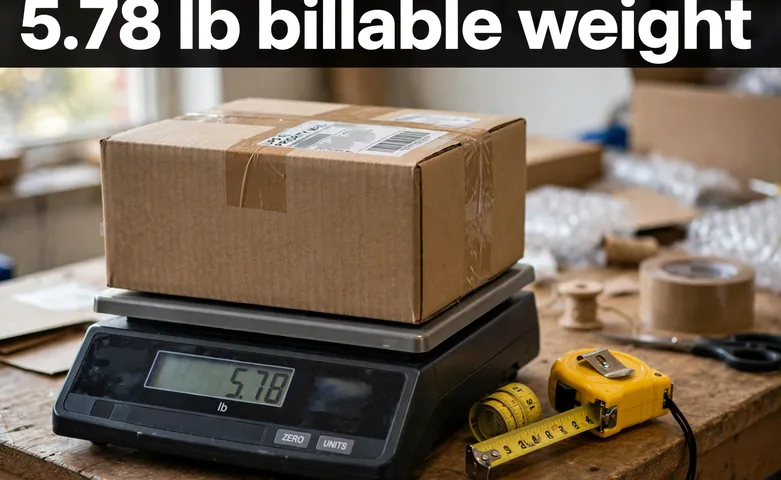
A photo of a cardboard parcel on a digital postal scale next to a tape measure on a packing bench
The worked example box weighs 5 lb but bills at 5.78 lb, because its size pushes the dimensional weight higher.

Why a Light Big Box Costs More Than a Heavy Small One

Dimensional weight is the surprise in most shipping bills. A 5 lb box that is 12 by 10 by 8 inches bills at 5.78 lb, so you pay for 0.78 lb you never shipped. A bigger box makes it worse. A 5 lb box that is 18 by 14 by 12 inches has a dimensional weight of 18.22 lb, so the weight charge alone is $9.11 instead of $2.89. That is why right-sizing boxes is the fastest way to cut shipping cost.

Packaging and labor are the costs most sellers forget. In the worked example they add $4.25 per package, which is more than a third of the $11.64 total. A free shipping offer hides all of this, so check the true cost before you promise it. If the margin comes out negative, either raise the shipping price, use a smaller box, or fold the cost into the product price. Our profit margin calculator shows what the margin means for the whole order, and our markup calculator helps set a selling price that covers it.

What Moves Your Shipping Cost

The carrier base rate is the biggest single line for small parcels, and it changes with the service level. Standard ground is the cheapest, expedited roughly doubles the rate, and overnight can triple it. The per-pound rate matters most for heavy parcels, and dimensional weight matters most for large light ones. A 25 lb package measuring 24 by 18 by 16 inches bills at 41.64 lb, so the weight charge is $20.82 at $0.50 a pound, and the cost per package reaches $38.82 with $4.00 packaging and 20 minutes of packing at $18 an hour.

Packing time is the lever you control. Cutting packing from 10 minutes to 5 minutes at $18 an hour saves $1.50 per package, which is $30.00 on a 20 package batch. Pre-cut tape, a packing station with everything in reach, and standard box sizes all cut minutes. Buying boxes in bulk cuts the packaging line too. Check your carrier rates every few months, because carriers raise prices and your discount may have changed. Our sales tax calculator handles the tax side of the order total, and our business loan calculator prices borrowing if you need to fund a bigger packing setup.

Should You Offer Free Shipping

Free shipping is not free. It means the product price must absorb the whole $11.64 per package from the worked example, plus the carrier rate rises you cannot predict. A common rule is to keep shipping under 15% of the order value. At a $12.00 shipping charge the worked example package already sits near that line, so free shipping on a $30 order would eat more than a third of the revenue before product costs.

Free shipping works when the average order is large enough to absorb it, or when a minimum order value keeps small orders out. Try a threshold such as free shipping over $50, and use this calculator to check the cost on a typical basket first. If the margin on the basket still covers product cost and profit, the offer pays for itself in more orders. If it does not, a flat shipping rate that matches your true cost is the safer choice.

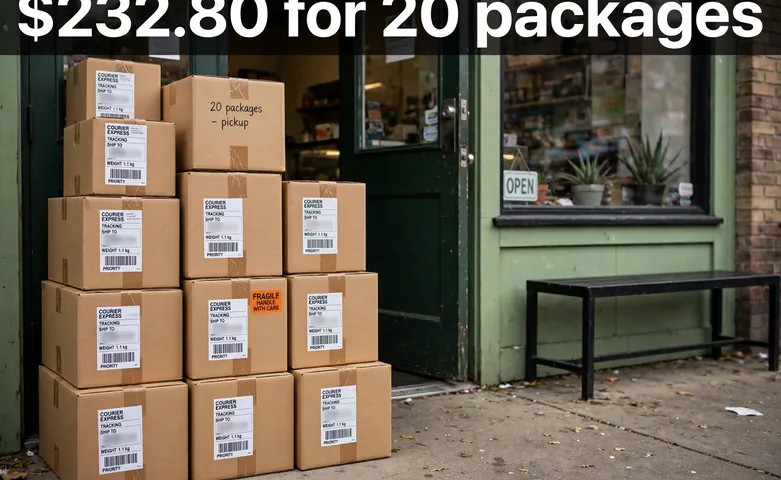
A photo of a stack of sealed cardboard shipping boxes with labels ready for courier pickup outside a small shop door
Twenty packages at $11.64 each cost $232.80 to ship, against $240.00 charged to customers.

Frequently asked questions

How do I calculate shipping cost for my small business?

Use the formula cost per package = carrier base rate + (billable weight x per-pound rate) + packaging cost + packing labor. Billable weight is the larger of actual weight and dimensional weight, which is length x width x height in inches divided by 166. In the worked example, a 5 lb box measuring 12 by 10 by 8 inches costs $11.64 per package with a $4.50 base rate, $0.50 per pound, $1.25 packaging and 10 minutes of packing at $18 an hour.

What is dimensional weight in shipping?

Dimensional weight is the weight a carrier charges for the space a box takes up, not what it weighs. It is length x width x height in inches divided by 166. The carrier bills the larger of actual weight and dimensional weight, so a big light box can cost more to ship than a small heavy one.

Why does my carrier use a different DIM divisor than 166?

It depends on the carrier and the service. This calculator uses 166, which is the divisor most domestic parcel carriers use. FedEx uses 139 for some services, which gives a higher dimensional weight and a higher charge. Check your carrier's own divisor and compare it with the result here if the two disagree.

Can I use this calculator if I offer free shipping?

Yes. Enter 0 in the price charged field and the calculator shows the true cost without a margin check. Enter your actual charge to see whether you make or lose money on each package, and by how much per package and per batch.

How can I lower my small business shipping costs?

Right-size your boxes, because dimensional weight punishes big light boxes. Cut packing time with a set packing station and standard box sizes, buy packaging in bulk, and compare carrier services for each route. A 25 lb package in a 24 by 18 by 16 inch box bills at 41.64 lb, so a smaller box alone can save several dollars per package.

How do I work out the shipping cost for a whole batch of orders?

Add the carrier charge, the weight charge, packaging and packing labor, then multiply by the number of packages. The worked example ships 20 packages at $11.64 each, so the batch costs $232.80. Charging $12.00 per package brings in $240.00, leaving a $7.20 margin on the batch.

This is an estimate for planning. Actual shipping rates vary by carrier, service, destination and fuel surcharges, so confirm the rate with your carrier before you set prices.

Start Calculating Now!

Discover the power of smart tools at KitQuarter.

Explore All Tools