Sales Tax Calculator: What Is the Final Price With Tax?
That $99 price tag is never really $99. Enter any price and tax rate, and this free sales tax calculator will show the tax amount and the final total — or work backwards to extract the tax hidden inside a tax-inclusive price.
Formulas verified against standard references. Calculator logic tested with verified worked examples. Last reviewed: October 2026. Our methodology
How sales tax is calculated
Sales tax is a flat percentage of the selling price, applied once at checkout:
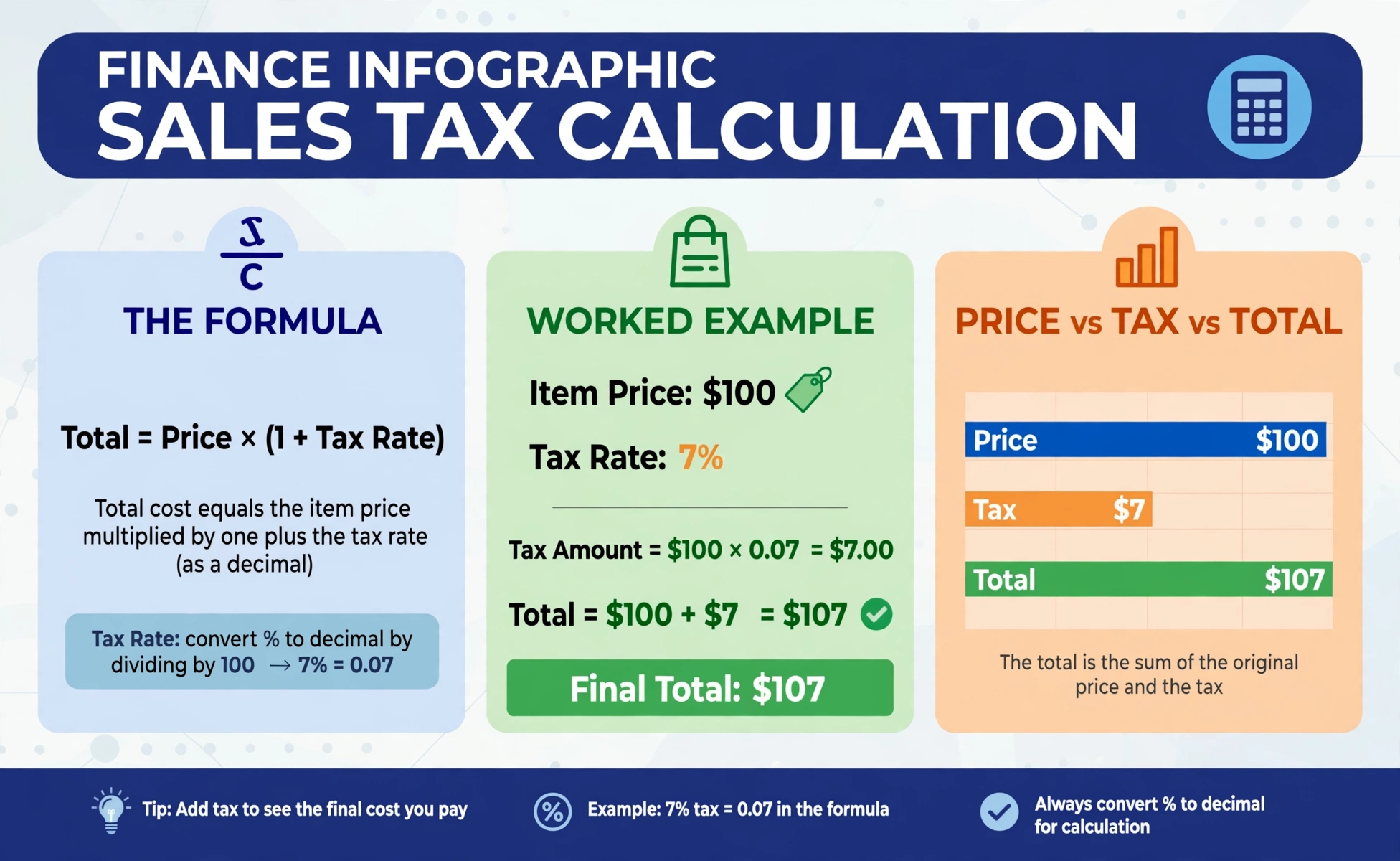
- Adding tax: total = price × (1 + rate); tax = price × rate.
- Extracting tax (tax-inclusive price): before-tax = total ÷ (1 + rate); tax = total − before-tax.
- Multiple items: tax applies to the discounted subtotal — coupons reduce the taxable amount first.
| $100 item at… | Tax | Total |
|---|---|---|
| 5% | $5.00 | $105.00 |
| 7% | $7.00 | $107.00 |
| 9.5% | $9.50 | $109.50 |
US rates combine state, county and city taxes — the total at the register can differ by whole percentage points between neighboring towns.
Worked example
A jacket costs $100 and your local sales tax rate is 7%. Tax = 100 × 0.07 = $7.00. Total = 100 + 7 = $107.00.
Working backwards: a $107 tax-inclusive receipt at 7% means the before-tax price was 107 ÷ 1.07 = $100.00, with $7.00 of embedded tax.
How to use the sales tax calculator
Find your combined local rate — state revenue department sites list them by ZIP code — then calculate.
Step by step
- Enter the price. The shelf price before tax.
- Enter the tax rate. Your combined state + local rate, e.g. 7.
- Choose add or extract. "Add" for shelf prices; "extract" when the price already includes tax.
- Press Calculate. Read the tax amount and the final total.
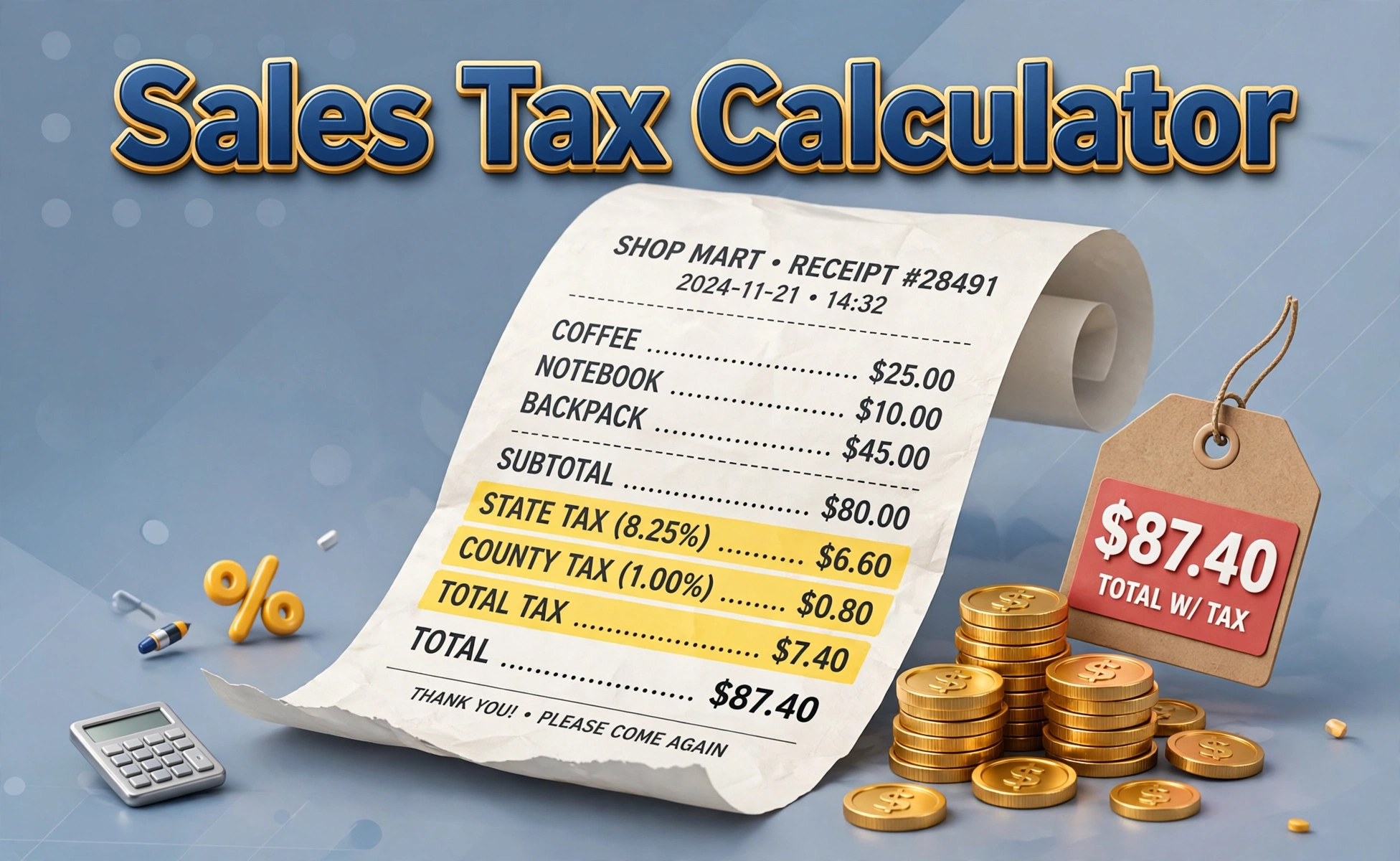
US sales tax rates: why your ZIP code matters
There is no national US sales tax — over 13,000 local jurisdictions stack their own rates:
| Place | Typical combined rate |
|---|---|
| Alaska, Delaware, Montana, New Hampshire, Oregon | 0% (no statewide tax) |
| Colorado | ~2.9% state (locals add more) |
| California | ~7.25%+ (up to ~10%+ locally) |
| Tennessee, Louisiana | ~9.5%+ combined |
Five states levy no statewide sales tax at all. Elsewhere, the register total depends on exactly where you stand — two stores a mile apart can charge different rates. Online purchases generally follow the destination rate: where the item ships, not where the seller sits.
What sales tax does and does not apply to
The rules have more exceptions than people expect:
- Usually taxed: clothing, electronics, furniture, restaurant meals, most goods.
- Often exempt or reduced: groceries (many states), prescription drugs, some clothing under a threshold.
- Services are taxed in some states and not others — a haircut's tax depends on your statehouse, not logic.
- Discounts cut tax: a 20%-off coupon lowers the taxable price first — you save the tax on the discount too. A discount calculator shows the before-tax price.
When in doubt, the receipt is the authority: it separates taxable and non-taxable lines.
Sales tax vs. VAT: the receipt looks different
American visitors abroad meet the VAT — value-added tax — and it works backwards from what they know:
- US sales tax: added at the register; the shelf price is before-tax.
- VAT (Europe etc.): included in the displayed price; the shelf price is the final price.
- Use "extract" mode on this calculator to pull the VAT out of a European price tag.
- Tourists can often reclaim VAT on departures — keep receipts and ask about tax-refund schemes.
Same economics, opposite presentation: Americans do the math at checkout, Europeans already paid it in the sticker.
Frequently asked questions
How do you calculate sales tax?
Multiply the price by the rate: $100 at 7% = $7.00 tax, $107.00 total. To extract tax from a tax-inclusive price, divide by (1 + rate): $107 ÷ 1.07 = $100 before tax.
What is the sales tax rate in my area?
It depends on your exact location — US rates combine state, county and city taxes. Check your state revenue department's rate lookup by ZIP code; five states (AK, DE, MT, NH, OR) have no statewide tax.
Is sales tax charged on discounted prices?
Yes — on the discounted price. A 20%-off coupon lowers the taxable amount first, so you also save the tax on the discount.
Do I pay sales tax on online purchases?
Generally yes, at the destination rate — where the item ships to, not where the seller is. Marketplaces collect it automatically in most states.
What is the difference between sales tax and VAT?
US sales tax is added at checkout to a before-tax shelf price; VAT is already included in the displayed price. Use this calculator's 'extract' mode on VAT-inclusive prices.
Are groceries taxed?
It depends on the state — many exempt groceries entirely, some tax them at a reduced rate, a few at the full rate. Restaurant meals are taxed almost everywhere.
How do I back out sales tax from a total?
Divide by one plus the rate: a $107 total at 7% tax = 107 ÷ 1.07 = $100.00 before tax, so $7.00 was tax.