Discount Calculator: Sale Price & Savings
Calculate the sale price, discount amount and total savings on any purchase. Enter the original price and discount percentage to see what you pay and what you save.
Formula
Discount amount = original price x discount percentage / 100. Sale price = original price - discount amount.
Quick mental math: 10% off means multiply the price by 0.9. 20% off means multiply by 0.8. 25% off means multiply by 0.75. So a $80 item at 25% off is $80 x 0.75 = $60.
Worked example
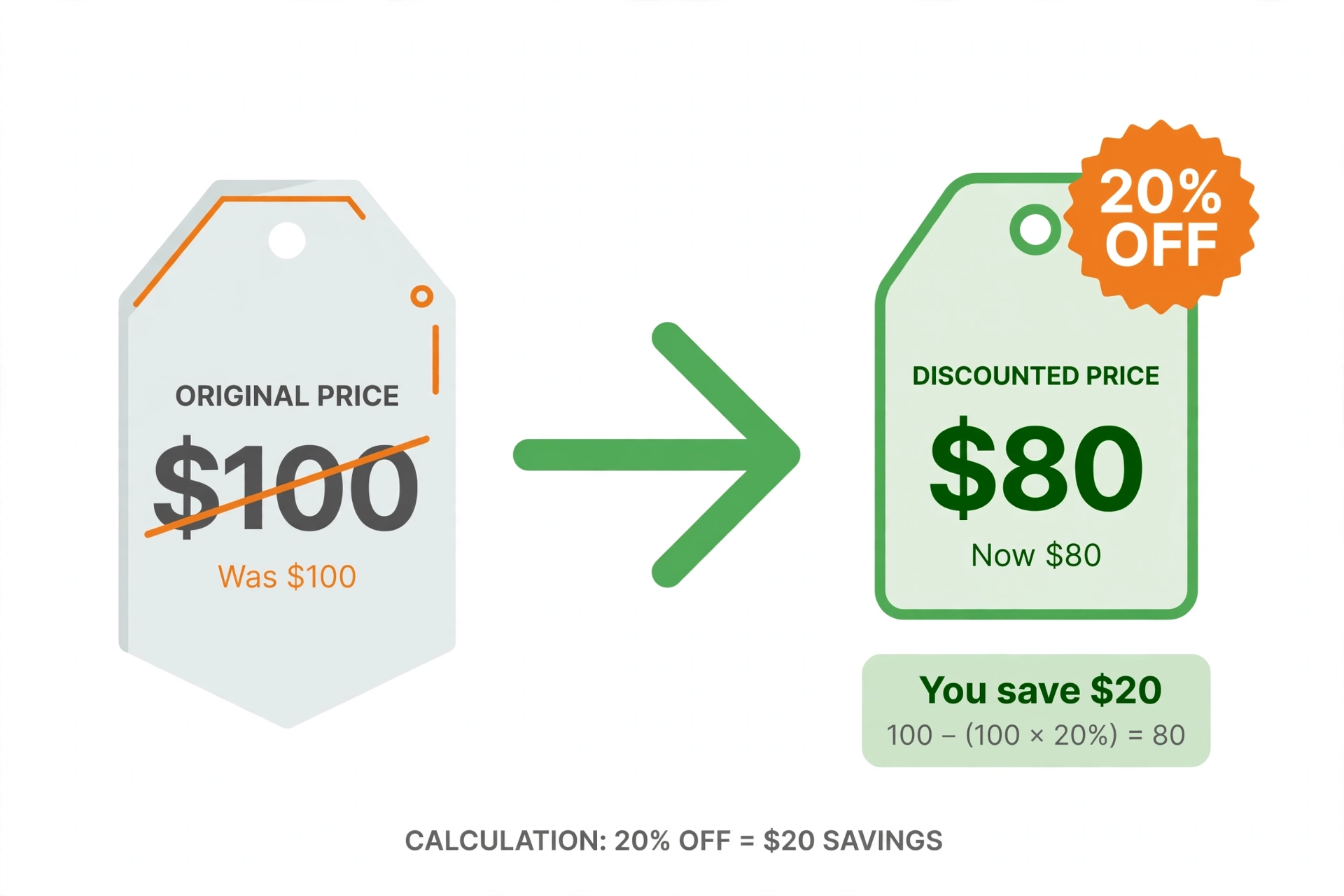
A $100 jacket at 20% off: discount = $100 x 20 / 100 = $20. Sale price = $100 - $20 = $80. You save $20.
A $250 TV at 15% off: discount = $250 x 0.15 = $37.50. Sale price = $250 - $37.50 = $212.50.
How to use the discount calculator
Enter the original price, then the discount percentage. The calculator shows the discount amount, the final sale price, and your total savings instantly.
The two fields
- Original price — the price before any discount, in dollars.
- Discount % — the percentage off, from 0 to 100.
What it does not do
It does not add sales tax or shipping. The sale price shown is before tax — your checkout total will be higher once tax is applied. Planning a bigger purchase? The compound interest calculator shows what saving that money could grow into instead.
Common discounts at a glance
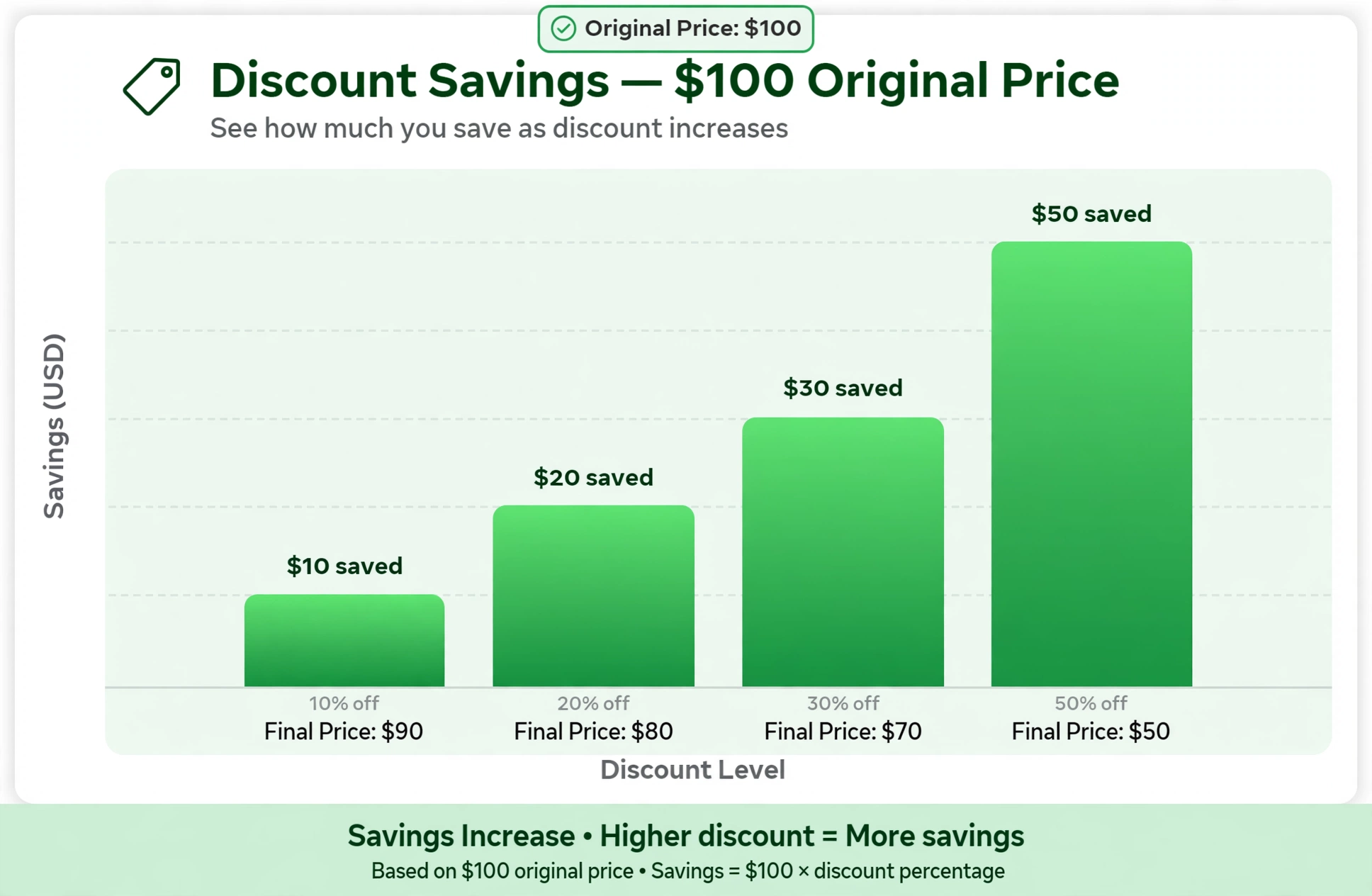
What common discount percentages mean for a $100 item:
| Discount | You save | Sale price |
|---|---|---|
| 10% off | $10.00 | $90.00 |
| 15% off | $15.00 | $85.00 |
| 20% off | $20.00 | $80.00 |
| 25% off | $25.00 | $75.00 |
| 30% off | $30.00 | $70.00 |
| 50% off | $50.00 | $50.00 |
Stacking two discounts
Two discounts do not simply add up. A 20% discount followed by an extra 10% off is not 30% off — the second discount applies to the already-reduced price.
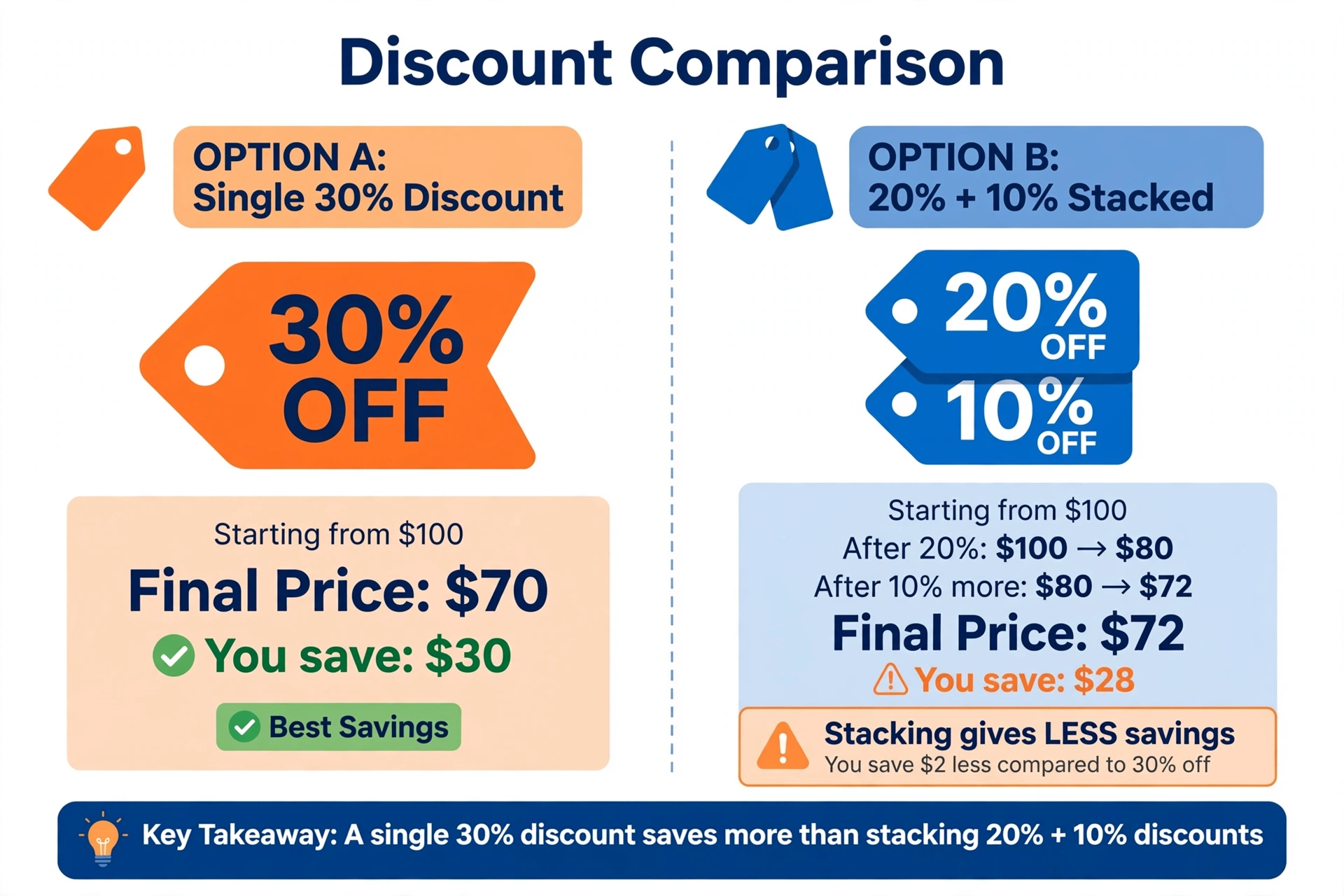
Example: $100 with 20% off becomes $80. An extra 10% off $80 saves $8 more, for a final price of $72 — a total saving of 28%, not 30%.
| Deal | Final price on $100 |
|---|---|
| 30% off | $70.00 |
| 20% then 10% off | $72.00 |
| Buy one get one 50% off (2 items) | $75.00 each on average |
Sale price vs checkout total
The calculator shows the sale price before tax. Your checkout total adds sales tax and possibly shipping on top of that.
Example: a $80 sale price with 8% sales tax costs $80 x 1.08 = $86.40 at checkout. Always factor in tax when comparing deals across states or countries with different tax rates.
Comparing deals: which saves more?
A bigger percentage is not always the better deal. Convert every offer to the final sale price with the calculator above, then compare:
| Offer | Final price | Verdict |
|---|---|---|
| $120 with 25% off | $90.00 | Better deal |
| $100 with 10% off | $90.00 | Same price |
| $95 with 5% off | $90.25 | Slightly worse |
Watch for inflated "original" prices. A 50% discount off a marked-up price can cost more than 20% off a fair price. Compare the final sale prices, not the discount percentages.
Frequently asked questions
How do you calculate a 20% discount?
Multiply the original price by 0.20 to get the discount amount, then subtract it. For $100: $100 x 0.20 = $20 off, so the sale price is $80.
What is the sale price of $50 with 30% off?
$50 x 0.30 = $15 discount. Sale price = $50 - $15 = $35.
How do you stack two discounts?
Apply them one at a time. A 20% discount then an extra 10% off $100: first $100 becomes $80, then 10% off $80 saves $8 more, for a final price of $72 — not $70.
Does the sale price include tax?
No. This calculator shows the price before sales tax and shipping. Add your local tax rate on top of the sale price to get the checkout total.
What is a good discount percentage?
It depends on the product. Everyday items often go 10-20% off on sale, while clearance can reach 50-70%. Compare the final sale price across stores rather than chasing the biggest percentage.
How do I reverse-calculate the original price?
Divide the sale price by (1 - discount as a decimal). If you paid $80 after 20% off: $80 / 0.80 = $100 original price.
Related calculators
Loan EMI Calculator
Estimate your monthly loan payment from amount, rate and term.
Use calculatorCompound Interest Calculator
See how your savings grow with compounding interest over time.
Use calculator
Percentage Calculator
Find what P% of any number is — instant answers with the formula shown.
Use calculator