Unit Price Calculator
Find the better buy between two package sizes with this unit price calculator. Enter each price and quantity, press Calculate, and see the unit price of both items, a clear winner, and your savings per unit and in percent. Free, no sign-up, and everything runs in your browser.
Formula: unit price = total price / quantity. The lower unit price is the better buy.

Formulas verified against standard references. Calculator logic tested with verified worked examples. Published: November 5, 2026 | Last updated: November 5, 2026. Fact-checked: November 5, 2026. Our methodology
How to Use the Unit Price Calculator
Getting an answer takes five quick steps. The tool compares two items, but it works just as well with one.
- Type the price and the quantity of Item A in the matching fields.
- To compare a second package, type its price and quantity in the Item B fields. Leave them blank and the tool shows only the unit price of Item A.
- Type the unit you measured in, such as oz, lb, g, or count. Both items must use the same unit, so convert first if the labels differ.
- Press Calculate, or press Enter. The winner appears first, then both unit prices, the savings, and the steps.
- Press Reset to clear the form and try another pair.
The Unit Price Formula
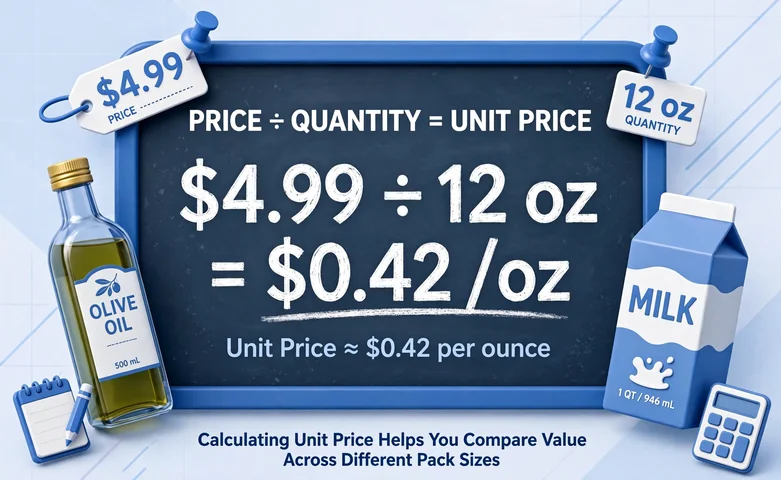
Unit price = total price / quantity. P is the price you pay for the package, and Q is the amount inside it, measured in ounces, pounds, liters, count, or any single unit. It is the only number that makes two package sizes directly comparable.
The savings percent is (higher unit price - lower unit price) / higher unit price x 100. It says how much cheaper each unit of the winner is.
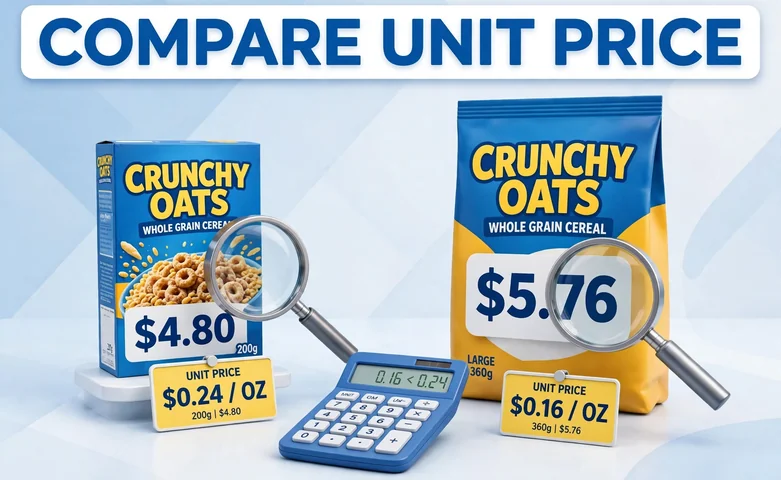
Grocery stores print the same math on shelf tags in the small yellow box under the main price, and it works anywhere the price scales with size.
Worked Example: The Two Cereal Boxes
A 12 oz box costs $4.99 and a 20 oz bag costs $7.49. The bag looks more expensive, but the unit prices tell a different story.
Item A: $4.99 / 12 oz. In cents, 499 / 12 = 41.5833 cents, which rounds to $0.4158 per oz. Item B: $7.49 / 20 oz. In cents, 749 / 20 = 37.45 cents, which is $0.3745 per oz. Item B wins by $0.0413 per ounce.
The savings percent is (0.4158 - 0.3745) / 0.4158 x 100 = 9.9%. In plain dollars, 12 oz of cereal at Item B's rate would cost $4.49 instead of $4.99, a saving of $0.50 on the same amount.
How to Read Your Result
The winner line names the item with the lower unit price. When both unit prices match, the tool reports a tie instead of picking a favorite.
Below the winner you get both unit prices, shown to four decimal places, then the savings in dollars and in percent. The same-amount line prices the loser's quantity at the winner's rate, turning the per-unit gap into real money. With only Item A, you get its unit price and the steps.
Mistakes That Break the Comparison
Mixing units is the most common error. Ounces measure weight while fluid ounces measure volume, and a pound is 16 ounces. Convert both items to one unit before you divide.
Use the net weight on the label. A 14 oz box holding 12 oz of cereal gives a false unit price if you divide by 14. For multi-packs, multiply first, so a 12-pack of 16 oz bottles is 192 oz of product.
Subtract coupons from the price before you divide. A $3 coupon on the $7.49 bag drops its unit price to $0.2245 per oz. If your price already reflects a sale, check it with the discount calculator first.
When the Bigger Pack Is Not the Better Buy
The bigger pack usually wins on unit price, but sales rewrite the rules. A buy-one-get-one deal doubles the quantity at the same price, so run the actual numbers instead of trusting the package size. Watch for shrinkflation too. A 20 oz package shrinking to 18 oz at the same price raises the unit price 11.1%, and that gap is what our percentage change calculator measures.
Disclaimer
This calculator gives an estimate for planning and is for informational purposes only, not financial advice. Actual prices vary by store and over time, and shelf unit prices may be rounded differently from the four decimals shown here. See our disclaimer.
Sources
- NIST Handbook 130: Uniform Unit Pricing Regulation — National Institute of Standards and Technology, how unit prices must be expressed and rounded.
Frequently asked questions
How do you calculate unit price?
Divide the total price by the quantity. A $4.99 package with 12 ounces has a unit price of $0.4158 per ounce.
How do I find the better buy between two package sizes?
Work out the unit price of each and pick the lower one. Make sure both quantities use the same unit, such as ounces or count, before you compare.
Should tax be included in a unit price?
Usually not. Shelf unit prices are almost always pre-tax. If you want the after-tax comparison, add tax afterward with the sales tax calculator.
How do I compare ounces with pounds?
Convert to the same unit first, because 1 pound equals 16 ounces. A 2 lb bag is 32 oz, so divide its price by 32 to get the price per ounce.
Can I use this calculator with only one item?
Yes. Fill in the Item A fields and leave Item B blank. The tool shows just the unit price of that one item, with the steps.
Is the bigger package always the better deal?
No. Sales, coupons, and brand pricing can make a smaller package cheaper per unit. Always compare the unit prices instead of trusting the package size.
Related calculators

Discount Calculator
Calculate sale price, discount amount and total savings on any purchase.
Use calculatorSales Tax Calculator
Add any tax rate to a price and see the final total.
Use calculatorTip Calculator
Work out the tip, split the bill, and see what each person pays, with pre-tax or post-tax tipping and smart rounding.
Use calculatorBill Splitter
Split restaurant bills with tip and tax among friends.
Use calculator
Percentage Change Calculator
Calculate the percent increase or decrease between two numbers, step by step.
Use calculatorROI Calculator
Measure investment returns with ROI, gain or loss and annualized growth.
Use calculator