ROI Calculator: Return on Investment
Return on investment (ROI) is the standard way to measure how profitable an investment was relative to what you paid for it. Enter the cost of your investment and what it grew to (or was sold for), plus how long you held it, and this ROI calculator returns your gain or loss in dollars, your ROI percentage and your annualized ROI.
Formulas verified against standard finance references. Calculator logic tested with verified worked examples. Last reviewed: October 2026. Our methodology
The ROI formulas
ROI answers one question: how much did you earn for every dollar you put in? The gain is simply the final value minus the cost, and dividing by the cost scales that profit relative to the size of the investment. The result is usually written as a percentage.
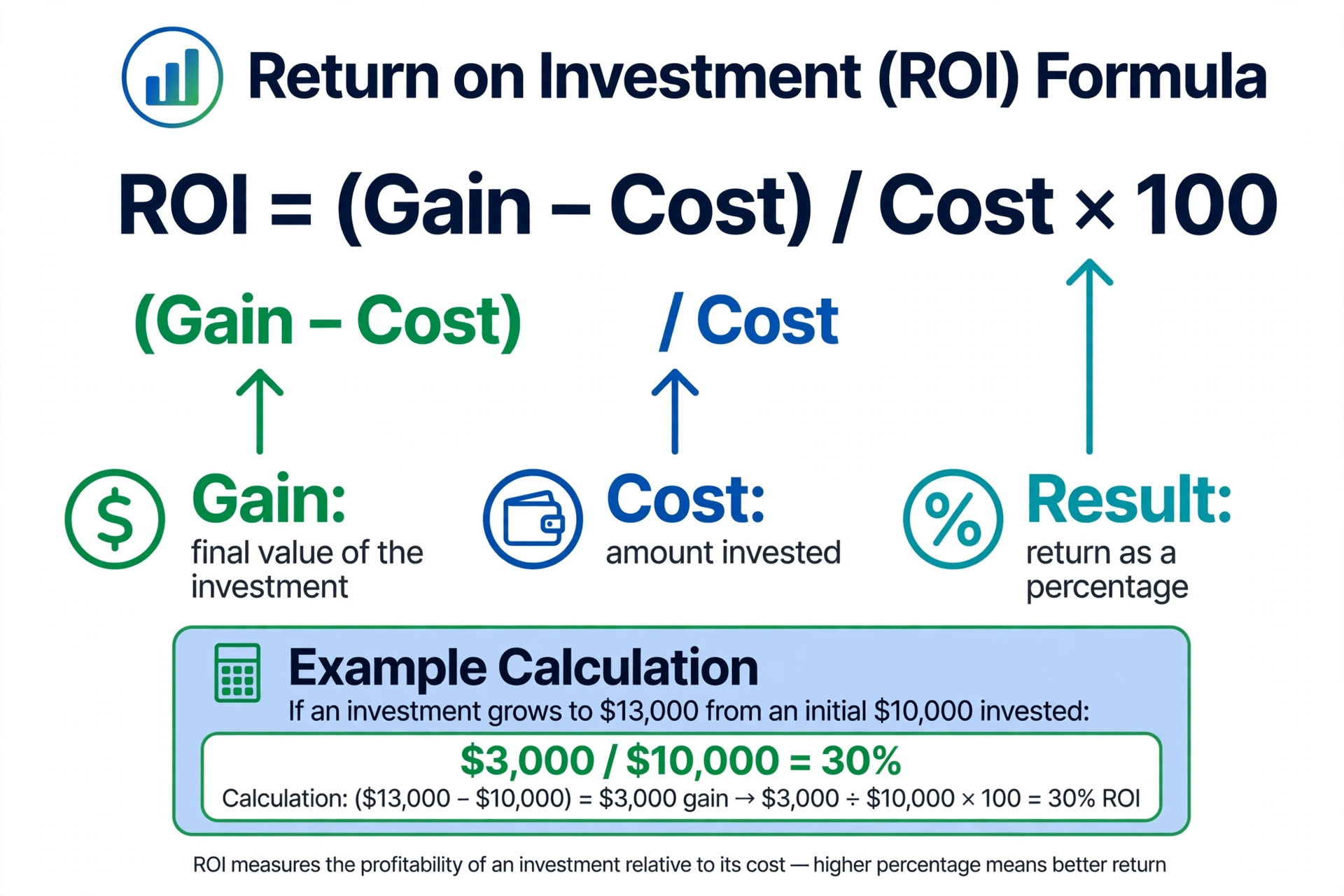
- Investment gain: gain = final value − cost of investment
- Simple ROI: ROI = gain ÷ cost × 100
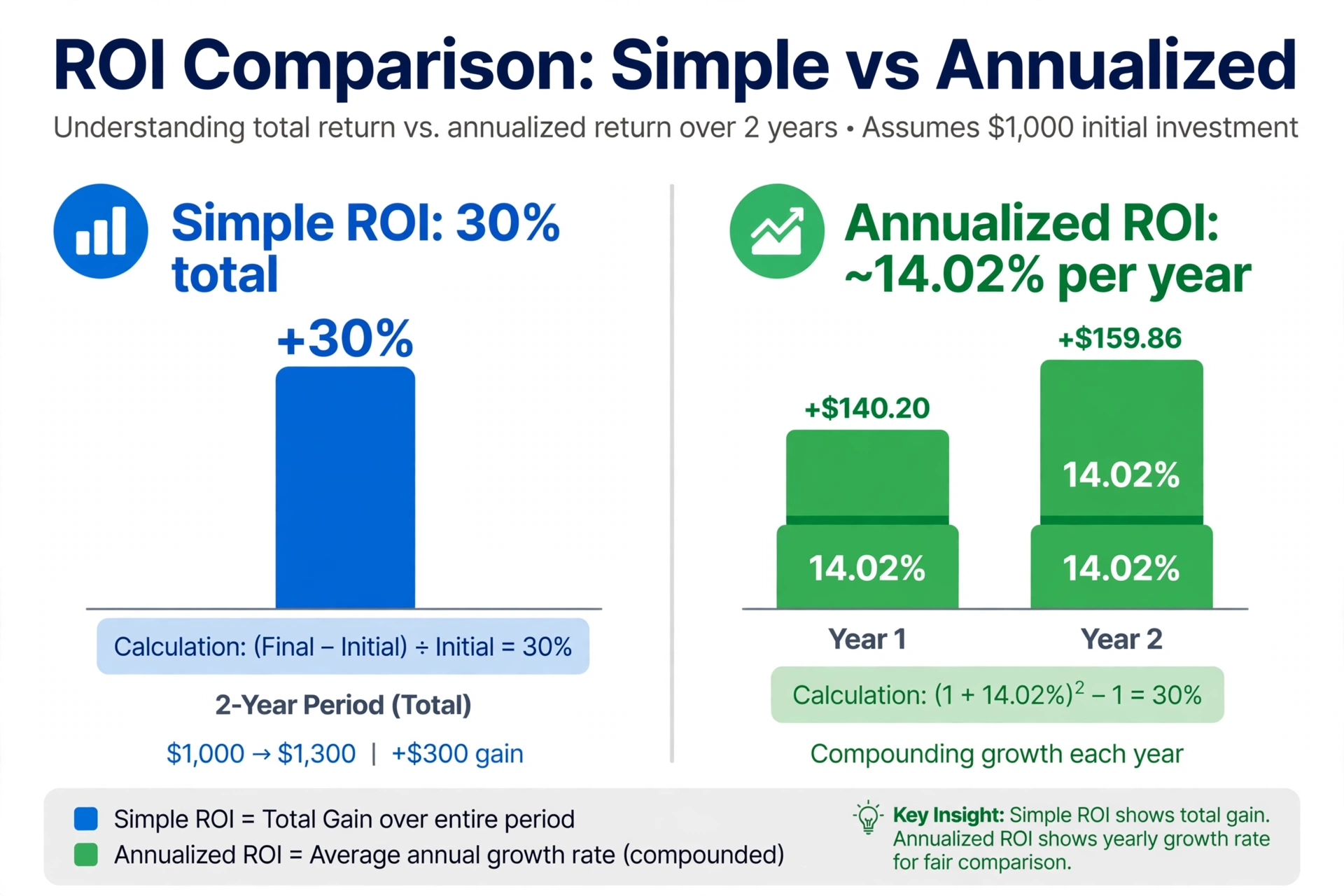
- Annualized ROI: (1 + ROI)1/years − 1, where ROI is the decimal form of the simple ROI and years is the holding period
- Negative ROI: when the final value is below the cost, the gain — and therefore the ROI — is negative, which means the investment lost money
Sources: Investopedia — Return on Investment (ROI); Corporate Finance Institute — Return on Investment (ROI).
Worked example
Suppose you buy shares for $10,000 and sell them two years later for $13,000. The gain is $13,000 − $10,000 = $3,000. Divide by the cost: $3,000 ÷ $10,000 = 0.30, so the simple ROI is 30%. To annualize it over the 2-year holding period: (1 + 0.30)1/2 − 1 ≈ 0.1402, an annualized ROI of about 14.02% per year.
How to use the ROI calculator
Four inputs are all it takes. Use total figures — include purchase fees in the cost, and include any income the investment paid you (dividends, rent) in the final value for a complete picture.
Step by step
- Enter the cost of investment. Everything you paid: purchase price plus any fees or commissions. This must be greater than zero.
- Enter the final value. What the investment is worth now, or what you sold it for. If it fell in value, just enter the lower number — the calculator will report a loss.
- Enter the investment time in years and months. This is only used for the annualized ROI. Leave it as zero if you only want the simple ROI.
- Press Calculate. Read the gain or loss in dollars, the ROI percentage, the annualized ROI and the step-by-step working underneath.
ROI vs rate of return
"ROI" and "rate of return" are often used as synonyms, and in practice simple ROI is the rate of return for the whole holding period: the gain relative to the cost. The difference is mostly in convention — "rate of return" is the general concept, while "ROI" is the specific percentage formula most people reach for first.
| Measure | What it answers | Example ($10,000 → $13,000, 2 years) |
|---|---|---|
| Simple ROI | Total return over the whole period | 30% |
| Rate of return | Gain relative to cost, in general | 30% over the period |
| Annualized ROI | Equivalent yearly growth rate | ≈ 14.02% per year |
| Total return (loss case) | Gain relative to cost when value fell | −20% if sold for $8,000 |
Where compounding enters the picture, ROI stops being enough on its own. An investment that grows by reinvesting its earnings each year behaves differently from one that pays out a lump sum at the end, which is why a compound interest calculator is the natural next step when your returns are reinvested rather than realized at sale.
Annualized ROI: comparing investments fairly
A 30% return sounds better than a 15% return — until you learn the first took two years and the second took six months. Annualized ROI (also called the compound annual growth rate) converts any holding period into an equivalent per-year rate, so investments of different lengths can be compared on equal terms.
Annualized ROI examples
| Simple ROI | Holding period | Annualized ROI |
|---|---|---|
| 30% | 2 years | ≈ 14.02% per year |
| 50% | 5 years | ≈ 8.45% per year |
| 20% | 6 months | 44.00% per year |
| 100% | 10 years | ≈ 7.18% per year |
The table shows why time matters so much: doubling your money over ten years is only about 7.18% a year. When you want to project how a steady yearly return would accumulate into the future — including regular contributions — an investment calculator picks up where simple ROI leaves off.
What ROI doesn't tell you
ROI is a blunt instrument: simple to compute and easy to compare, but it hides several things that can change which investment was really better.
- Time, in the simple version. Two investments can both show 30% ROI while one took a year and the other took a decade. Always annualize before comparing.
- Risk. A 30% ROI from government bonds and a 30% ROI from a speculative startup are not the same achievement — ROI says nothing about the odds of losing your money.
- Cash flow timing. ROI assumes one lump sum in and one lump sum out. If you deposited money midway through, the true return depends on when each dollar was invested, which plain ROI cannot capture.
- Non-financial returns. Learning, brand value, or the use you got from an asset never appear in the formula, even when they were part of the reason to invest.
Finance references such as Investopedia's ROI guide treat ROI as a profitability ratio of net profit to cost — useful for ranking opportunities, but never the whole story on its own.
Frequently asked questions
What is ROI (return on investment)?
ROI — return on investment — measures how much profit an investment generated relative to its cost. It is expressed as a percentage: a 30% ROI means you earned 30 cents of profit for every dollar invested. It is one of the most widely used profitability ratios in finance.
How do you calculate ROI?
Subtract the cost of the investment from its final value to get the gain, divide by the cost, and multiply by 100. For a $10,000 investment that grows to $13,000: ($13,000 − $10,000) ÷ $10,000 × 100 = 30%.
What is a good ROI?
It depends on the risk and the time period. A long-term stock market investor might target 7–10% annualized, while a business project may need 15% or more to justify the risk. Always compare ROI against alternatives with similar risk — and use annualized ROI so time periods match.
What is the difference between ROI and annualized ROI?
Simple ROI measures the total return over the whole holding period — 30% over two years, say. Annualized ROI converts that into a per-year rate — about 14.02% per year compounded — so investments held for different lengths can be compared fairly.
Can ROI be negative?
Yes. If the final value is less than the cost, the gain is negative and so is the ROI — a $10,000 investment sold for $8,000 has an ROI of −20%. A negative ROI simply means the investment lost money.
How is ROI different from the rate of return?
They are closely related: rate of return is the general concept of gain relative to cost, and simple ROI is the most common way to express it as a percentage. People often say 'ROI' when they mean the simple rate of return over the whole period, and use annualized figures when comparing across time.
What are the limitations of ROI?
ROI ignores how long the investment took (use annualized ROI for that), the risk involved, and the time value of money beyond compounding. It also cannot capture non-financial returns like learning or brand value. Two investments with the same ROI can be very different deals once risk and timing are considered.
Related calculators

Compound Interest Calculator
See how reinvested earnings compound into growth year after year.
Use calculatorInvestment Calculator
Project investment growth with regular contributions and returns.
Use calculatorSimple Interest Calculator
Calculate straightforward interest on a principal without compounding.
Use calculator