Simple Interest Calculator: Interest and Total Owed
Work out the interest on a loan or deposit when interest is charged only on the original principal. Enter the principal, the annual rate and the time in years to get the interest, the total amount, and a year-by-year breakdown of how the balance grows.
The simple interest formula
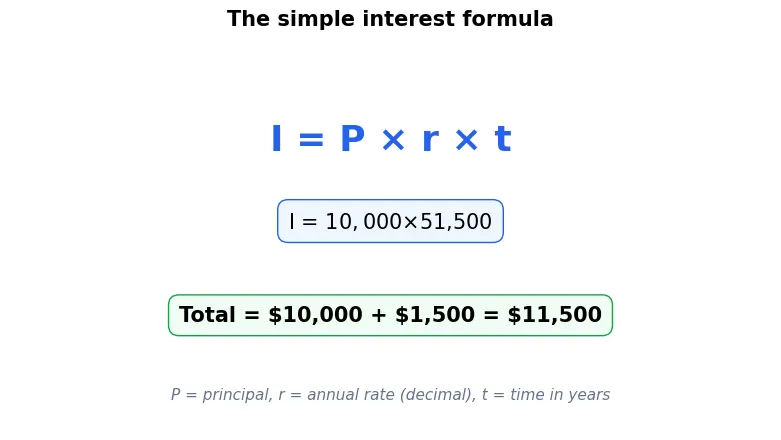
Simple interest is calculated on the original principal every period — earlier interest never earns interest itself. That keeps the formula short:
- Interest = principal × rate × time
- Total amount = principal + interest
The rate must be a decimal in the formula, so 5% becomes 0.05. The calculator handles that conversion for you — just type the rate as a percent.
Worked example
Borrow $10,000 at 5% per year for 3 years. Interest = 10,000 × 0.05 × 3 = $1,500. Total repayment = 10,000 + 1,500 = $11,500. Each year adds exactly $500 — $500 in year one, $1,000 after year two, $1,500 after year three — because every year's interest is computed on the original $10,000.
How to use the simple interest calculator
Three numbers are all it takes. The calculator converts the percent to a decimal, multiplies through, and builds the yearly table for you.
Step by step
- Enter the principal. The lump sum being borrowed or invested.
- Enter the annual rate as a percent. Type 5 for 5% — the calculator converts it to 0.05 itself.
- Enter the time in years. Fractions are fine: 18 months is 1.5 years.
- Press Calculate. You get the total interest, the total amount, the interest per year, and a year-by-year table.
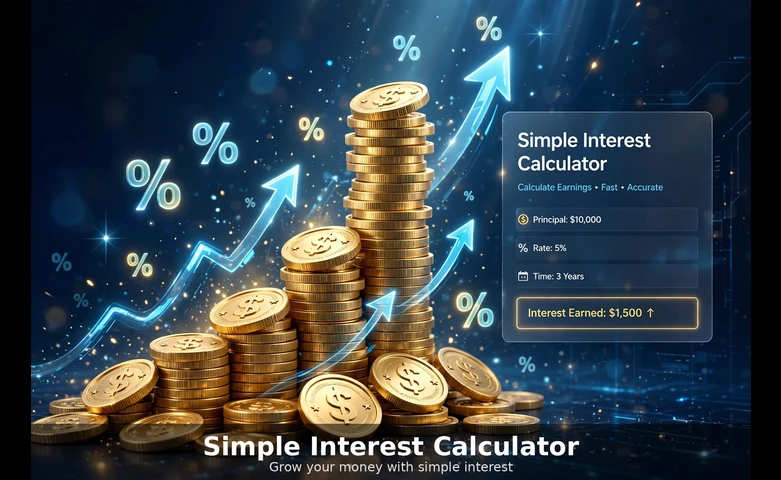
Because each year's interest is identical, the balance grows in a perfectly straight line — the chart below shows $10,000 at 5% adding exactly $500 every year.
Simple vs compound interest
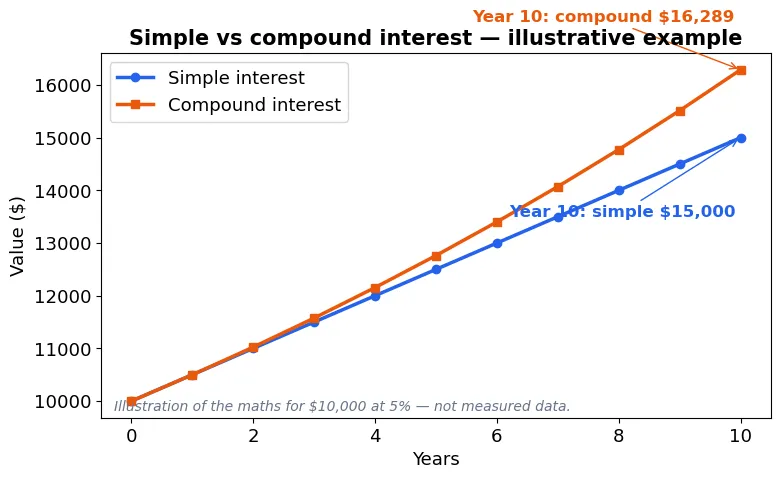
The difference is what the interest is calculated on. Simple interest always uses the original principal, so growth is steady. Compound interest recalculates on the growing balance, so growth accelerates — slowly at first, then dramatically over long periods.
| Feature | Simple interest | Compound interest |
|---|---|---|
| Calculated on | Original principal only | Principal plus accumulated interest |
| Growth pattern | Steady and linear | Accelerating over time |
| Yearly interest | Identical every year | Grows every year |
| Typical use | Short-term loans, some auto loans | Savings accounts, investments, mortgages |
| $10,000 at 5% for 10 years | $15,000 | $16,289 |
To see the gap on your own numbers, run them through a compound interest calculator and compare the totals — for horizons beyond a few years the difference is usually larger than people expect.
Where simple interest is used
Simple interest shows up wherever the term is short or the product is deliberately kept uncomplicated. Short-term personal loans and some car loans charge it, and very short-term deposits are often quoted on a simple basis because compounding would barely change the number.
| Product | How simple interest applies |
|---|---|
| Short-term personal loans | Interest is charged on the original amount for the whole term |
| Some auto loans | Daily interest accrues on the outstanding balance without compounding |
| Short-term deposits | Terms under a year are often quoted without compounding |
Mortgages, credit cards and savings accounts compound instead — which is exactly why their long-run numbers look so different. Investopedia's simple interest explainer walks through the mechanics with further examples.
If you are on the saving side rather than the borrowing side, a savings goal calculator turns the question around: given a target and a rate, how much must you set aside each month?
Mistakes to avoid
- Entering the rate as a decimal. Type 5 for 5%. Typing 0.05 would be read as 0.05% — one hundred times too small.
- Mixing months and years. The formula needs years. For 18 months, enter 1.5, not 18.
- Confusing interest with APR. Simple interest here is just the interest charge. APR annualises the total cost including fees, which is a different — and usually higher — number.
- Assuming long loans stay simple. Multi-year borrowing almost always compounds; simple interest is realistic mainly for short terms.
When in doubt, check the loan agreement: it states whether interest is simple or compounding and how often it is applied.
Frequently asked questions
What is simple interest?
Interest calculated only on the original principal amount. If you borrow $10,000 at 5% simple interest, you pay $500 of interest per year no matter how many years pass, because each year's charge is computed on the original $10,000.
What is the simple interest formula?
Interest = principal × rate × time, with the rate as a decimal and time in years. The total amount owed is the principal plus the interest. For $10,000 at 5% for 3 years: 10,000 × 0.05 × 3 = $1,500 interest, $11,500 total.
What is the difference between simple and compound interest?
Simple interest is always charged on the original principal, so growth is linear. Compound interest is charged on the principal plus all previously accumulated interest, so growth accelerates. Over long periods, compounding produces a noticeably larger total.
Do I enter the rate as 5 or 0.05?
Enter 5. The calculator expects a percent and converts it to the decimal 0.05 internally. Entering 0.05 would be interpreted as 0.05%, which is one hundred times smaller than intended.
Can I use months instead of years?
Convert months to years first by dividing by 12. For 18 months, enter 1.5. The calculator accepts fractional years, so any month count works.
Is simple interest the same as APR?
No. Simple interest here is just the interest charge on the principal. APR (annual percentage rate) annualises the total cost of borrowing including upfront fees, so it is the better number for comparing loan offers.
Where is simple interest actually used?
Mainly in short-term personal loans, some auto loans where interest accrues on the outstanding balance without compounding, and short-term deposits. Mortgages, credit cards and savings accounts compound instead.
Related calculators

Compound Interest Calculator
See how your savings grow with compounding interest over time.
Use calculatorLoan Calculator
Calculate monthly payment, total interest, and total cost with an amortization breakdown.
Use calculatorInvestment Calculator
Project how your lump sum and monthly contributions grow with compound returns over time.
Use calculator