Pool Volume Calculator
Pick your pool shape, enter the dimensions in feet or meters, and press Calculate to see the volume in gallons, liters, cubic feet and cubic meters, with the steps shown.

Formulas verified against standard references. Calculator logic tested with verified worked examples. Published: November 3, 2026 | Last updated: November 3, 2026. Our methodology
The Pool Volume Formula
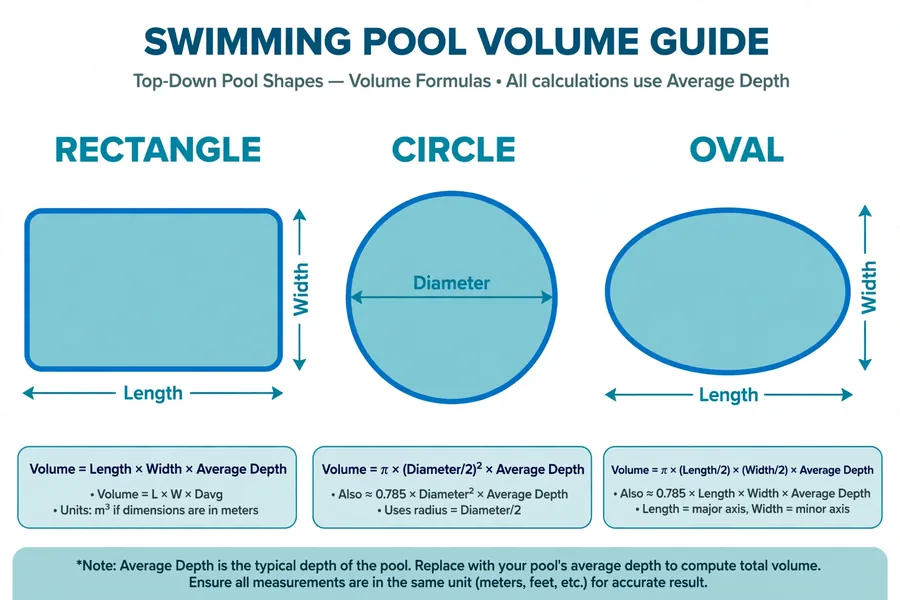
Pool volume is surface area times average depth. The shape only changes how you find the surface area. For a rectangular pool, volume = length x width x average depth. For a round pool, volume = 3.14159 x (diameter / 2) squared x average depth. For an oval pool, volume = 3.14159 x (length / 2) x (width / 2) x average depth. Those give cubic feet when your dimensions are in feet. Multiply by 7.48052 to get US gallons, because one cubic foot holds 7.48052 gallons.
In the formulas, length is the longest point of the pool, width is the widest point, and depth is the average water depth from the waterline down, not the wall height. Oval pools use the ellipse formula with half the length and half the width. A 32 x 16 ft rectangle at 5.5 ft average depth holds 21,065 gallons, and an 18 ft round pool at 4 ft deep holds 7,614 gallons.
Worked Example
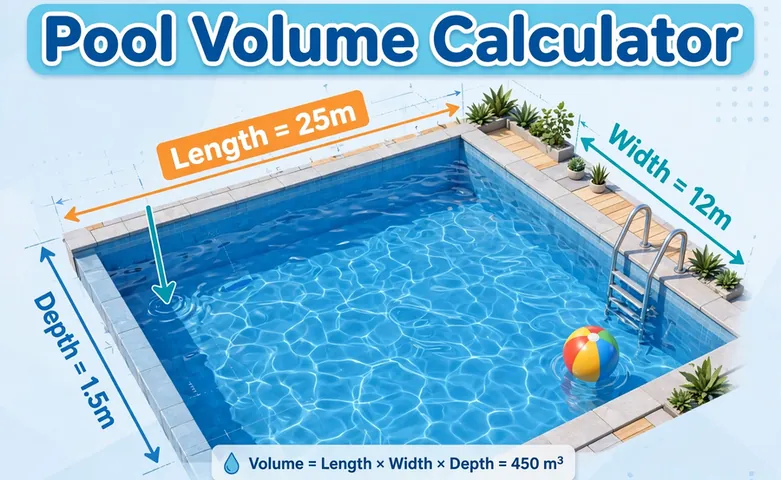
Here is the full arithmetic for a rectangular pool 20 ft long, 12 ft wide, with an average depth of 5 ft, step by step.
First the surface area: 20 x 12 = 240 sq ft. Then the cubic feet: 240 x 5 = 1,200 cu ft. Then the gallons: 1,200 x 7.48052 = 8,976.6, which rounds to 8,977 gallons. The same water is 33,980 liters, or 33.98 cubic meters. So the answer is 8,977 gallons.
The same steps work for the other shapes. An oval pool 15 ft by 30 ft at 5 ft average depth holds 13,219 gallons. Type any of these numbers into the calculator above to check the arithmetic yourself. Concrete pool shells use the same surface-times-depth logic: the concrete calculator turns pool dimensions into concrete volume and bag counts.
How to Use the Pool Volume Calculator
- Choose your pool shape: rectangular, round or oval.
- Pick feet or meters. The toggle changes the unit on every dimension field.
- Enter the dimensions for your shape. A round pool needs only a diameter and an average depth.
- Enter the average depth. For a sloped floor, add the shallow-end and deep-end water depths and divide by 2.
- Press Calculate. You get gallons first, then liters, cubic feet and cubic meters, plus the step-by-step working so you can check the math by hand.
Measuring the Average Depth
Most pools are not one depth all the way across. For a pool with a constant slope, add the shallow-end water depth to the deep-end water depth and divide by 2. A pool that goes from 3 ft to 7 ft has an average depth of 5 ft. This is the standard method used in pool operator training, and every calculator on this page of results expects that average.
Always measure the water depth, from the waterline down to the floor, never the wall height. Pools are rarely filled to the brim, so the wall height overstates the volume, sometimes by a third. Measure at the shallow end and the deep end, in the same spot a swimmer would stand.
If the floor drops suddenly or has separate levels, split the pool into sections. Calculate each section's volume with its own average depth and add the sections together. A 3-to-5 ft section plus a 5-to-8 ft section beats a single rough average every time.
Gallons vs Liters: Which Number to Use
Gallons and liters describe the same water. The right one depends on what you do next. In the United States, pool chemicals are dosed in gallons and water bills are usually in gallons, so gallons is the practical number for most pool owners. Dosing instructions outside the US are usually in liters or cubic meters.
Convert between them with two exact factors. One US gallon is 3.78541 liters, and one cubic foot is 28.3168 liters. The 8,977-gallon pool in the worked example holds 33,980 liters, which is 33.98 cubic meters. If you need other volume units, the volume converter handles the rest.
Keep one habit: match the unit to the product label. Chemical labels state doses per gallon or per liter, and mixing the two is the most common dosing mistake pool owners make.
Frequently asked questions
How do you calculate the volume of a pool in gallons?
Multiply the surface area by the average depth in feet, then multiply by 7.48052. A 32 x 16 ft rectangle with an average depth of 5.5 ft holds 2,816 cubic feet, which is 21,065 gallons. Enter your own dimensions in the calculator for the exact figure.
What is the average depth of a pool?
For a constant slope, add the shallow-end and deep-end water depths and divide by 2. A pool sloping from 3 ft to 8 ft averages 5.5 ft. For abrupt drops or multi-level floors, split the pool into sections and add the section volumes.
How many gallons does a 24 ft round pool hold?
At 4.5 ft of average depth it holds 15,228 gallons, computed as 3.14159 x 12 x 12 x 4.5 x 7.48052. Measure the diameter straight across the widest point and halve it to get the radius.
How do you calculate the volume of an oval pool?
Use the ellipse area: 3.14159 x (length / 2) x (width / 2) x average depth x 7.48052. An oval 15 ft by 30 ft at 5 ft average depth holds 13,219 gallons. Measure the length and width at the longest and widest points.
Should I use the wall height or the water depth?
The water depth, always. Measure from the waterline down to the floor at each end. Pools are rarely filled to the brim, so the wall height overstates the volume, sometimes by a third, and every dose computed from it is off by the same share.
How many liters are in 20,000 gallons?
75,708 liters. Multiply gallons by 3.78541. That is 75.71 cubic meters, about the volume of a mid-size in-ground pool.
This is a planning estimate. Confirm the volume and chemical doses with your pool builder or supplier before you buy. Read the full disclaimer.
Related calculators
Concrete Calculator
Volume in cubic feet and yards, bag counts.
Use calculatorCountertop Calculator
Countertop area, slabs, and material to buy.
Use calculatorPaint Calculator
Gallons needed for walls and ceilings.
Use calculatorTile Calculator
Tiles and boxes needed for any area.
Use calculatorFlooring Calculator
Floor area and boxes for plank or tile.
Use calculatorDeck Calculator
Boards, joists and screws for a deck.
Use calculatorBrick Calculator
Bricks and mortar for any wall.
Use calculatorLumber Calculator
Board feet, linear feet and material cost.
Use calculatorVolume Converter
Convert gallons, liters and cubic units.
Use calculatorArea Converter
Convert square feet, meters and acres.
Use calculator