Brick Calculator: How Many Bricks for Your Wall
A brick wall starts with one number: how many bricks to buy. Enter the length and height of your wall, and this free brick calculator figures the wall area, the bricks needed for standard modular brickwork, adds your waste allowance, and tells you how many 80-lb mortar bags to buy.
Formulas verified against standard masonry references. Calculator logic tested with verified worked examples. Last reviewed: October 2026. Our methodology
How the brick math works
The brick calculator runs on one planning figure: a single-wythe wall built from standard modular bricks (7.625 × 2.25 in face) with a 3/8 in mortar joint takes about 6.55 bricks per square foot of wall, mortar joint included. That rate is the standard estimating figure used in masonry takeoffs, so it already accounts for the joints between bricks.
- Wall area: wall length × wall height, in square feet.
- Bricks needed (no waste): wall area × 6.55.
- Bricks to buy: bricks needed × (1 + waste % ÷ 100), rounded up — you cannot buy a fraction of a brick.
- Mortar bags: plan on one 80-lb bag of mortar mix per 30 sq ft of standard brickwork, rounded up (bags = ceil(area ÷ 30)).
Source: Brick Industry Association — Technical Notes, "Dimensioning and Estimating Brick Masonry" (TN 10).
Worked example
Take a wall that is 20 ft long and 8 ft high with a 10% waste allowance. First the area: 20 × 8 = 160 sq ft. Bricks needed with no waste: 160 × 6.55 = 1,048 bricks. Add the waste: 1,048 × 1.10 = 1,152.8, rounded up to 1,153 bricks to buy. Mortar: ceil(160 ÷ 30) = 6 bags of 80-lb mortar mix. Run the calculator with those same inputs and you will get exactly these numbers.
How to use the brick calculator
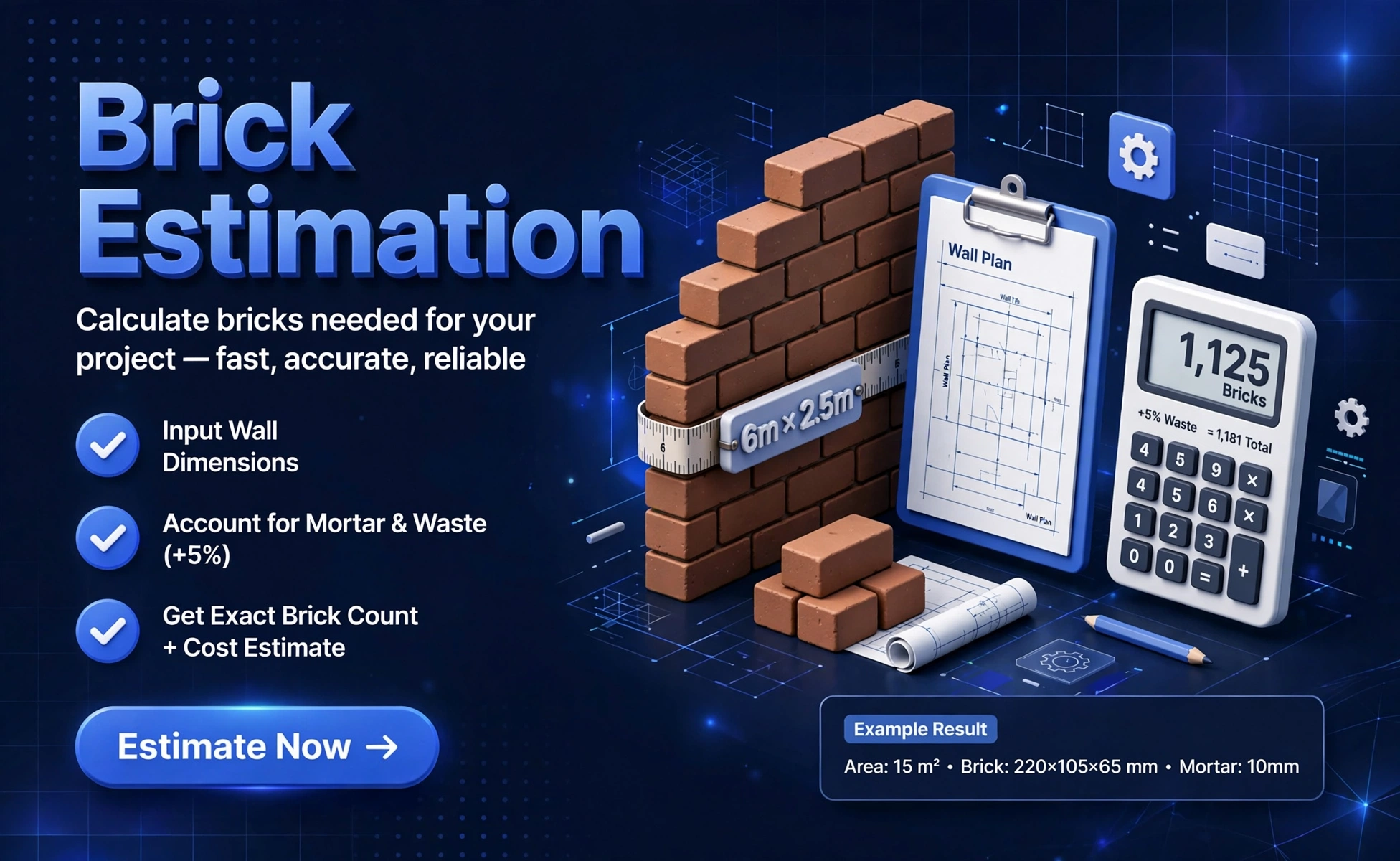
Measure the wall at its longest and tallest points — for a brick veneer on a house, that is the full length of the wall and the full height from footing to top. Type those two numbers in feet, leave the waste allowance at 10% unless your wall has a lot of cuts, and press Calculate.
Step by step
- Enter the wall length in feet.
- Enter the wall height in feet.
- Set the waste allowance. The default is 10%. Use 5% for a plain straight wall and 15% for a wall with many corners, openings or angles.
- Press Calculate. Read the wall area, bricks needed, bricks to buy and mortar bags underneath.
For walls with doors or windows, subtract the openings from the total area first and enter the net dimensions. A 20 × 8 ft wall with a 3 × 7 ft doorway is 160 − 21 = 139 sq ft of actual brickwork.
Why the waste allowance matters
No mason lays every brick untouched. Bricks get cut to fit around openings and corners, a few crack in transport, and odd courses at the top of a wall always need trims. The waste allowance buys that reality up front so you are not short a dozen bricks on the last course.
Ten percent is the industry default for ordinary straight walls, and it is the calculator's default for that reason. Straight walls with no openings can drop to 5%, while walls with many windows, arches or angles should use 15%. Whatever percentage you choose, order from a single batch or run — brick color varies between kiln runs, and a second batch can leave a visible stripe across your wall.
| Wall size (ft) | Wall area | Bricks needed | Bricks to buy (10%) | 80-lb mortar bags |
|---|---|---|---|---|
| 10 × 8 | 80 sq ft | 524 | 577 | 3 |
| 20 × 8 | 160 sq ft | 1,048 | 1,153 | 6 |
| 20 × 10 | 200 sq ft | 1,310 | 1,441 | 7 |
| 30 × 10 | 300 sq ft | 1,965 | 2,162 | 10 |
The table shows common wall sizes at the default 10% waste. A brick veneer usually sits on a concrete footing, so once you have the brick count, a concrete calculator tells you how much concrete that footing needs.
Bricks per square foot and mortar math
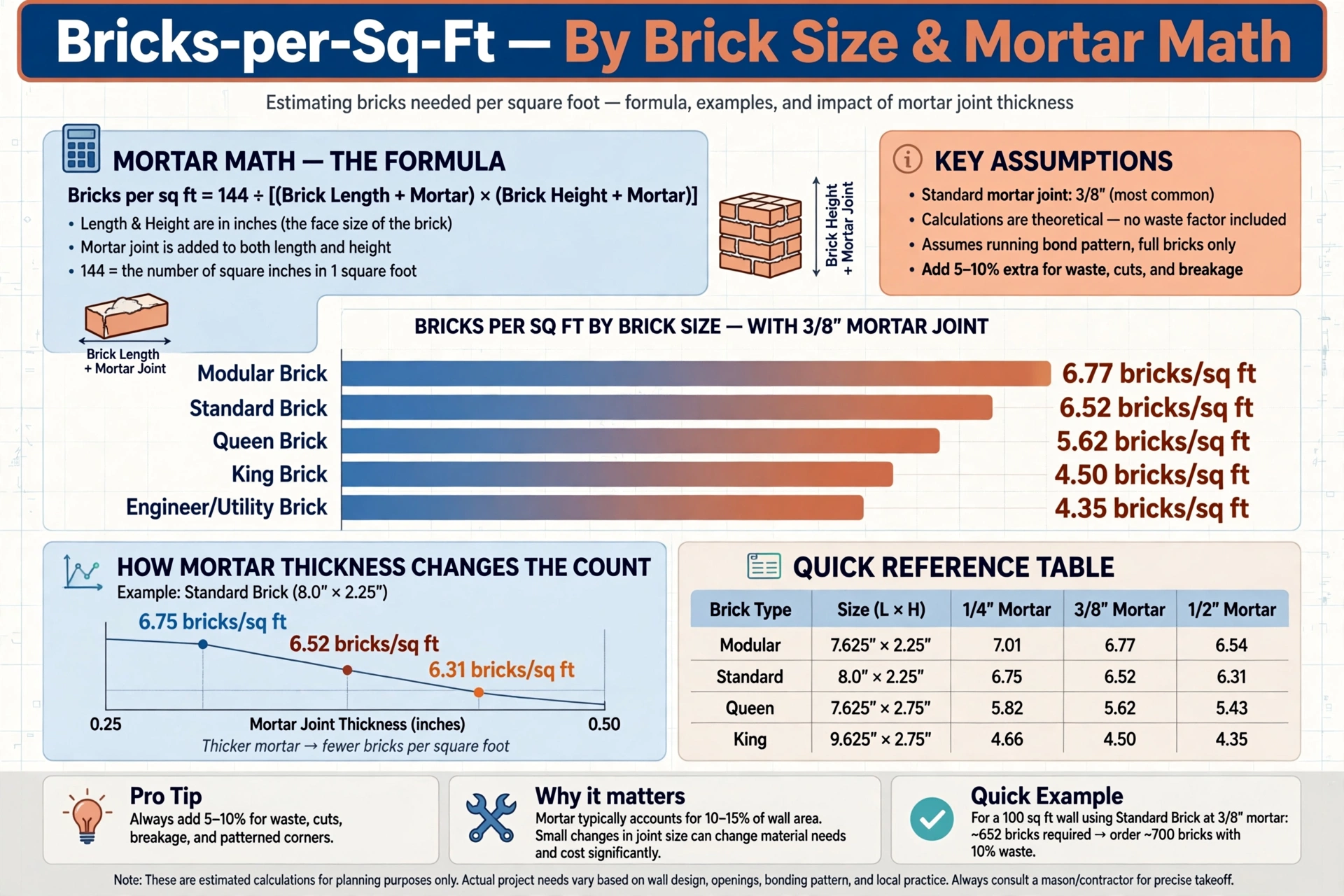
The 6.55 rate already includes the mortar joint, which is why it is lower than the count of bricks laid dry against each other. A standard modular brick has a face of 7.625 × 2.25 in, and once the 3/8 in mortar joint is added to each side, each unit effectively covers more area. The estimating figure of 6.55 bricks per square foot is the number masons and suppliers actually use, so the calculator matches what a brickyard will expect to hear.
Mortar is estimated in 80-lb bags of premixed mortar. A common planning rule is one bag per 30 sq ft of standard single-wythe brickwork; the calculator rounds bags up, because a half bag at the end of a job is far cheaper than a return trip to the supplier. Wet mortar goes a long way in theory but joints thicker than 3/8 in eat through bags quickly, so keep joints consistent.
| Waste % | Bricks to buy | Extra bricks |
|---|---|---|
| 0% | 1,048 | 0 |
| 5% | 1,101 | 53 |
| 10% | 1,153 | 105 |
| 15% | 1,206 | 158 |
What each waste setting costs on a 20 × 8 ft wall (1,048 bricks with no waste).
Measuring and ordering tips
Measure length and height separately and multiply them — never pace off the area itself, because small errors on each dimension compound. For a veneer that wraps a corner, measure each wall face and add the areas together rather than stretching one number around the bend.
- Subtract openings before calculating. Measure each door and window, multiply length by height, and take the total off the wall area. Rough openings count, not the finished frame.
- Round up at the end, not in the middle. Only the final buy number is rounded up. Rounding intermediate steps can stack and inflate the order.
- Think in pallets. Bricks are usually sold by the pallet (commonly around 500–560 modular bricks per pallet). A 1,153-brick order is roughly two and a third pallets — order three and keep the extras for future repairs.
- Keep spare bricks. Save a few dozen from the same batch. Matching the exact color and texture years later is nearly impossible.
Getting the wall area right is a skill that transfers to other projects. If the same wall later needs a new surface, a tile calculator uses that identical length-by-height math to estimate tiles instead of bricks.
Frequently asked questions
How many bricks do I need for a wall?
Multiply wall length by wall height to get the area in square feet, then multiply by 6.55 bricks per square foot for standard modular brickwork including the mortar joint. Add your waste allowance (10% is typical) and round up. A 20 × 8 ft wall at 10% waste needs 1,153 bricks.
How many bricks per square foot?
For a standard modular brick wall (7.625 × 2.25 in face) with a 3/8 in mortar joint, the standard estimating figure is 6.55 bricks per square foot. That rate already includes the mortar joint, so you do not add anything extra for joints.
How much waste should I add to a brick order?
Use 10% for an ordinary straight wall, 5% for a plain wall with no openings, and 15% for walls with many corners, windows, arches or angles. Waste covers cuts, breakage in transport and trimming at the top course.
How much mortar do I need per square foot of brickwork?
A common planning rule is one 80-lb bag of mortar mix per 30 square feet of standard single-wythe brickwork. Divide your wall area by 30 and round up. A 160 sq ft wall needs 6 bags.
Should I subtract doors and windows from the wall area?
Yes. Measure each opening (length × height) and subtract the total from the wall area before calculating. Rough openings count, not the finished frame. Forgetting a large opening can inflate the order by a few hundred bricks.
Does this calculator include the mortar joint?
Yes. The 6.55 bricks-per-square-foot rate is for a standard modular brick with a 3/8 in mortar joint — the joint is baked into the rate, so you do not need to add anything for it. The brick type is fixed to the standard modular brick.
How many bricks are in a pallet?
Most suppliers sell modular bricks by the pallet of roughly 500–560 bricks, though the exact count varies by manufacturer. Divide your buy number by the pallet count your supplier uses, round up, and keep the extras as spares from the same batch.