Lumber Calculator: Board Feet, Linear Feet and Cost
Lumber yards price hardwood and rough-sawn stock by the board foot, not by the piece. Enter your board dimensions and quantity, and this free lumber calculator returns the board feet per piece, the total for your project, the linear footage, and the material cost at your price per board foot.
Formulas verified against standard references. Calculator logic tested with verified worked examples. Last reviewed: October 2026. Our methodology
How board feet are calculated
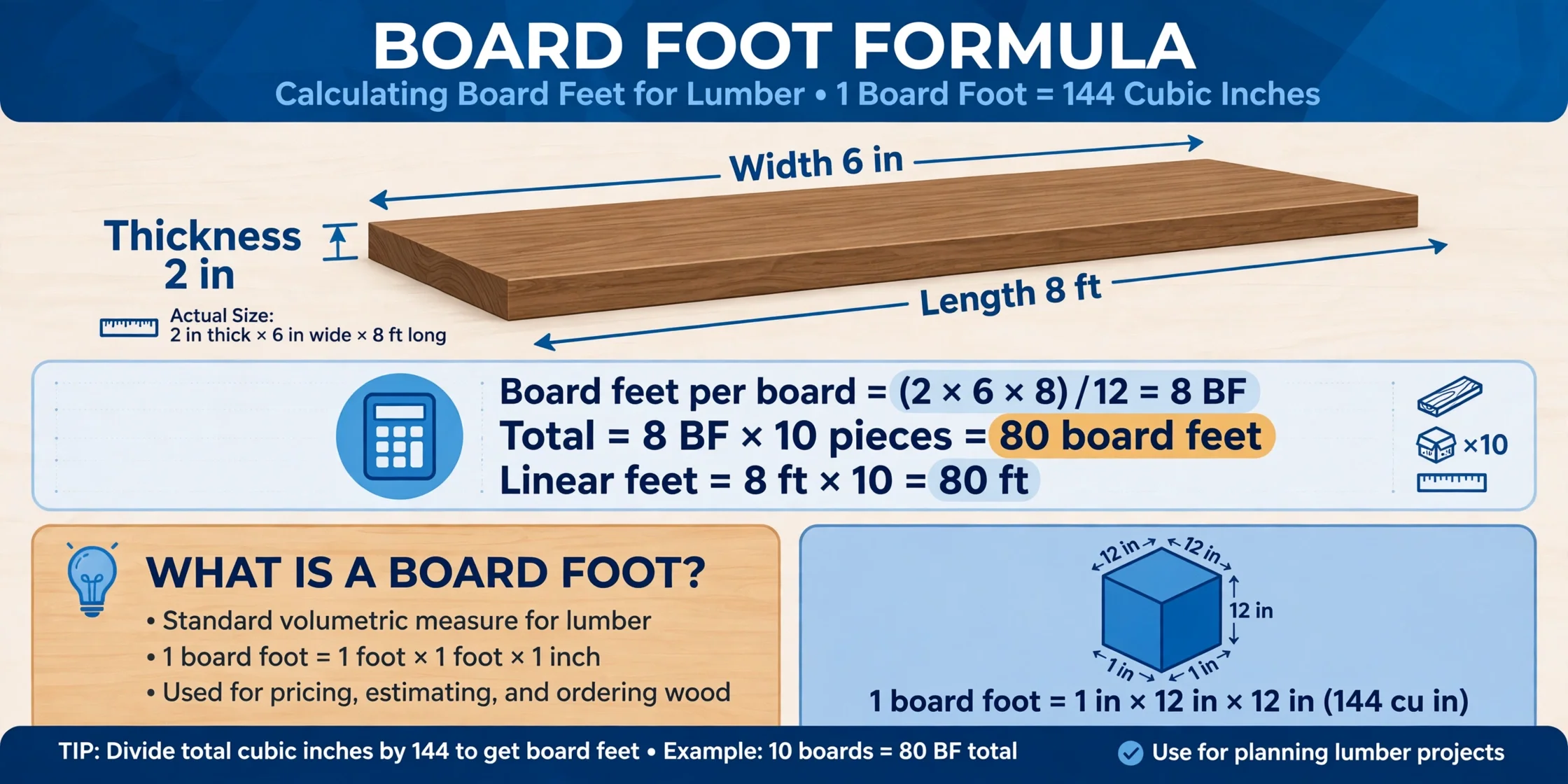
A board foot is a unit of volume: a board 1 inch thick, 12 inches wide and 12 inches long — exactly 144 cubic inches. The standard sawmill formula is:
- Board feet per piece = (thickness in × width in × length ft) ÷ 12.
- All-inches version = (thickness in × width in × length in) ÷ 144.
- Total board feet = board feet per piece × number of pieces.
- Total cost = total board feet × price per board foot.
- Cubic feet = total board feet ÷ 12.
| Result | What it tells you |
|---|---|
| Board feet per piece | Volume of one board — the unit lumber is priced in |
| Total board feet | Project volume; multiply by $/BF for material cost |
| Total linear feet | End-to-end length of all boards laid in a line |
| Cubic feet | True volume — useful for weight and shipping estimates |
The ÷ 12 works because length is entered in feet while thickness and width are in inches — the mix the lumber trade itself uses. Length in inches? Multiply it by 12 first, or use the ÷ 144 version.
Worked example
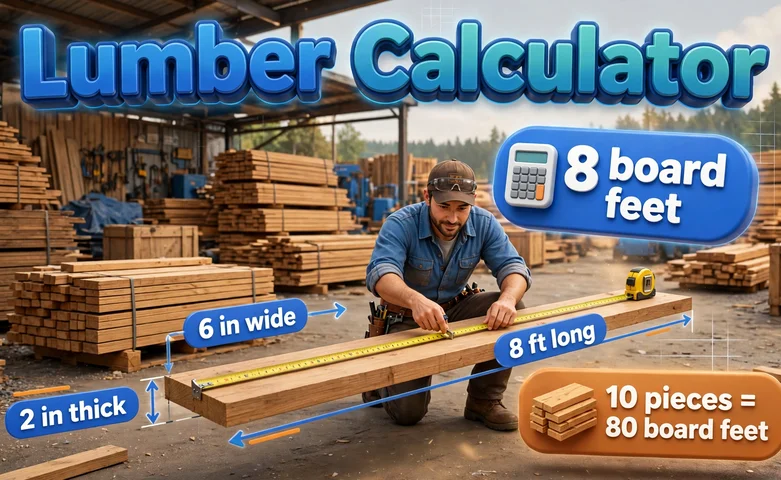
You need 10 pieces of 2 × 6 lumber, each 8 ft long, priced at $6.50 per board foot.
Board feet per piece: (2 × 6 × 8) ÷ 12 = 8 BF. Total: 8 × 10 = 80 board feet. Linear feet: 8 × 10 = 80 ft. Cubic feet: 80 ÷ 12 ≈ 6.67 cu ft. Cost: 80 × $6.50 = $520.00.
How to use the lumber calculator
Have the lumber list from your cut plan ready — this calculator prices identical pieces, so run it once per board size.
Step by step
- Enter the board thickness and width in inches. Use the nominal size the yard sells (2 × 6), not the planed size.
- Enter the board length in feet. Lumber comes in even lengths — 8, 10, 12, 14, 16 ft.
- Enter the number of identical pieces. Group your cut list by size first.
- Enter the price per board foot (optional). Leave it blank to see board feet only.
- Press Calculate. Add 10–15% extra boards when you place the order.
Nominal vs. actual lumber dimensions
Dimensional lumber is sold by its nominal size — the rough size before planing — and priced on that nominal volume. A "2×4" is actually about 1.5 × 3.5 in after surfacing, but the yard charges for the full 2 × 4:
| Nominal size | Actual size (in) | Board feet per 8-ft board |
|---|---|---|
| 1 × 6 | 0.75 × 5.5 | 2.75 |
| 2 × 4 | 1.5 × 3.5 | 3.50 |
| 2 × 6 | 1.5 × 5.5 | 5.50 |
| 2 × 8 | 1.5 × 7.25 | 7.25 |
| 2 × 10 | 1.5 × 9.25 | 9.25 |
| 2 × 12 | 1.5 × 11.25 | 11.25 |
| 4 × 4 | 3.5 × 3.5 | 8.17 |
Enter the nominal dimensions in the calculator — that matches how the yard prices the stock. Use actual dimensions only when you need precise finished volume, for example when checking whether boards fit a tight space.
Board feet vs. linear feet vs. cost
Three different "feet" show up on a lumber quote, and they answer different questions:
| Unit | Measures | Used for |
|---|---|---|
| Board feet (BF) | Volume (144 cu in) | Pricing hardwood and rough-sawn stock |
| Linear feet (LF) | Length only | Trim, moulding, decking runs — anything sold by the foot |
| Cubic feet | True volume | Weight estimates, shipping, drying calculations |
Board feet and linear feet coincide only for 1×12 boards — a 2×6×8 ft board is 8 BF over 8 linear feet, while a 2×12×8 ft board is 16 BF over the same 8 linear feet. Building a deck from these numbers? A deck calculator turns deck dimensions into boards, joists and screws directly.
Waste, defects and ordering tips
Board-foot math is exact; real boards are not. Order smart:
- Add 10–15% extra for defects, miscuts, knots and grain selection — more for clear-grade or highly visible work.
- Buy from one lot so color and moisture content match across the project.
- Check each board for twist, cup and bow before it goes on the truck — culls are cheaper at the yard than at home.
- Round up to full boards when the math gives a fractional piece count.
For the fence that often follows the lumber run, a fence calculator estimates posts, pickets, rails and concrete the same way. For wood design standards behind structural spans, see the American Wood Council.
Frequently asked questions
What is a board foot?
A board foot (BF) is 144 cubic inches of lumber — the volume of a board 1 inch thick, 12 inches wide and 12 inches (1 foot) long. It is the standard unit North American lumber yards use to price hardwood and rough-sawn stock.
How do you calculate board feet?
Board feet = (thickness in inches × width in inches × length in feet) ÷ 12. If all three dimensions are in inches, divide by 144 instead. Multiply the per-piece result by the number of pieces for the project total.
Should I use nominal or actual dimensions?
Use nominal dimensions (the named size, e.g. 2 × 6) when estimating cost, because lumber yards price on nominal volume. Use actual planed dimensions only when you need precise finished volume.
How many board feet are in a 2x4x8?
(2 × 4 × 8) ÷ 12 = 5.33 board feet per board. Ten of them total 53.33 board feet.
What is the difference between board feet and linear feet?
Board feet measure volume (144 cu in each); linear feet measure length only. A 2×6×8 ft board is 8 board feet and 8 linear feet, but a 2×12×8 ft board is 16 board feet over the same 8 linear feet.
How much extra lumber should I order?
Add 10–15% extra for defects, miscuts and grain selection — more for clear-grade or highly visible work, and always round up to whole boards.
Why is some lumber priced per board foot and some per piece?
Hardwood and rough-sawn stock vary in width and thickness, so volume-based per-board-foot pricing is the fair comparison. Standard dimensional framing lumber (2×4s, 2×6s) is usually priced per piece.