Countertop Calculator
Enter your countertop measurements, an optional backsplash and cutouts, and a waste allowance. Get the net countertop area, the material to buy with waste, and how many standard slabs that means for granite, quartz, marble or laminate.

Formulas verified against standard references. Calculator logic tested with verified worked examples. Published: November 2, 2026 | Last reviewed: November 2026. Our methodology
The Countertop Formula
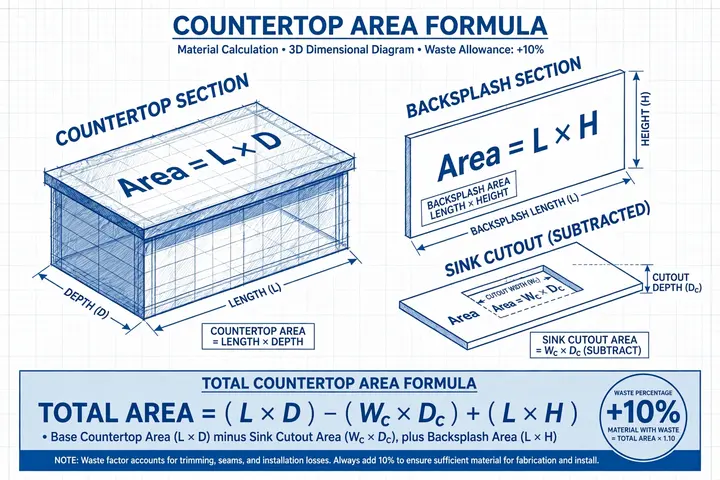
To calculate countertop material, multiply each section's length by its depth, add the runs together, add any backsplash area, subtract sink or cooktop cutouts, then add a waste allowance. In one formula: total = ((length x depth x sections) + (backsplash length x backsplash height) - cutouts) x (1 + waste / 100).
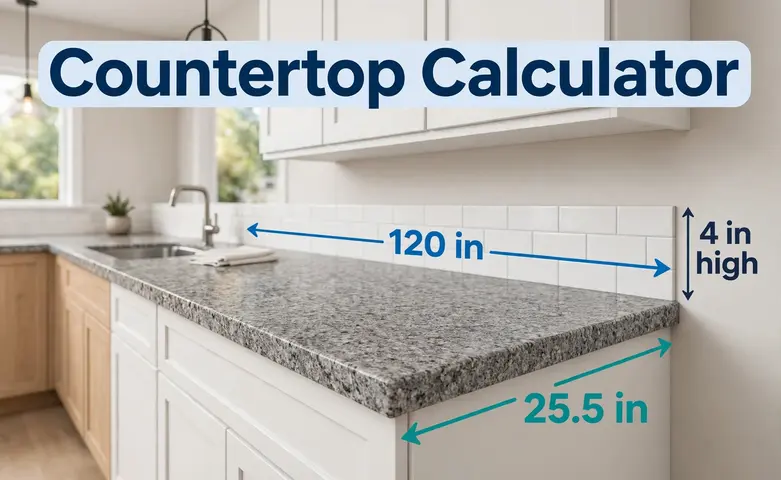
Every field above maps to one term. Length is the longest straight run of each counter. Depth is the front-to-wall distance, and the standard finished depth is 25.5 inches, which covers 24 inches of cabinet plus the overhang. Backsplash counts only when it uses the same stone or laminate. Divide by 144 when your measurements are in inches to convert square inches to square feet.
Worked Example
Here is the full arithmetic for one straight kitchen run, step by step. Take a 10 ft counter that is 2 ft deep: 10 x 2 = 20 sq ft of counter. Add a matching backsplash 10 ft long and 1.5 ft high: 10 x 1.5 = 15 sq ft. Net is 20 + 15 = 35 sq ft. With a 10% waste allowance: 35 x 1.10 = 38.5 sq ft to buy.
Divide by the usable slab yield of 50 sq ft: 38.5 / 50 = 0.77, so you buy 1 slab. The leftover slab stock covers cutting waste and future repairs. Without the backsplash the same counter is 20 sq ft net, 22 sq ft with 10% waste, still 1 slab. The same area logic applies to other projects: the tile calculator turns floor and wall square footage into tiles and boxes.
How to Measure an L-Shaped Counter
Break an L-shape or U-shape into straight rectangles and measure each one wall to wall. A 12 ft run meeting an 8 ft run, both 25.5 inches deep, becomes two sections: 12 x 2.125 = 25.5 sq ft and 8 x 2.125 = 17 sq ft, for 42.5 sq ft net before waste. Use the number of sections field for identical runs, or run the calculator once per different-depth section and add the results.
The corner where the two runs meet gets counted twice if you measure both runs wall to wall. That double-counted corner is about 4.5 sq ft at standard depth, and most fabricators treat it as part of the cutting waste rather than something you must subtract. It also feeds other material estimates: the flooring calculator turns the same room dimensions into planks or tiles.
How Much Waste Should You Allow?
Ten percent is the standard waste allowance for a straight run with few cutouts: it covers edge trimming, the sink and cooktop cutouts, and one miscut. Raise it to 15 percent for L-shapes, and to 15 to 20 percent for U-shapes, diagonal cuts, or pattern-matched stone where offcuts cannot be reused.
Set waste to zero only when you already know the exact finished yield from your fabricator, for example when they quote you in net square feet plus a fixed overage. Otherwise the waste allowance is what keeps a 20 sq ft counter from leaving you 2 sq ft short after the sink cutout.
How Many Slabs Do You Need?
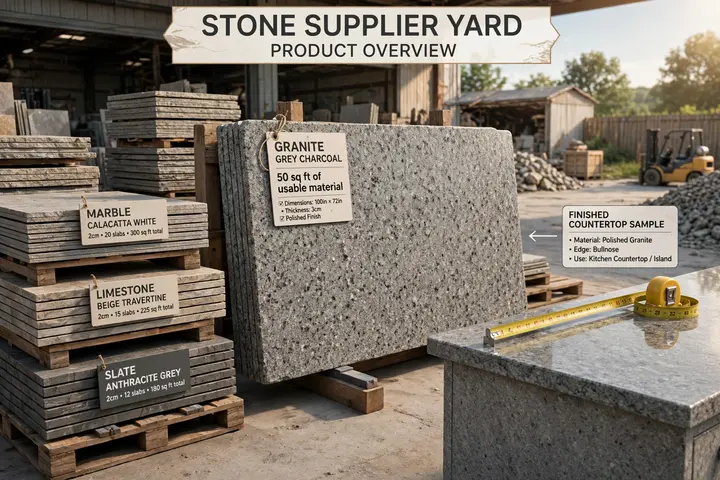
A standard granite or quartz slab measures about 9 to 10 ft long and 5 to 6 ft wide, roughly 45 to 60 sq ft gross. After the fabricator trims the irregular edges, the usable yield is about 50 sq ft per slab. Divide your total square footage with waste by 50 and round up: 38.5 sq ft means 1 slab, 62 sq ft means 2 slabs.
Always round up to a whole slab, because slabs are sold whole and the leftover is useful. Keep the remnant for repairs or a matching vanity top; the concrete calculator works the same way for cast-in-place concrete counters, rounding up to whole bags and yards.
Frequently asked questions
How do you calculate countertop square footage?
Multiply each section's length by its depth, add the sections together, add the backsplash area when it uses the same material, and subtract sink or cooktop cutouts. Divide by 144 if your measurements are in inches. Then multiply by 1 plus the waste percentage to get the material to buy.
What is the standard depth of a kitchen countertop?
The finished depth is typically 25.5 inches, which covers a standard 24 inch base cabinet plus a 1 to 1.5 inch overhang at the front. Islands and peninsulas are often deeper, so measure those separately instead of assuming 25.5 inches.
How many square feet is a slab of granite?
A standard granite or quartz slab is about 9 to 10 feet long and 5 to 6 feet wide, roughly 45 to 60 square feet gross. After the fabricator trims the edges, about 50 square feet is usable. Divide your total square footage by 50 and round up to get the slab count.
How much waste should I add to a countertop estimate?
Use 10 percent for a straight run with few cutouts. Choose 15 percent for L-shapes, and 15 to 20 percent for U-shapes, diagonal cuts, or pattern-matched stone where offcuts cannot be reused. The waste allowance covers edge trimming, cutouts, and miscuts.
Do you count the backsplash in countertop square footage?
Count the backsplash area only when it is made from the same material as the countertop, which is common for granite, quartz, and marble. Multiply the backsplash length by its height and add it to the counter area. Skip it for tile backsplashes, which are estimated separately.
Should you subtract the sink from countertop area?
Yes, subtract the full area of each sink and cooktop cutout when you know the sizes, because those areas need no countertop material. If you do not know the cutout sizes yet, leave the field blank and let the waste allowance absorb them.
This is a planning estimate for material ordering. Confirm final quantities and slab yields with your fabricator before you buy.
Related calculators

Roofing Calculator
Shingles, area, and waste for your roof.
Use calculatorPaint Calculator
Gallons needed for walls and ceilings.
Use calculatorDrywall Calculator
Sheets, mud, and tape for drywall jobs.
Use calculatorTile Calculator
Tiles and boxes needed for any area.
Use calculatorFlooring Calculator
Floor area and boxes for plank or tile.
Use calculatorConcrete Calculator
Volume in cubic feet and yards, bag counts.
Use calculatorLumber Calculator
Board feet, linear feet and material cost.
Use calculatorConcrete Block Calculator
Blocks for a wall with waste allowance.
Use calculatorBoard Foot Calculator
Board feet and cubic feet from dimensions.
Use calculatorDeck Calculator
Boards, joists and screws for a deck.
Use calculator