Roofing Calculator: Estimate Roof Area, Squares and Shingle Bundles
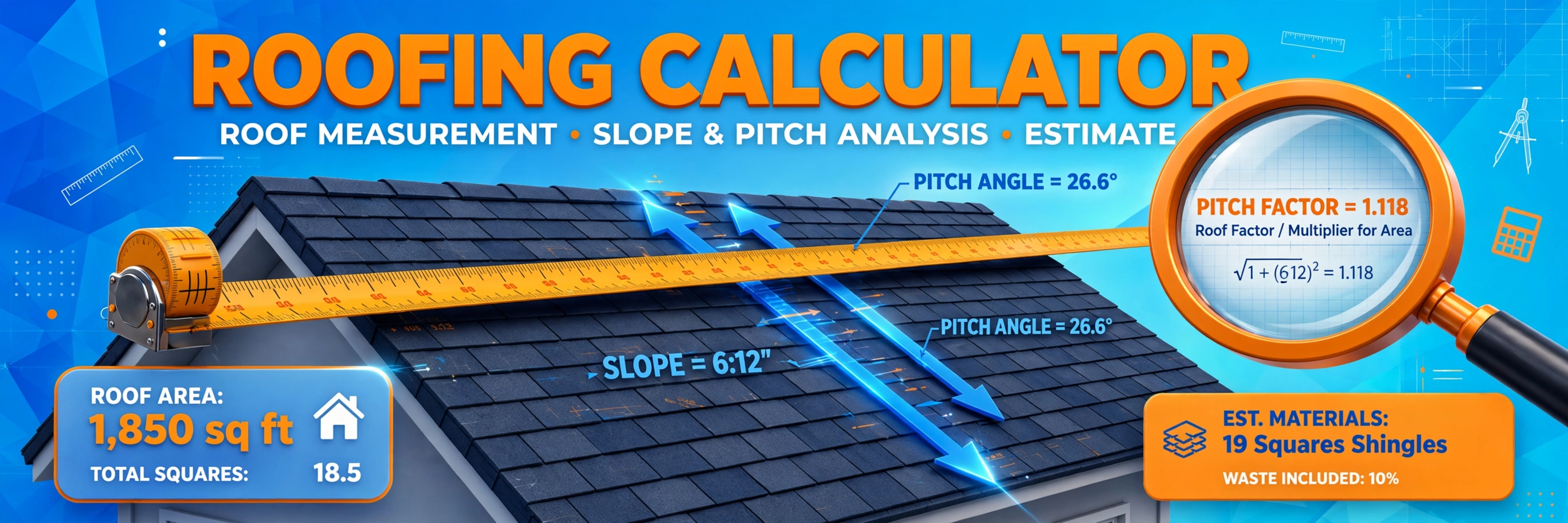
Find your roof's true surface area from its footprint and pitch, then convert it into roofing squares and shingle bundles — with a waste allowance built in.
Formulas verified against standard roofing references. Calculator logic tested with verified worked examples. Last reviewed: October 2026. Our methodology
How the roofing math works
A roofing estimate is five short steps: measure the flat footprint, correct it for slope, then translate the true area into the units shingles are sold in — squares and bundles — and add a waste allowance.
- Footprint (horizontal) area: length × width × number of roof planes. Measure along the eaves and from eave to ridge, including the overhang.
- Slope factor: √(1 + (pitch ÷ 12)²). Pitch is rise per 12 inches of run, so a 6/12 roof rises 6 inches for every 12 inches across.
- Actual roof area: footprint area × slope factor. This is the real surface the shingles must cover, and it is always larger than the footprint.
- Roofing squares: roof area ÷ 100. One square is 100 square feet of roof surface.
- Shingle bundles: squares × 3. A standard asphalt-shingle bundle covers about 33.3 square feet, so three bundles make a square.
- With waste: bundles × (1 + waste % ÷ 100). Ten percent suits simple gable roofs; use fifteen for hips, valleys and dormers.
Sources: calculator.net — roofing calculator methodology; asphalt-calculator.org — roofing formulas and bundle standards.
Worked example
Take a 40 ft by 30 ft roof with two planes and a 6/12 pitch, with a 10% waste allowance. Footprint: 40 × 30 × 2 = 2,400 sq ft. Slope factor: √(1 + (6 ÷ 12)²) = √1.25 = 1.1180. Actual roof area: 2,400 × 1.1180 = 2,683.3 sq ft. Squares: 2,683.3 ÷ 100 = 26.83. Bundles: 26.83 × 3 = 80.5. With waste: 80.5 × 1.10 = 88.5, so order 89 bundles.
How to use the roofing calculator
Enter the footprint measurements and the pitch; the calculator does the geometry. Measure each roof plane along the eaves for the length and from eave to ridge for the width, overhangs included.
Step by step
- Enter the roof length in feet, measured along the eaves including the overhang.
- Enter the roof width in feet, measured from eave to ridge.
- Enter the pitch as rise per 12 inches of run. If you only know the roof angle, pitch = tan(angle) × 12.
- Set the number of roof planes. A basic gable roof has 2; a hip roof typically has 4.
- Set the waste percentage. The default of 10% fits simple roofs; complex roofs need more.
- Press Calculate. Read the roof area, squares and bundle counts below the form.
What you get
- Horizontal (footprint) area
- Slope factor for your pitch
- Actual roof area in square feet
- Roofing squares
- Shingle bundles, with and without waste
- Bundles to order, rounded up to whole bundles
How roof pitch changes the real roof area
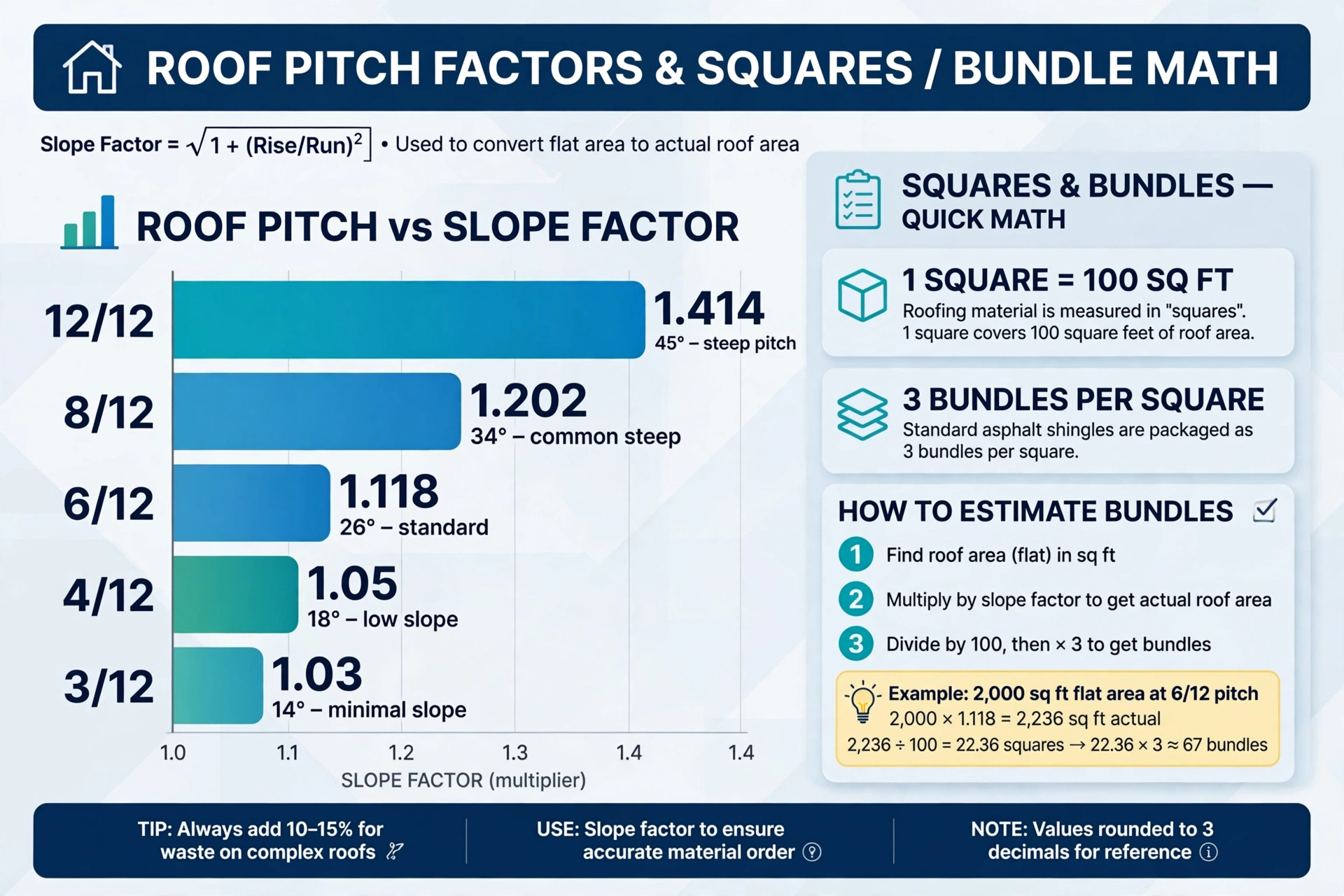
A flat 2,000-square-foot footprint is 2,000 square feet of roofing only if the roof is perfectly flat. The steeper the pitch, the more surface every horizontal foot produces, and the slope factor converts one to the other. A 6/12 pitch — the most common residential slope — multiplies the footprint by 1.118, while a steep 12/12 roof multiplies it by 1.414, a 41% increase.
| Pitch | Slope factor | Roof angle | Typical use |
|---|---|---|---|
| 3/12 | 1.0308 | 14.0° | Low-slope sections |
| 4/12 | 1.0541 | 18.4° | Minimum pitch for shingles |
| 6/12 | 1.1180 | 26.6° | Common residential |
| 8/12 | 1.2019 | 33.7° | Steep residential |
| 10/12 | 1.3017 | 39.8° | Very steep |
| 12/12 | 1.4142 | 45.0° | Extreme pitch |
Pitch also decides what can go on the roof: below about 3/12, standard shingles are usually not recommended and a membrane or roll roofing system is used instead. If a new roof is part of a bigger project you are financing, our loan calculator estimates the monthly payment for any loan amount, rate and term.
Roofing squares and shingle bundles, explained
Roofers measure and quote by the square — 100 square feet of roof surface — while suppliers sell by the bundle. The US standard for asphalt shingles is three bundles per square: each bundle covers about 33.3 square feet with normal overlap, and splitting a square into three keeps each package light enough to carry up a ladder. Heavier designer shingles sometimes ship four or five bundles per square, so check the coverage printed on the wrapper.
| Actual roof area | Roofing squares | Shingle bundles (no waste) |
|---|---|---|
| 1,000 sq ft | 10.0 | 30 |
| 1,500 sq ft | 15.0 | 45 |
| 2,000 sq ft | 20.0 | 60 |
| 2,500 sq ft | 25.0 | 75 |
| 3,000 sq ft | 30.0 | 90 |
The three-bundle-per-square rule is the industry standard for three-tab and architectural shingles, and it is the same bundle math used by asphalt-calculator.org's roofing guide, which this calculator mirrors.
Once you know the square count, you can sanity-check a contractor's material quote line by line. A roof replacement is also one of the largest single home expenses — if you are weighing the home purchase itself, our mortgage calculator breaks the monthly cost into principal, interest, tax and insurance.
Waste allowance and measuring tips
Waste is not padding — it is the material lost to cuts at ridges, edges and valleys, starter courses, and the occasional damaged shingle. Ten percent covers a simple gable roof; roofs with hips, valleys or dormers deserve fifteen. Complex or cut-up roofs can need even more, which is why this calculator lets you set the percentage yourself.
- Measure each plane separately and add them up for L-shaped or multi-plane roofs.
- Include overhangs in the length and width — they are roof surface too.
- Count the planes honestly: a gable roof has 2, a hip roof 4, and each dormer adds small planes of its own.
- Order whole bundles only; round up, never down — a short order stalls the job.
- Buy from one batch when possible — shingle dye lots can vary slightly in color.
When the geometry gets complicated, measure each rectangle, triangle and dormer face on its own and add the areas together before entering the totals here. The waste allowance then covers the cuts, not the missing measurements.
Frequently asked questions
How do you calculate the area of a roof?
Multiply the roof's length by its width and by the number of roof planes to get the horizontal (footprint) area, then multiply by the slope factor — the square root of 1 plus the pitch divided by 12, squared. A 40 by 30 ft roof with 2 planes and a 6/12 pitch gives 2,400 × 1.1180 = 2,683 sq ft of actual roof surface.
What is a roofing square?
A roofing square is the industry's area unit: exactly 100 square feet of roof surface. Contractors quote and price roofing work by the square, and shingle packaging is built around it — this calculator converts your roof area into squares before counting bundles.
How many shingle bundles are in a square?
Three, for standard asphalt shingles. Each bundle covers about 33.3 square feet with normal overlap, so 3 × 33.3 = 100 sq ft. Heavier designer shingles sometimes ship four or five bundles per square, so always check the coverage printed on the wrapper rather than assuming three.
What waste percentage should I add?
Add 10% for a simple gable roof with few cuts. Use 15% or more for roofs with hips, valleys, dormers or multiple planes, where offcuts pile up. This calculator applies the waste to the bundle count and rounds the final order up to whole bundles.
How do I find my roof's pitch?
Pitch is the rise in inches for every 12 inches of horizontal run. From inside the attic, hold a level horizontal, mark 12 inches along it, and measure straight down to the roof deck — that measurement in inches is your pitch. From the ground, measure the roof angle and use pitch = tan(angle) × 12. Common residential pitches are 4/12, 6/12 and 8/12.
Does this calculator include ridge cap shingles?
No — it estimates field shingles only. Ridge caps are a separate line item: measure the total ridge length in feet and buy cap bundles to match your shingle manufacturer's guidance, often about one bundle per 20 to 35 linear feet depending on the product.
How many bundles do I need for a 2,400 sq ft roof?
If that is the footprint with a 6/12 pitch: 2,400 × 1.1180 = 2,683 sq ft of actual roof, or 26.83 squares. At 3 bundles per square that is 80.5 bundles, and with 10% waste the order comes to 89 bundles.
Is the estimate exact?
It is a planning estimate. It assumes rectangular planes, so dormers, valleys, skylights and irregular shapes need section-by-section measuring first. Always confirm the final material list with a roofing professional before you order.
Related calculators

Percentage Calculator
Find what P% of any number is — instant answers with the formula shown.
Use calculator
Loan Calculator
Work out monthly payments, total interest and the payoff schedule for any loan.
Use calculatorMortgage Calculator
Estimate your monthly mortgage payment from price, down payment and rate.
Use calculator