Concrete Block Calculator: How Many Blocks for a Wall
Enter your wall length and height, pick a block face size, add a waste allowance, and get the number of concrete blocks to order.

Formulas verified against standard references. Calculator logic tested with verified worked examples. Last reviewed: October 2026. Our methodology
How Block Counts Are Calculated
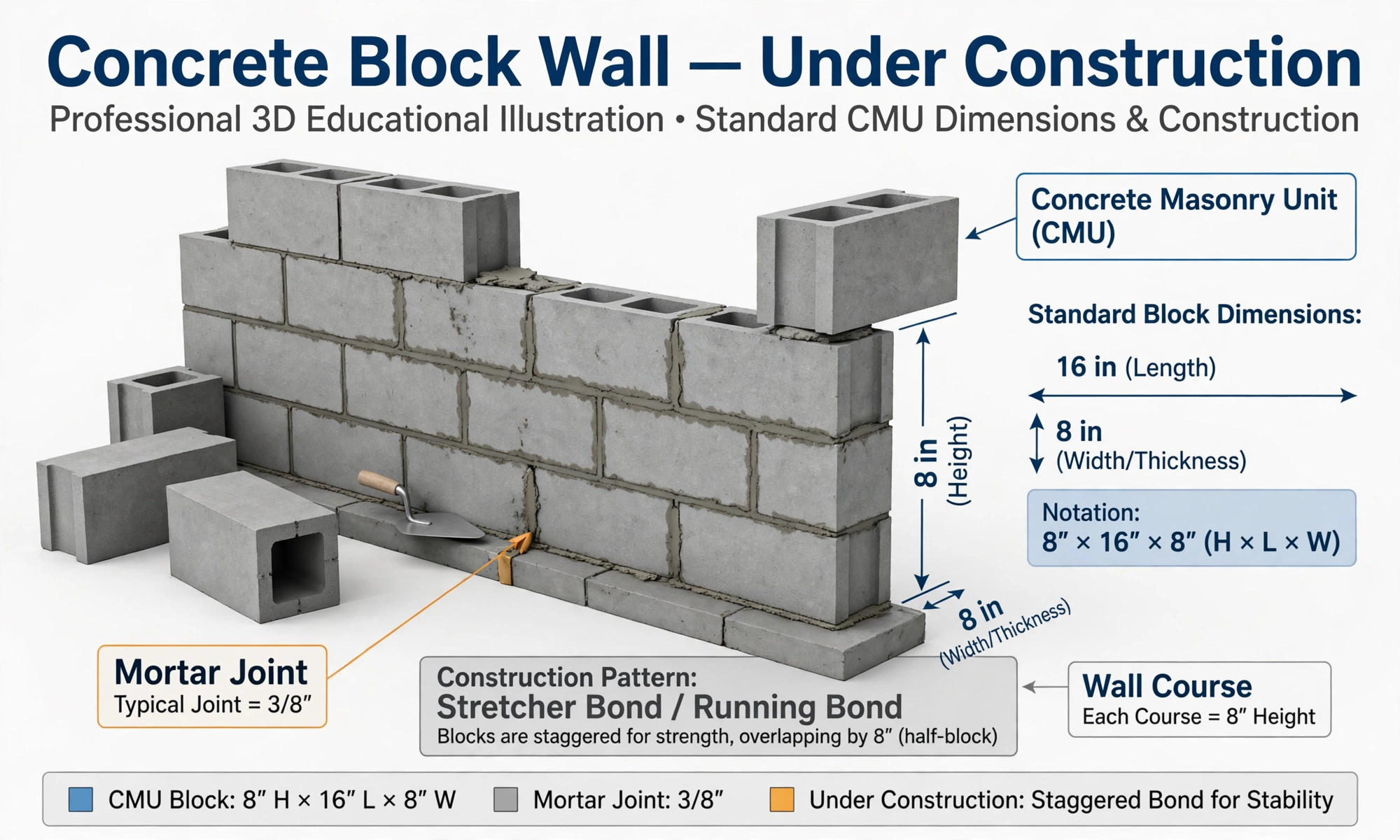
A concrete block wall is counted by area. First find the wall area in square feet: length times height. Then divide by the block face area in square feet. A standard block face is 8 inches high by 16 inches long, which is 128 square inches, or 0.8889 square feet, since a square foot is 144 square inches. That gives 1.125 blocks per square foot.
A 10 ft by 8 ft wall has an area of 80 square feet, so it needs 80 times 1.125, which is 90 blocks before waste. Adding a 10 percent waste allowance gives 99 blocks, which is the order quantity. Waste covers cuts, breakage, and the mortar joint allowance in real block sizes, which are slightly smaller than nominal sizes.
Block Sizes and Face Areas
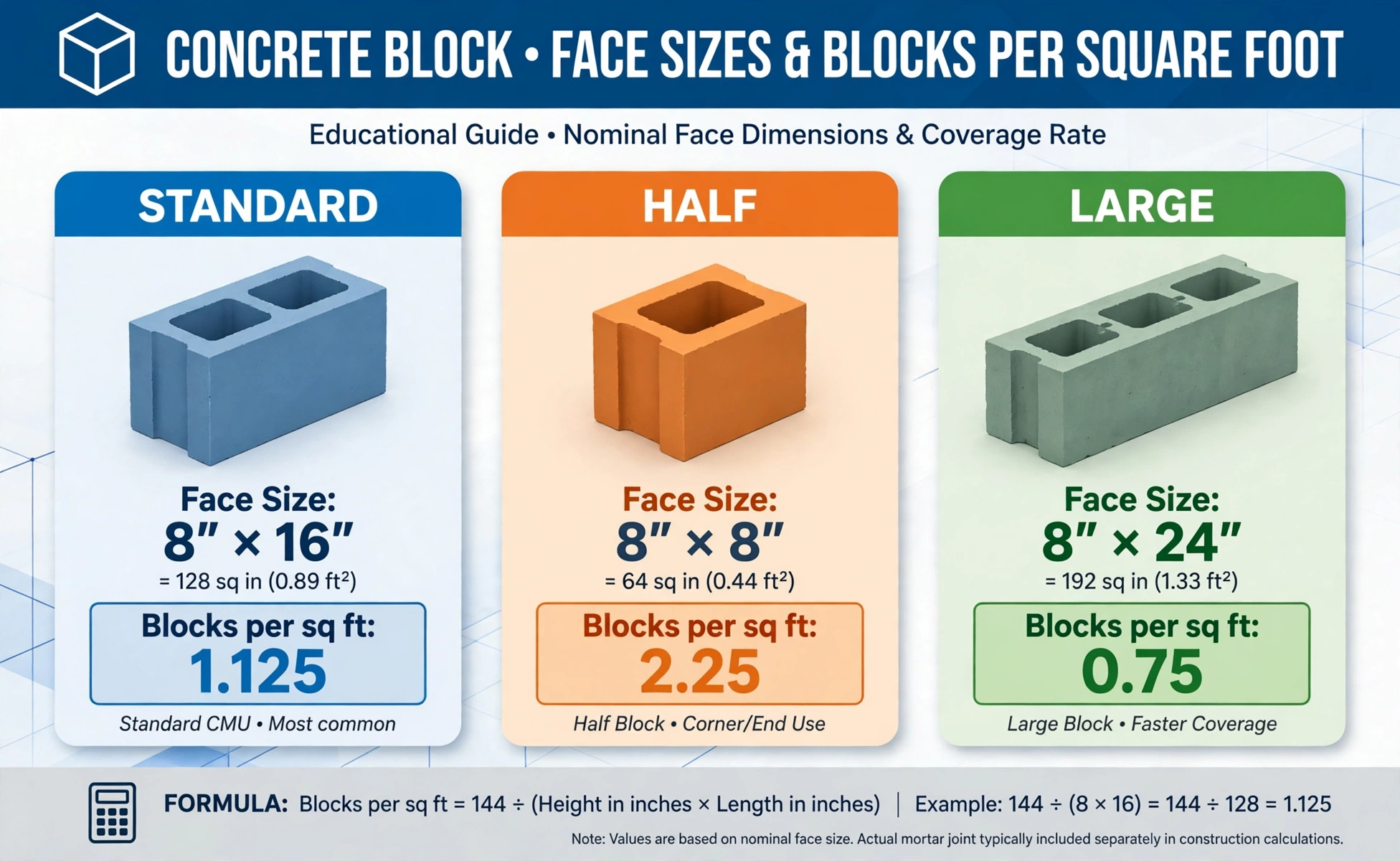
Concrete blocks are sold by nominal size, which includes the mortar joint, while the actual block is about 3/8 inch smaller on each dimension. A standard 8 x 8 x 16 inch block has a face of 8 by 16 inches. A half block, 8 by 8 inches, has half the face area, so it needs twice as many blocks per square foot. A large 12 by 16 inch face needs fewer blocks per square foot.
Block thickness, the third dimension, does not change the face count, but it changes the wall's strength, insulation, and cost. A thicker block suits load-bearing and exterior walls, while a thinner block suits partitions. For a related material estimate, a brick calculator counts bricks for a wall by the same area method.
| Block face | Face area | Blocks per square foot |
|---|---|---|
| Standard 8 x 16 in | 128 square inches | 1.125 |
| Half block 8 x 8 in | 64 square inches | 2.25 |
| Large 12 x 16 in | 192 square inches | 0.75 |
Worked Examples
Example 1: a 10 ft by 8 ft wall with standard blocks is 80 square feet, 90 blocks before waste, and 99 blocks with 10 percent waste. Example 2: the same wall with half blocks needs 180 blocks before waste, because half blocks cover half the area each, and 198 blocks with 10 percent waste.
Example 3: a 20 ft by 10 ft wall with standard blocks is 200 square feet, 225 blocks before waste, and 248 blocks with 10 percent waste, since 225 times 1.10 is 247.5, rounded up to 248. Always round up: a fraction of a block cannot be ordered, and rounding down leaves the wall short.
| Wall | Area | Standard blocks, 10% waste |
|---|---|---|
| 10 ft x 8 ft | 80 square feet | 99 blocks |
| 20 ft x 10 ft | 200 square feet | 248 blocks |
| 10 ft x 8 ft, half blocks | 80 square feet | 198 blocks |
Openings, Corners, and Waste
Subtract openings before counting. A door 3 ft by 7 ft removes 21 square feet, which is about 24 standard blocks, and a window removes its own area the same way. Corners and wall ends need half blocks and cut blocks, which is why a waste allowance is essential even for a careful builder.
Use 5 percent waste for a simple straight wall with few cuts, 10 percent for a typical wall with openings and corners, and 15 percent for a complex wall with many cuts or an inexperienced crew. Ordering a few extra blocks is cheaper than a second delivery and a mismatched batch, since block color can vary between batches.
Common Mistakes
The most common mistake is forgetting to subtract door and window openings, which over-orders blocks and inflates the cost. A second mistake is using the block's nominal face area without the mortar joint, or the actual size without the joint, which shifts the count by a few percent. A third mistake is rounding down the final count instead of up.
A fourth mistake is measuring the wall in mixed units, such as feet for length and inches for height, without converting first. A fifth is forgetting that a wall with two faces, such as a freestanding garden wall, is still one wall area for block counting, unless it is actually a double wall with two layers.
Beyond the Block Count
Blocks are only part of a wall estimate. Mortar, reinforcement, lintels over openings, and a foundation or footing all add cost and time. Mortar quantity depends on joint size and block type, so ask your supplier for a mortar estimate based on the block count, rather than guessing from the wall area alone.
For a full project budget, get quotes for blocks, mortar, delivery, and labor together, and confirm the block size and color in writing before ordering. A clear block count from this calculator makes those quotes comparable, because every supplier prices the same quantity.
Frequently asked questions
How many blocks do I need for a 10 by 8 foot wall?
90 standard blocks before waste, and 99 blocks with a 10 percent waste allowance. The wall area is 80 square feet at 1.125 blocks per square foot.
How many blocks are in a square foot?
1.125 standard 8 by 16 inch blocks, 2.25 half blocks, or 0.75 large 12 by 16 inch blocks.
Should I subtract doors and windows?
Yes. Subtract each opening's area from the wall area before counting, or you will over-order.
What waste allowance should I use?
5 percent for a simple wall, 10 percent for a typical wall with openings, and 15 percent for a complex wall with many cuts.
Do I round the block count up or down?
Up, to whole blocks. Rounding down leaves the wall short, and a fraction of a block cannot be ordered.
Does block thickness change the count?
No. Thickness changes strength and cost, but the face area, which decides the count, stays the same for the same face size.
Why do nominal and actual block sizes differ?
Nominal size includes the mortar joint. The actual block is about 3/8 inch smaller, so the joint plus the block equals the nominal size.