Board Foot Calculator
Price and plan lumber like the yard does: in board feet. Enter a board's length, width, thickness, and how many pieces you need to get board feet per piece and for the whole order, plus cubic feet and an optional total cost from your price per board foot.

Formulas verified against standard references. Calculator logic tested with verified worked examples. Last reviewed: October 2026. Our methodology
The Board Foot Formula
One board foot is a unit of lumber volume: 144 cubic inches, the wood in a piece 12 inches wide, 12 inches long, and 1 inch thick. Lumber yards price rough hardwood and bulk softwood by the board foot, so speaking BF lets you compare quotes and order correctly.
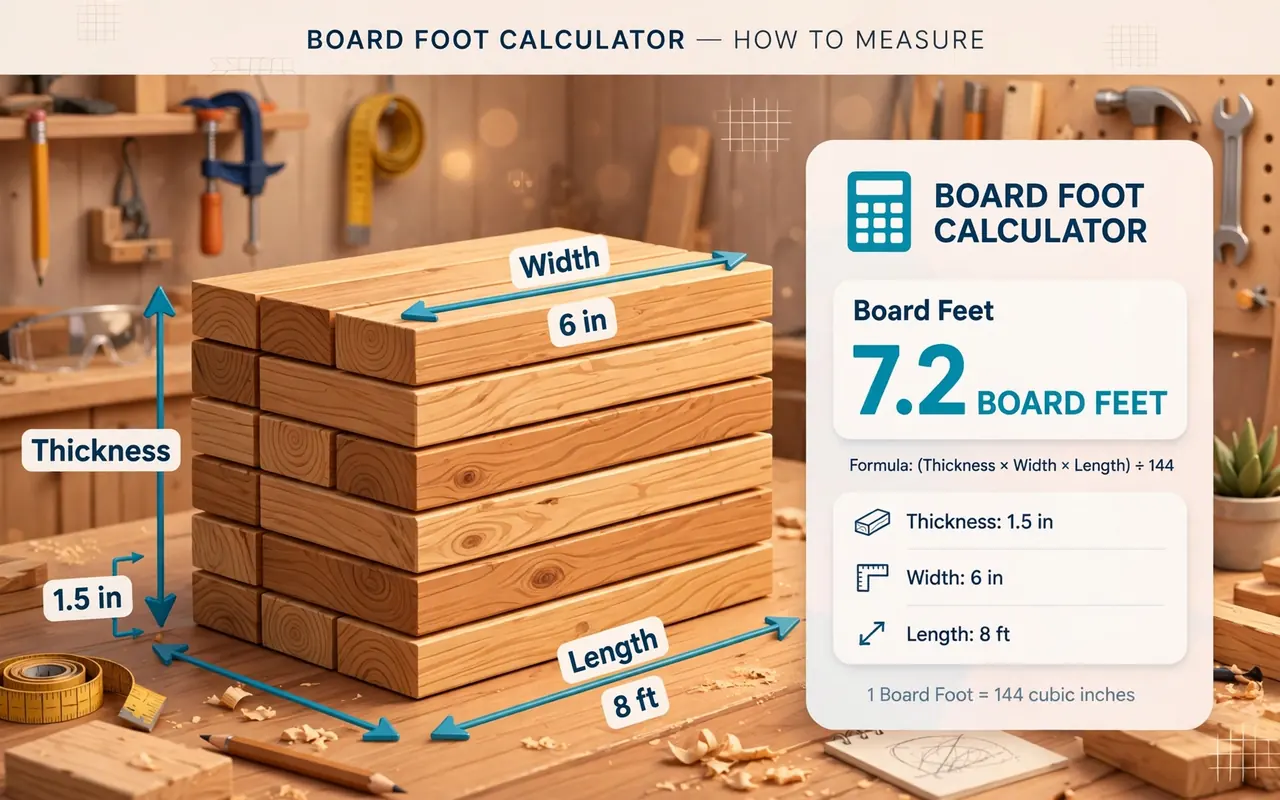
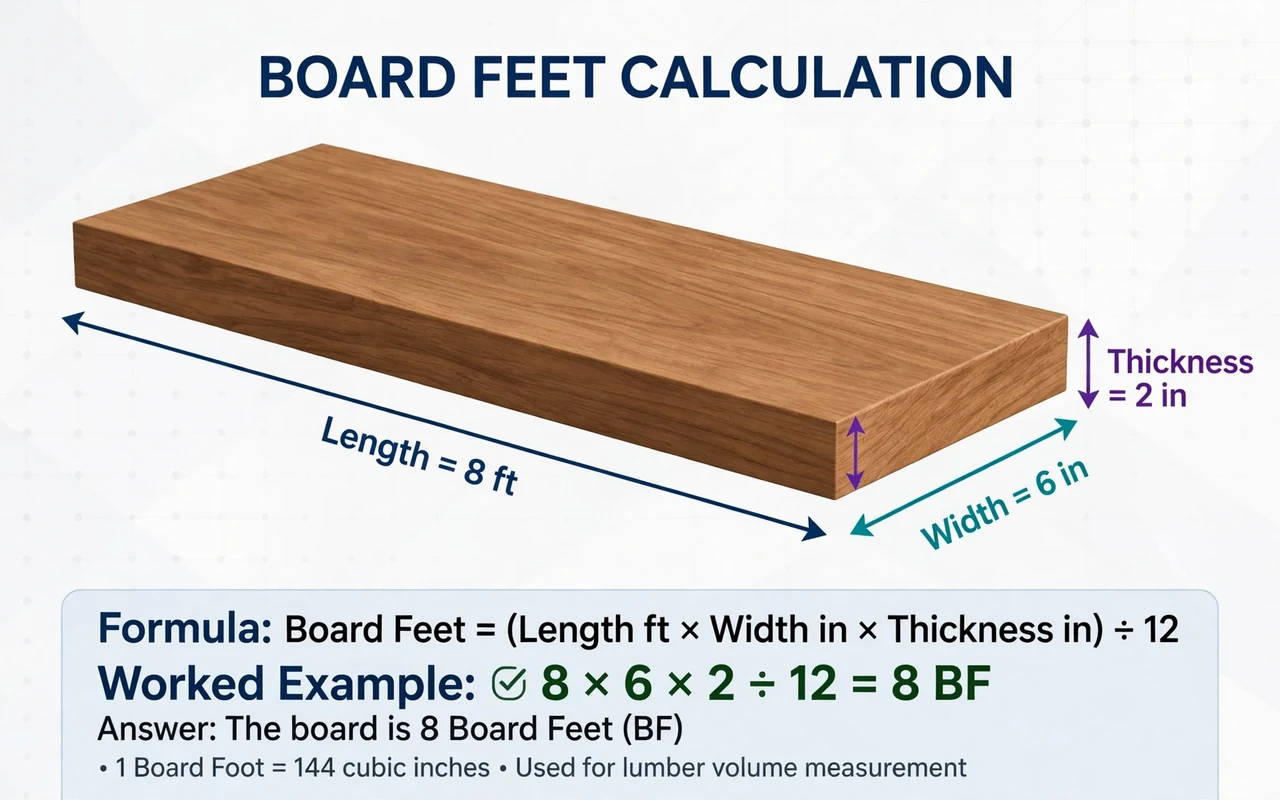
The standard formula mixes units the way the trade talks: length in feet, width and thickness in inches. Board feet per piece = (length in feet × width in inches × thickness in inches) ÷ 12. If you measured length in inches instead, divide by 144. A 2 × 6 × 8 ft board is (8 × 6 × 2) ÷ 12 = 8 BF.
| Board (nominal) | Math | Board feet |
|---|---|---|
| 1 x 6 x 8 ft | (8 x 6 x 1) / 12 | 4 BF |
| 2 x 6 x 8 ft | (8 x 6 x 2) / 12 | 8 BF |
| 2 x 4 x 10 ft | (10 x 4 x 2) / 12 | 6.67 BF |
| 1 x 12 x 12 ft | (12 x 12 x 1) / 12 | 12 BF |
Nominal vs Actual Sizes
Construction lumber is sold by nominal size, the rough-cut dimension before drying and planing, but the actual board you take home is smaller. A nominal 2×4 is actually 1.5 × 3.5 inches. Both work in the formula; you just have to be consistent about which you are pricing.
Use nominal dimensions when matching a supplier's quote, since yards price on nominal. Use actual dimensions when estimating true wood volume for joinery or weight. The difference is real: a nominal 2×4×8 holds 5.33 BF nominal but only about 3.5 BF of actual wood.
| Nominal size | Actual size (in) | BF per foot (nominal) |
|---|---|---|
| 1x4 | 0.75 x 3.5 | 0.33 |
| 1x6 | 0.75 x 5.5 | 0.50 |
| 2x4 | 1.5 x 3.5 | 0.67 |
| 2x6 | 1.5 x 5.5 | 1.00 |
| 2x12 | 1.5 x 11.25 | 2.00 |
Board Feet vs Linear Feet vs Cubic Feet
Three volume words get mixed up constantly. A linear foot measures length only: a 10-foot board is 10 linear feet whether it is trim or a wide plank. A board foot measures volume (144 cubic inches). A cubic foot is 12 board feet.
When a project is specified in cubic feet, for example a volume fill, divide by 12 to get board feet, or use the volume calculator for the shape math first. Ordering by linear feet when the yard prices by board foot is how budgets quietly double.
Estimating Cost
Enter your price per board foot and the calculator extends the volume into a cost estimate: total BF × price. Ten 2×6×8 boards at 8 BF each is 80 BF; at $3.50 per BF the order is $280.
Treat the estimate as a planning figure, not a quote: FAS-grade hardwood, wide planks, and custom milling command premiums of 20 to 50 percent, and prices move with supply. Always confirm the yard's per-BF price and whether it applies to nominal or actual dimensions before ordering.
Waste and Ordering Smart
Board feet measure volume, not usable yield. Knots, checks, grain matching, and saw kerf all consume wood, so add 15 to 30 percent extra for furniture work and 10 percent for rough framing. Running short mid-project costs more than the extra boards would have.
Buying tip: random-width hardwood is tallied from actual widths, so measure each board. For dimensioned softwood, the nominal BF-per-foot table above lets you estimate an entire cut list in your head: a 2×4 carries 0.667 BF per foot, so 100 linear feet is about 67 BF.
| Project | Typical waste factor | Why |
|---|---|---|
| Rough framing | 10% | Straight cuts, standard sizes |
| Decking | 15% | End cuts, some culling |
| Fine furniture | 25-30% | Grain matching, defecting |
Planning the Rest of the Build
Lumber is rarely the only material on the ticket. If the project includes a slab or footings, the rebar calculator sizes the reinforcement steel by the same plan dimensions.
Keep one consistent unit convention across the whole estimate: feet for length, inches for width and thickness in board-foot math, then convert once at the end. Mixed-unit slips, like entering length in inches into the ÷ 12 formula, inflate the result twelvefold and are the most common board-foot error.

Frequently asked questions
What is a board foot?
A unit of lumber volume equal to 144 cubic inches: a piece 12 in wide, 12 in long, and 1 in thick. Lumber yards use it to price hardwood and rough-sawn stock.
How do you calculate board feet?
Multiply length in feet by width in inches by thickness in inches, then divide by 12. For a 2x6x8 ft board: (8 x 6 x 2) / 12 = 8 board feet.
What is the difference between board feet and linear feet?
Linear feet measure length only; board feet measure volume, accounting for width and thickness too.
Should I use nominal or actual dimensions?
Use nominal to match a supplier quote, actual for true wood volume. A nominal 2x4 is actually 1.5 x 3.5 inches.
How many board feet are in a cubic foot?
12. Divide cubic feet by 12, or board feet by 12 to get cubic feet.
How much extra lumber should I order?
Add 10% for framing, 15% for decking, and 25 to 30% for fine furniture to cover waste, knots, and miscuts.
Why is my result 12 times too big?
You probably entered length in inches into the divide-by-12 formula. Convert length to feet first, or divide by 144 with all dimensions in inches.