Hexagon Calculator

Find the area, perimeter and diagonals of a regular hexagon from a single measurement. Enter the side length, the area or the perimeter, and this hexagon calculator works out the rest.

Pick the measurement you already have. Side length is the usual choice.

The number for the measurement you chose above, in any unit. Area comes back in square units of that unit.

Formula: area A = (3 x sqrt(3) / 2) x s squared, where s is the side length. Perimeter P = 6 x s. Apothem a = s x sqrt(3) / 2.

How to Use the Hexagon Calculator

Pick what you already know, then enter the number. The calculator works out the side length first, then every other measurement from it.

  1. Choose Side length, Area or Perimeter in the first box. Side length is the usual choice.
  2. Enter the measurement in the second box. The example uses a side length of 4, so you can press Calculate right away.
  3. Press Calculate, or press Enter. The area appears first and large, with the perimeter, the apothem and the circumradius below.
  4. Press Reset to clear the form and start over.
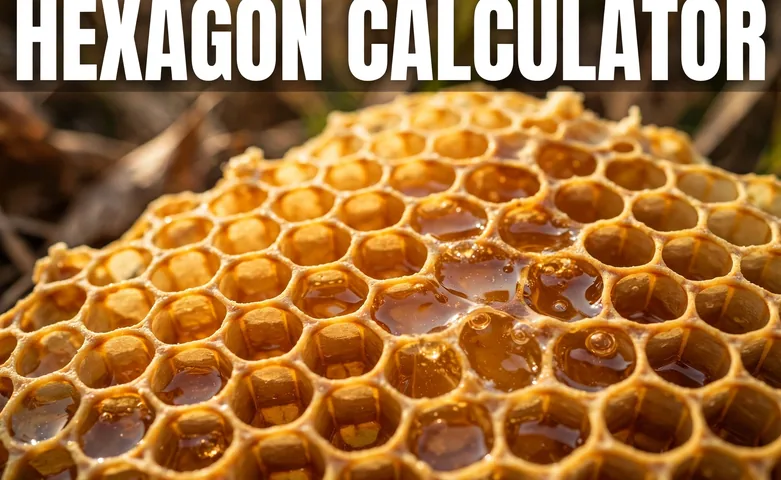
A photo of natural hexagonal honeycomb cells filled with golden honey in warm natural light
A regular hexagon with side 4 has an area of 41.57 and a perimeter of 24.

The Hexagon Area Formula

A regular hexagon has six equal sides and six equal angles of 120 degrees each. It splits neatly into six equilateral triangles, and that split gives the area formula.

Each triangle has side s and area (sqrt(3) / 4) x s squared. Six of them make the hexagon, so the area is A = (3 x sqrt(3) / 2) x s squared. The constant 3 x sqrt(3) / 2 is about 2.598, so a quick estimate is that the area is about 2.6 times the side squared.

The perimeter is simpler. Six equal sides give P = 6 x s. The apothem, the distance from the center to the middle of a side, is a = s x sqrt(3) / 2, which is the height of one of the six triangles. Our triangle calculator works out the area of one of those triangles on its own.

Worked Example: A Hexagon With Side 4

Find the area, perimeter and apothem of a regular hexagon with side length 4.

  1. Area: A = (3 x sqrt(3) / 2) x 4 squared = 2.598 x 16 = 41.57.
  2. Perimeter: P = 6 x 4 = 24.
  3. Apothem: a = 4 x sqrt(3) / 2 = 4 x 0.866 = 3.46.
  4. Diagonals: the long diagonal is 2 x 4 = 8, and the short diagonal is 4 x sqrt(3) = 6.93.

As a second check, take a hexagon with side 6. The area is 2.598 x 36 = 93.53, the perimeter is 36, and the apothem is 6 x 0.866 = 5.2. The same steps work for any side length, so try your own numbers in the tool above.

A photo of hexagonal ceramic floor tiles in warm beige and terracotta tones being laid with a trowel
Six equilateral triangles make the hexagon, so the area is 6 times the triangle area.

The Other Measurements: Apothem, Radius and Diagonals

One measurement fixes the whole hexagon, because every other measurement is a fixed multiple of the side. The circumradius, the distance from the center to a corner, equals the side length exactly. A hexagon with side 4 fits inside a circle of radius 4, which is a property no other regular polygon shares.

The long diagonal runs from one corner through the center to the opposite corner, so it is 2s. The short diagonal runs from the middle of one side to the middle of the opposite side, so it is s x sqrt(3). For side 4, the diagonals are 8 and 6.93. The short diagonal is also called the across flats width, and it is the number stamped on hex bolt heads and socket sizes.

The apothem is half the short diagonal. It is the distance from the center to the middle of a side, and it is the height of each of the six equilateral triangles. The area can also be written as half the perimeter times the apothem, which gives the same answer. For side 4, half of 24 times 3.4641 is 41.57.


Common Mistakes to Avoid

The most common mistake is using the side length where the apothem belongs, or the other way round. The apothem is the perpendicular distance from the center to a side, 3.46 for side 4, not the side length itself.

A second mistake is measuring across the flats and calling it the side. The across flats width is the short diagonal, s x sqrt(3), so the side is that width divided by sqrt(3). A width of 6.93 gives a side of 4, not 6.93.

A third mistake is forgetting that the formulas only work for a regular hexagon. An irregular hexagon has unequal sides and needs to be split into triangles piece by piece. If your hexagon has six equal sides and six 120 degree angles, these formulas are exact.

Hexagons in Real Life

Honeycomb is the famous hexagon. Bees build hexagonal cells because the shape packs the most area into the least wax. A honeycomb cell is a regular hexagon, so its area follows the same formula.

Hexagon tiles cover floors and walls with no gaps, because regular hexagons tile a flat surface perfectly. Nuts and bolts use hexagonal heads for the same reason the shape is practical. A wrench grips six flat sides, and the across flats width is the size stamped on the tool. Our perimeter calculator works out the edging or trim length for any shape, and our circle calculator covers the circle that a hexagon fits inside.

A photo of a carpenter measuring a wooden hexagonal table top with a steel ruler in a workshop
Hexagon tiles and honeycomb both use the same six sided shape.

Frequently asked questions

How do you find the area of a regular hexagon?

Use A = (3 x sqrt(3) / 2) x s squared, where s is the side length. For a side of 4, the area is 2.598 x 16 = 41.57.

What is the perimeter of a hexagon?

Multiply the side length by 6, because a regular hexagon has six equal sides. For a side of 4, the perimeter is 6 x 4 = 24.

What is the apothem of a hexagon?

Use a = s x sqrt(3) / 2, where s is the side length. For a side of 4, the apothem is 4 x 0.866 = 3.46.

How many sides and angles does a hexagon have?

Six sides and six interior angles of 120 degrees each, adding to 720 degrees. That is true of every regular hexagon, whatever its size.

What is the difference between a regular and an irregular hexagon?

A regular hexagon has six equal sides and six equal angles of 120 degrees. An irregular hexagon has unequal sides or angles, so these formulas do not apply directly and it must be split into triangles.

Can I find the side length from the area?

Yes. Use s = sqrt(2A / (3 x sqrt(3))), where A is the area. For an area of 41.57, the side is 4. Pick Area in the first box of the calculator to do this.

Start Calculating Now!

Discover the power of smart tools at KitQuarter.

Explore All Tools