Ellipse Calculator
Find the area and perimeter of an ellipse from its two semi-axes. Enter the semi-major axis and the semi-minor axis to get the area, the perimeter, the eccentricity and the focal distance, with every step shown. Free, no sign-up, everything runs in your browser.
Formula: Area = pi x a x b. Perimeter uses Ramanujan's first approximation, P = pi x [3(a + b) - sqrt((3a + b)(a + 3b))]. Enter both lengths in the same unit.

Formulas verified against standard references. Calculator logic tested with verified worked examples. Published: November 9, 2026 | Last updated: November 9, 2026. Fact-checked: November 9, 2026. Our methodology
How to Use the Ellipse Calculator
Getting an answer takes three quick steps. The tool needs only the two semi-axes, the half lengths of the ellipse, and it returns the area, the perimeter and two extra measures that describe the shape.
- Enter the semi-major axis in the first field. This is the longer radius, half the longest width of the ellipse.
- Enter the semi-minor axis in the second field. This is the shorter radius, half the shortest width.
- Press Calculate, or press Enter. The area appears first and large, with the perimeter, the eccentricity and the focal distance below. Press Reset to clear the form and start over.
Enter both lengths in the same unit. If you measured the full length and the full width instead, halve each one first, because the formulas use semi-axes, not full diameters.
The Ellipse Area Formula
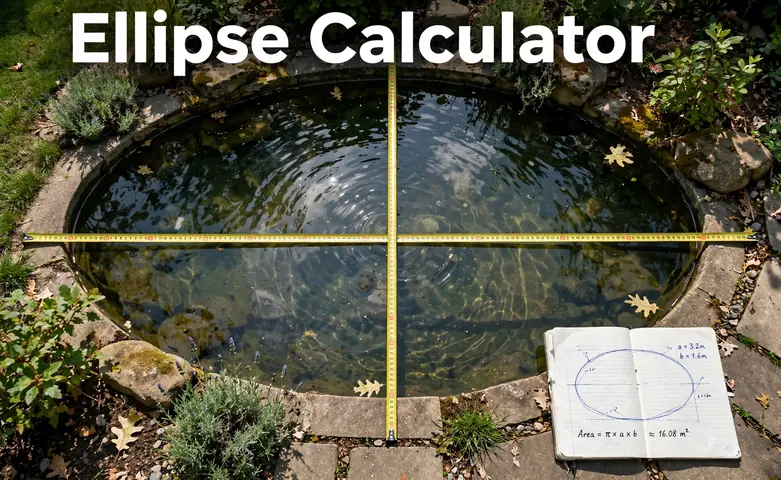
The area of an ellipse is A = pi x a x b, where a is the semi-major axis and b is the semi-minor axis. Pi is about 3.14159, a is the longer radius and b is the shorter radius.
The formula is a stretched version of the circle area formula. A circle has one radius, so its area is pi x r x r. An ellipse has two different radii, so you multiply pi by both of them instead. When a and b are equal, the shape is a circle and the formula gives the usual circle area, which is a good way to check your answer. Our circle calculator uses that same idea with a single radius.
Area comes out in square units. If you enter the axes in centimetres, the area is in square centimetres. If you enter them in feet, the area is in square feet.
Worked Example: Semi-Axes of 5 and 3
An ellipse has a semi-major axis of 5 and a semi-minor axis of 3. Here is exactly what the calculator does.
- Area = pi x 5 x 3 = 15 x pi = 47.12 square units.
- Perimeter = pi x [3 x (5 + 3) - sqrt((3 x 5 + 3) x (5 + 3 x 3))] = pi x [24 - sqrt(252)] = pi x 8.13 = 25.53 units.
- Eccentricity = sqrt(1 - 9 / 25) = sqrt(0.64) = 0.8. Focal distance = sqrt(25 - 9) = 4 units.
As a second check, a circle with a radius of 5 has an area of pi x 5 x 5 = 78.54 and a perimeter of 2 x pi x 5 = 31.42. The ellipse is smaller than that circle in both measures, which makes sense, because its short axis is only 3.
Why the Perimeter Needs an Approximation
The area has an exact formula, but the perimeter does not. The exact perimeter of an ellipse is given by an elliptic integral, a kind of integral that has no closed form using ordinary arithmetic. No calculator can give it exactly with a short formula, so every ellipse tool uses an approximation.
This calculator uses Ramanujan's first approximation, P = pi x [3(a + b) - sqrt((3a + b)(a + 3b))]. It was published by the mathematician Srinivasa Ramanujan and it stays within about 0.4% of the true perimeter for any shape of ellipse. For a circle it is exact, because it reduces to 2 x pi x r when a equals b.
For most real work, such as garden beds, tabletops and running tracks, an error under half a percent is far smaller than the error in measuring the axes by hand. If you need more precision than that, a numerical integration of the elliptic integral is the next step, but that is rarely needed outside specialist maths.
Eccentricity and the Focal Distance
Eccentricity measures how stretched an ellipse is. It is e = sqrt(1 - b squared / a squared). A circle has an eccentricity of 0, because its two axes are equal. A long thin ellipse has an eccentricity close to 1. Our worked example has an eccentricity of 0.8, which is a clearly stretched oval.
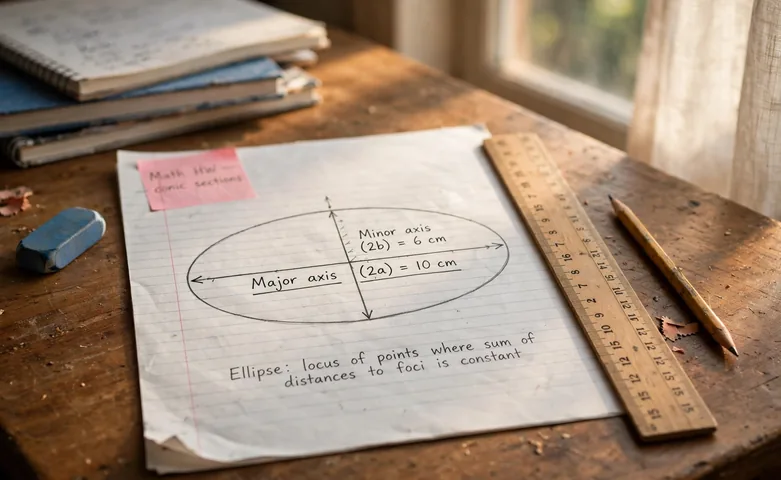
The focal distance is c = sqrt(a squared - b squared). The two foci sit on the long axis, each one c units from the centre. An ellipse has a neat property tied to them. For any point on the ellipse, the sum of its distances to the two foci is always 2a, the full length of the long axis. Gardeners use this to draw an ellipse with two pegs and a loop of string, and whispering galleries use it because sound from one focus reflects to the other.
Our percentage calculator can turn an eccentricity into a percent if you want to describe the stretch that way, since an eccentricity of 0.8 is the same as 80% of the way from a circle to a line.
Common Ellipse Mistakes
Using the full length and width instead of the semi-axes is the most common error. The formulas need half lengths. If you enter the full length of 10 and the full width of 6, the area comes out four times too large, because each axis is doubled. Always halve full measurements first.
Swapping the axes the wrong way round is harmless here, because this calculator treats the longer value as a and the shorter value as b, and it tells you when it does that. But in your own working, keep a as the longer radius, or the eccentricity formula gives a negative number under the square root.
Treating the perimeter as exact is the third mistake. The Ramanujan value is an approximation, so do not quote it to six decimal places as if it were exact. Two decimal places is plenty for real measurements, and the calculator says so in the result.

Frequently asked questions
What is the area of an ellipse?
Multiply pi by the two semi-axes. Area = pi x a x b, where a is the semi-major axis and b is the semi-minor axis. For a = 5 and b = 3, the area is pi x 5 x 3 = 47.12 square units.
How do you find the perimeter of an ellipse?
There is no exact short formula, so calculators use an approximation. This tool uses Ramanujan's first approximation, P = pi x [3(a + b) - sqrt((3a + b)(a + 3b))], which stays within about 0.4% of the true perimeter.
What is the semi-major axis?
It is the longer radius of the ellipse, the distance from the centre to the farthest point on the edge. It is half the longest width. The semi-minor axis is the shorter radius, half the shortest width.
What is eccentricity?
Eccentricity measures how stretched an ellipse is. It is sqrt(1 - b squared / a squared). A circle has an eccentricity of 0, and a long thin ellipse has one close to 1. An ellipse with a = 5 and b = 3 has an eccentricity of 0.8.
What happens when a equals b?
The ellipse becomes a circle. The area formula gives pi x r squared, the perimeter formula gives 2 x pi x r, the eccentricity is 0 and the focal distance is 0, because the two foci meet at the centre.
What is the difference between an ellipse and an oval?
An ellipse is a precise mathematical shape defined by two foci and two axes, and its area and perimeter follow the formulas on this page. Oval is a loose everyday word for any egg-like or rounded shape, and many ovals are not true ellipses.
Related calculators

Circle Calculator
Find the area and circumference of any circle.
Use calculatorPercentage Calculator
Find what P% of any number is, instantly.
Use calculatorAverage Calculator
Work out the average of a list of numbers.
Use calculatorStandard Deviation Calculator
Find how spread out a set of numbers is.
Use calculatorFraction Calculator
Add, subtract, multiply and divide fractions.
Use calculatorMean Median Mode Calculator
Find the mean, median and mode of any list.
Use calculator