Fraction Calculator: Add, Subtract, Multiply and Divide Fractions
Enter two fractions, pick an operation, and get the simplified answer instantly — with the mixed number, the decimal value and the step-by-step working shown.
Fraction formulas
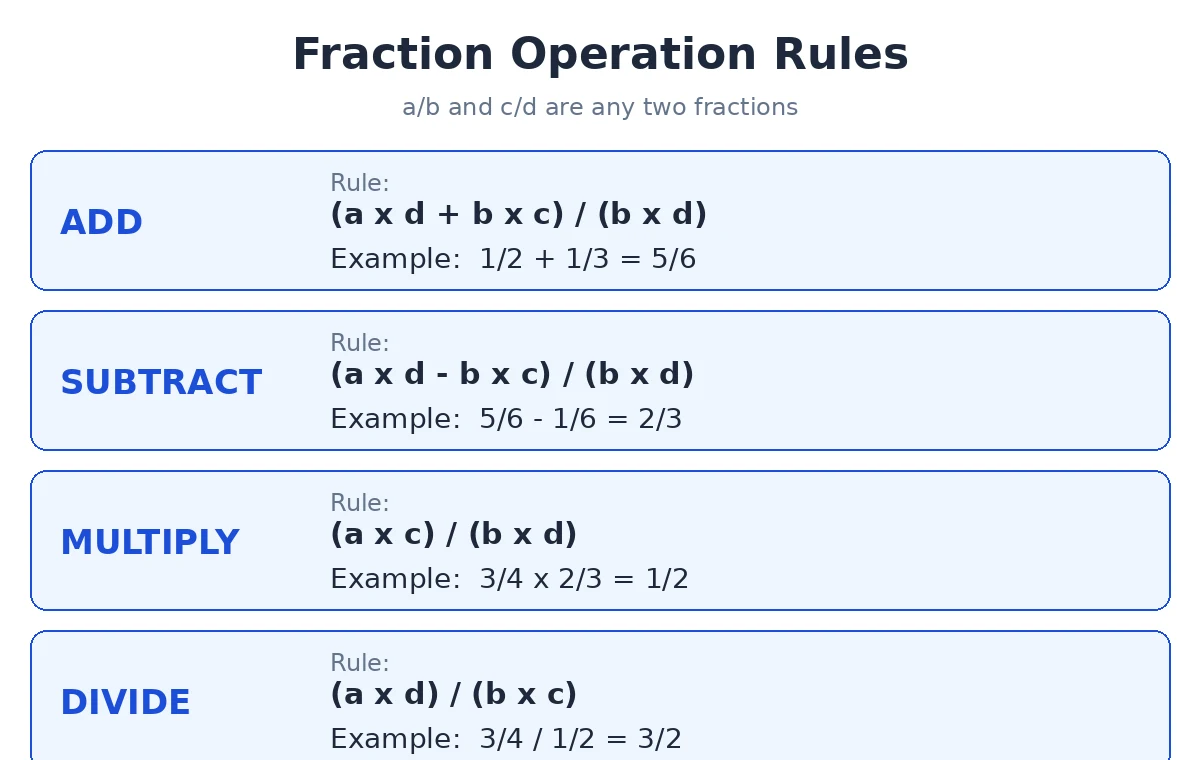
Every calculation on this page follows one of four rules, where the first fraction is a/b and the second is c/d:
| Operation | Rule | Example |
|---|---|---|
| Add | (a × d + b × c) / (b × d) | 1/2 + 1/3 = (3 + 2)/6 = 5/6 |
| Subtract | (a × d − b × c) / (b × d) | 5/6 − 1/6 = 4/6 = 2/3 |
| Multiply | (a × c) / (b × d) | 3/4 × 2/3 = 6/12 = 1/2 |
| Divide | (a × d) / (b × c) — flip the second fraction, then multiply | 3/4 ÷ 1/2 = (3 × 2)/(4 × 1) = 6/4 = 3/2 |
After applying the rule, the calculator divides the top and bottom of the answer by their greatest common divisor (GCD), which puts the result in lowest terms. For example, 6/12 becomes 1/2 because GCD(6, 12) = 6.
Worked example
Add 1/2 and 1/3 by hand:
- Apply the addition rule: (1 × 3 + 2 × 1) / (2 × 3) = (3 + 2)/6 = 5/6.
- Simplify: GCD(5, 6) = 1, so 5/6 is already in lowest terms.
- As a decimal: 5 ÷ 6 = 0.8333 (to 4 decimal places).
So 1/2 + 1/3 = 5/6 ≈ 0.8333 — exactly what the calculator above shows when you enter 1, 2, +, 1, 3.
How to use the fraction calculator
Type two fractions and choose an operation. The calculator handles the common-denominator work and the simplification for you.
Step by step
- Enter the first fraction — the numerator on top, the denominator below. Use whole numbers only, for example 3 over 4.
- Pick an operation: Add (+), Subtract (−), Multiply (×) or Divide (÷).
- Enter the second fraction the same way.
- Press Calculate. The result appears with the simplified fraction, the mixed number when there is one, the decimal to 4 places, and the full step-by-step working.
What you get
- Simplified fraction — always in lowest terms
- Mixed number — shown when the answer is an improper fraction, for example 3/2 becomes 1 1/2
- Decimal — rounded to 4 decimal places
- Step-by-step working — the rule used, the un-simplified result, and the GCD step
Entry rules
All four boxes accept whole numbers, including negatives. Decimals are rejected, and denominators must not be zero — a denominator of 0 makes a fraction undefined. When dividing, the second fraction must not be 0 either, since that means dividing by zero.
How to simplify fractions
A fraction is in simplest (lowest) terms when the numerator and denominator share no common factor except 1. To simplify, find the greatest common divisor (GCD) of the two numbers and divide both by it:
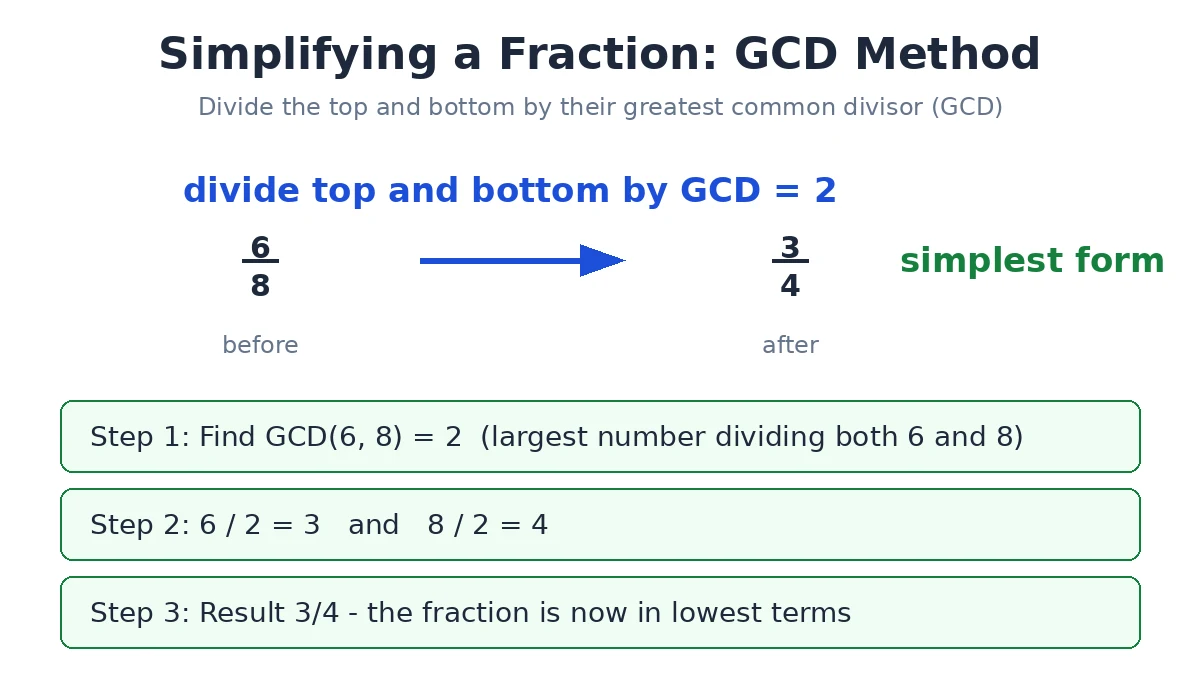
- Find the GCD of the numerator and denominator. For 6 and 8 it is 2; for 6 and 12 it is 6.
- Divide both numbers by the GCD: 6 ÷ 2 = 3 and 8 ÷ 2 = 4, so 6/8 becomes 3/4.
- Check: 3 and 4 share no common factor except 1, so 3/4 is in lowest terms.
For a visual walkthrough of equivalent fractions, the fractions guide at Maths is Fun is a clear, beginner-friendly reference. The calculator on this page performs the GCD step for you on every answer, so 5/6 − 1/6 = 4/6 is reported as 2/3 without you having to reduce it yourself.
Fraction, decimal and percent equivalents
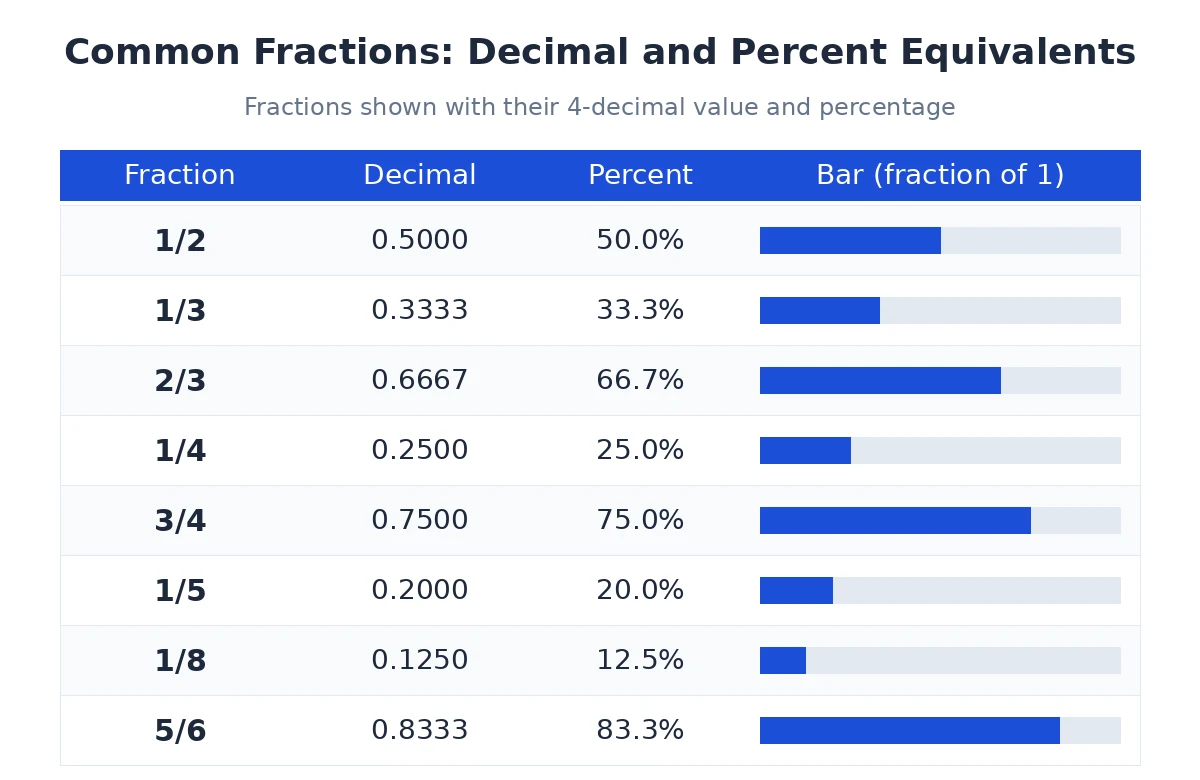
To turn a fraction into a decimal, divide the numerator by the denominator. To turn it into a percent, multiply that decimal by 100. Here are the equivalents you will meet most often:
| Fraction | Decimal | Percent |
|---|---|---|
| 1/2 | 0.5000 | 50.0% |
| 1/3 | 0.3333 | 33.3% |
| 2/3 | 0.6667 | 66.7% |
| 1/4 | 0.2500 | 25.0% |
| 3/4 | 0.7500 | 75.0% |
| 1/5 | 0.2000 | 20.0% |
| 2/5 | 0.4000 | 40.0% |
| 1/8 | 0.1250 | 12.5% |
| 3/8 | 0.3750 | 37.5% |
| 5/8 | 0.6250 | 62.5% |
| 7/8 | 0.8750 | 87.5% |
| 1/10 | 0.1000 | 10.0% |
When a discount or a rate is easier to read as a percent than as a fraction — 3/4 off is 75% off — our percentage calculator picks up where this page leaves off.
Improper fractions and mixed numbers
An improper fraction has a numerator larger than its denominator, like 3/2 or 7/4. A mixed number writes the same value as a whole number plus a proper fraction: 3/2 = 1 1/2, and 7/4 = 1 3/4.
Converting 3/2 to a mixed number
- Divide: 3 ÷ 2 = 1 with a remainder of 1.
- The whole number is 1, the remainder 1 becomes the new numerator, and the denominator stays 2.
- Result: 1 1/2.
Negative results keep the minus sign in front of the whole number: −3/2 becomes −1 1/2. If a calculation mixes fractions with decimals, powers or roots, a scientific calculator is the right tool for the follow-up work.
Frequently asked questions
How do you add fractions with different denominators?
Cross-multiply: a/b + c/d = (a × d + b × c) / (b × d), then simplify. For 1/2 + 1/3 that is (1 × 3 + 2 × 1) / (2 × 3) = 5/6. The calculator does the cross-multiplication and the GCD simplification for you.
How do you simplify a fraction?
Divide the numerator and denominator by their greatest common divisor (GCD). For 6/8, GCD(6, 8) = 2, so 6/8 = 3/4. Every answer on this page is simplified automatically.
What is an improper fraction versus a mixed number?
An improper fraction has a numerator larger than its denominator (for example 3/2). A mixed number writes the same value as a whole number plus a proper fraction (3/2 = 1 1/2). The calculator shows the mixed number whenever the answer is improper.
How do you convert a fraction to a decimal?
Divide the numerator by the denominator: 3/4 = 3 ÷ 4 = 0.75. The calculator shows the decimal to 4 places next to every answer, for example 1/3 = 0.3333.
Why can't the denominator be zero?
Division by zero is undefined in mathematics, so a fraction with a zero denominator has no value. The calculator rejects 0 in either denominator and also rejects a second fraction of 0 when you divide.
How do you divide fractions?
Flip the second fraction (its reciprocal) and multiply: a/b ÷ c/d = (a × d) / (b × c). So 3/4 ÷ 1/2 = (3 × 2) / (4 × 1) = 6/4 = 3/2 = 1 1/2.
Can I use negative numbers in the calculator?
Yes. All four boxes accept negative whole numbers, and results follow normal sign rules: a negative divided by a negative is positive, and mixed numbers carry the sign on the whole number, for example −3/2 = −1 1/2.