Grout Calculator
This free grout calculator tells you how much grout a tile job needs. Enter the tile size, grout joint width and depth, the tiled area, and the grout type to get the weight in pounds and kilograms and the number of bags to buy, with every step of the working shown.

Formulas verified against standard references. Calculator logic tested with verified worked examples. Published: November 4, 2026 | Last updated: November 4, 2026. Our methodology
How Much Grout Do I Need?
A 100 sq ft floor in 12x12 inch tile with 1/8 inch joints and a 3/8 inch joint depth needs about 6.4 lb of grout, or about 7.0 lb with a 10% waste allowance. One 25 lb bag covers that job several times over. The number moves fast with tile size. The same 100 sq ft in 2x2 inch mosaic needs about 35.6 lb of grout, about 39.2 lb with waste, which means buying two 25 lb bags.
Run your own tile size through the calculator above before you shop, because guessing from the area alone is what sends people back to the store.
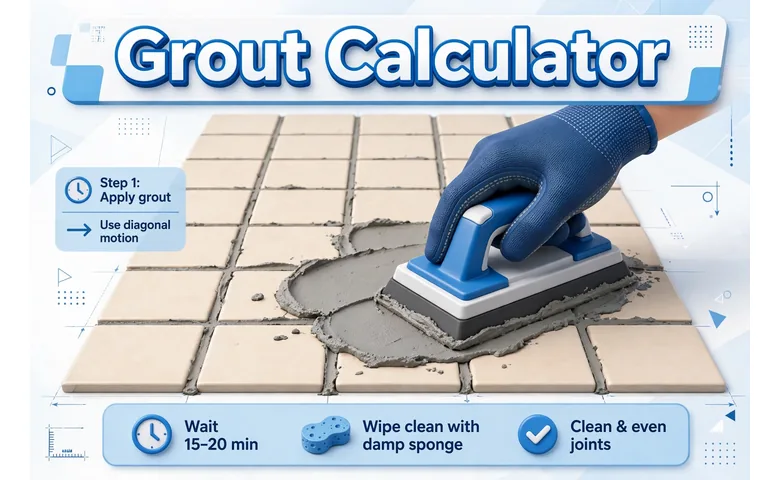
What Does a Grout Calculator Do?
Grout does not cover the floor. It fills the thin network of joints between the tiles, so the amount you need depends on how much joint your layout has, not on the area alone. A grout calculator finds the share of the surface taken by joints from your tile size and joint width, multiplies it by the tiled area and the joint depth to get the joint volume, converts that volume to a weight using the density of your grout type, adds your waste allowance, and rounds the result up into whole bags.
Small tiles pack far more joints into each square foot than large tiles, which is why the same floor can need four or five times more grout in mosaic than in 12x12 tile. The calculator above does the joint geometry for your exact tile, so the answer fits your job instead of a generic one.
How to Use the Grout Calculator
- Pick inches or millimeters. The toggle changes the unit on every field.
- Enter the tile length and width. Measure one tile rather than trusting the box label if they differ.
- Enter the grout joint width, the gap your spacers set, and the joint depth, which is normally the tile thickness.
- Enter the tiled area in square feet or square meters.
- Choose the grout type, set the waste allowance, and pick your bag size. A 10% waste allowance suits a flat simple floor.
- Press Calculate. You get the number of bags first, then the weight in pounds and kilograms, the joint volume, the coverage per bag, and the full step-by-step working so you can check the math by hand.
The Grout Calculation Formula
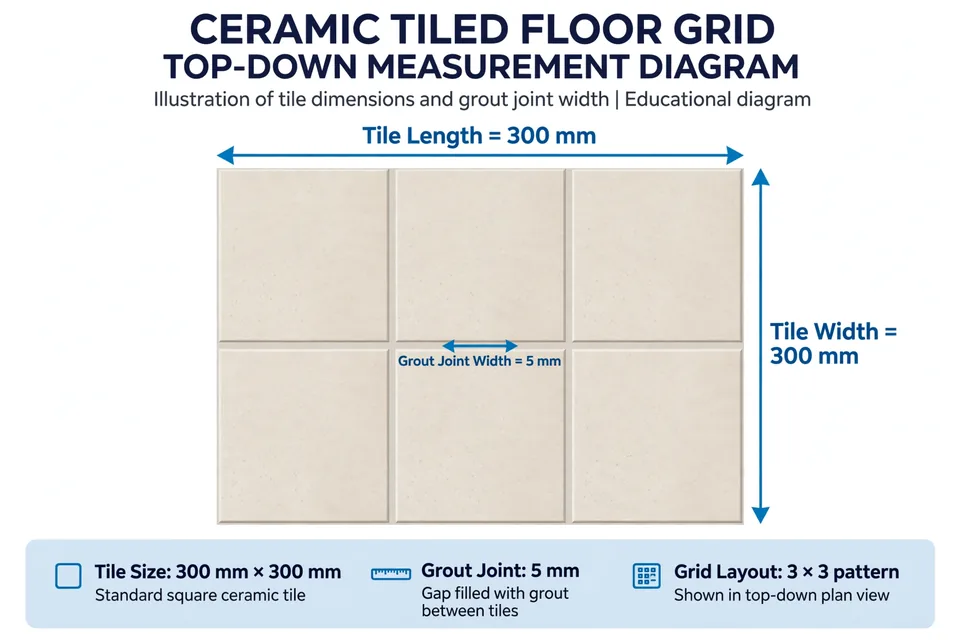
Joint share = 1 - (tile length x tile width) / ((tile length + joint width) x (tile width + joint width)). In this formula, tile length is the long side of one tile, tile width is the short side, and joint width is the gap between tiles. Grout weight = joint share x tiled area x joint depth x grout density.
Picture one tile plus the joint on two of its sides. That repeating cell covers (length + joint) by (width + joint), the tile itself covers length by width, and everything in the cell that is not tile is grout. The calculator turns that joint share into a volume with your area and depth, then into a weight with the density for your grout type. Densities are approximate and vary by manufacturer: sanded grout sits near 1.6 kg per liter, unsanded near 1.5, and epoxy near 1.8.
Worked Example
Here is the full arithmetic for 300 mm square tiles, 8 mm thick, with 3 mm joints over 10 sq m, using sanded grout with a 10% waste allowance.
First the joint share: 1 - (300 x 300) / (303 x 303) = 1 - 0.98030 = 0.019704, so about 1.97% of the surface is joint. Then the joint volume: 0.019704 x 10 sq m x 0.008 m = 0.0015763 cubic m, which is 1.58 liters. Then the grout weight: 1.58 L x 1.6 kg/L = 2.52 kg. With 10% waste: 2.52 x 1.10 = 2.77 kg, or about 2.8 kg. Type these numbers into the calculator above to check the arithmetic yourself. If you are pouring a solid mortar bed rather than filling joints, the concrete calculator handles volume by length, width, and depth.
Grout Coverage Chart by Tile Size
These numbers assume a 3/8 inch joint depth and sanded grout at 1.6 kg per liter. Each cell shows the grout used per square foot first, then how many square feet one 25 lb bag covers before waste. Scale the pounds per sq ft for your tile thickness. If your tile is 1/4 inch thick instead of 3/8, multiply the pounds per sq ft by 0.67.
| Tile size | 1/16 in joint | 1/8 in joint | 1/4 in joint |
|---|---|---|---|
| 2x2 in mosaic | 0.186 lb/sq ft, 134 sq ft | 0.356 lb/sq ft, 70 sq ft | 0.655 lb/sq ft, 38 sq ft |
| 4x4 in | 0.095 lb/sq ft, 262 sq ft | 0.186 lb/sq ft, 134 sq ft | 0.356 lb/sq ft, 70 sq ft |
| 6x6 in | 0.064 lb/sq ft, 390 sq ft | 0.126 lb/sq ft, 198 sq ft | 0.245 lb/sq ft, 102 sq ft |
| 12x12 in | 0.032 lb/sq ft, 775 sq ft | 0.064 lb/sq ft, 390 sq ft | 0.126 lb/sq ft, 198 sq ft |
| 24x24 in | 0.016 lb/sq ft, 1,544 sq ft | 0.032 lb/sq ft, 775 sq ft | 0.064 lb/sq ft, 390 sq ft |
Use this chart to plan, then confirm against the coverage table printed on your product packaging before you buy. Density varies by brand, so the bag chart is the final authority for your exact product.
Same Floor, Different Tile: Why Tile Size Matters
The table below runs the same 100 sq ft floor with 1/8 inch joints at 3/8 inch depth in sanded grout, changing only the tile size. It shows how violently the grout need swings on identical areas.
| Tile size | Grout needed | With 10% waste | 25 lb bags |
|---|---|---|---|
| 12x12 in | 6.40 lb | 7.04 lb | 1 |
| 6x6 in | 12.61 lb | 13.87 lb | 1 |
| 4x4 in | 18.63 lb | 20.49 lb | 1 |
| 2x2 in mosaic | 35.64 lb | 39.21 lb | 2 |
Halving the tile size roughly doubles the grout on the same floor, and the 2x2 mosaic uses more than five times the grout of the 12x12. Joint width works the same way: doubling the width from 1/16 to 1/8 inch nearly doubles the grout on the same tiles. Because these factors compound, eyeballing the quantity is unreliable and the per-joint calculation is the dependable way to estimate.
Sanded vs Unsanded vs Epoxy Grout
The joint volume is identical for all three types. The gaps in your floor do not change because the bag does. What changes is the weight of grout that fills that volume, because each type packs at a different density, and which joints each type is suited to. On the same 100 sq ft floor, unsanded grout runs about 6% lighter than sanded, which can decide whether a single 10 lb bag is enough.
Which Grout for Which Joint Width
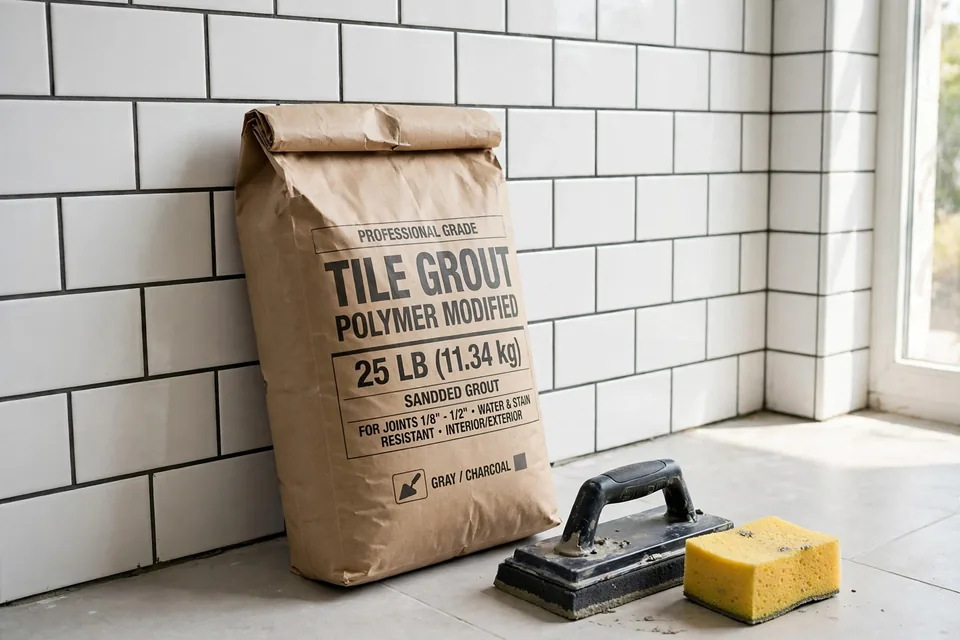
The 1/8 inch rule decides it. Use sanded grout for joints 1/8 inch (3 mm) and wider. The sand gives wide joints strength and resists shrinkage and cracking, which is why it suits floors and most tiling. Use unsanded grout for narrower joints and for polished or delicate tile that sand could scratch. Epoxy grout is waterproof and stain resistant, which makes it a good pick for kitchens, bathrooms, and commercial floors, though it costs more and sets fast.
| Grout type | Use it for joints | Approx. density |
|---|---|---|
| Sanded | 1/8 in and wider | 1.6 kg/L |
| Unsanded | Under 1/8 in | 1.5 kg/L |
| Epoxy | 1/8 in and wider | 1.8 kg/L |
Densities are starting points only. Follow the tile and grout manufacturer guidance for your specific job.
How Many Bags to Buy
Order the waste-adjusted weight, not the net weight. The net figure is the grout that ends up in the joints on a perfect day. The waste allowance covers what stays in the bucket, what drops and dries on the tile faces, and the part-bag left unmixed when the working time ran out. A 10% allowance suits a flat simple floor laid in a straight grid. Use 15% for diagonal layouts, small or mosaic tile, uneven handmade tile with wider effective joints, or your first tiling job.
Always round bags up. A 39.2 lb result with waste is two 25 lb bags, not one. This calculator already rounds up for you. Grout is only one bag on the shopping list. You also need thinset or mortar to bed the tiles, so plan those materials in the same trip.
Finally, confirm against the coverage table on your product packaging before a large order. Density varies by brand, so the bag chart is the final authority. For full floor material planning beyond grout, the flooring calculator estimates your overall material needs.
Grout Calculator vs Tile Calculator
These two tools answer different questions about the same project. The tile calculator counts the tiles and boxes your job needs. This grout calculator figures the grout that fills the joints between those tiles, in pounds, kilograms, and bags. Grout fills the gaps, tiles cover the area, and neither tool answers the other's question.
Use them together in this order. Count the tiles and boxes first, then figure the grout for the joints between them, then add thinset or mortar for the bed. That sequence gives you one shopping list and one trip to the store.
Frequently asked questions
How much grout do I need for 100 square feet of tile?
It depends on the tile size. With 12x12 inch tile and 1/8 inch joints at 3/8 inch depth, you need about 6.4 lb of grout, about 7.0 lb with a 10% waste allowance, so one 25 lb bag is plenty. The same 100 sq ft in 2x2 inch mosaic needs about 39.2 lb with waste, which is two 25 lb bags.
How many square feet does a 25 lb bag of grout cover?
Tile size decides it. At 1/8 inch joints and 3/8 inch depth, a 25 lb bag of sanded grout covers about 390 sq ft of 12x12 tile but only about 70 sq ft of 4x4 tile with 1/4 inch joints. Density varies by brand, so check the coverage chart on your bag before you buy.
What is the formula to calculate grout?
Joint share = 1 - (tile length x tile width) / ((tile length + joint width) x (tile width + joint width)). Multiply the joint share by the tiled area and the joint depth to get the grout volume, then multiply by the grout density for the weight. The calculator above runs the same steps and shows the working.
Should I use sanded or unsanded grout?
Use sanded grout for joints 1/8 inch and wider, especially on floors, because the sand keeps wide joints strong. Use unsanded grout for joints under 1/8 inch and for polished or delicate tile that sand could scratch. Epoxy is the third option for wet areas where stain resistance matters.
How wide should grout joints be?
Most tile looks best with 1/8 inch joints. Use 1/16 inch for rectified large-format tile with a tight modern look, and 1/4 inch for rustic, handmade, or uneven tile where wider joints hide edge variation. Wider joints need more grout, so re-run the calculator if you change the width.
How much extra grout should I buy for waste?
Add 10% for a flat simple floor laid in a straight grid. Use 15% for diagonal layouts, small or mosaic tile, or your first tiling job. Then round up to whole bags, because a part-bag cannot be bought.
Can I use this grout calculator for epoxy grout?
Yes. Choose Epoxy as the grout type and the calculator uses 1.8 kg per liter. Epoxy is usually sold in pre-measured kits rather than loose bags, so compare the computed weight against the kit's own coverage chart and pick your kit size in the bag size field.
How long does grout take to dry before sealing?
Cement-based grout typically needs 48 to 72 hours to cure fully. Epoxy grout sets faster, usually within 24 hours. Wait for a full cure before sealing, and follow the times printed on your product.
This grout estimate is for planning. Actual coverage varies by brand and job conditions, so confirm against the coverage chart on your bag before you buy. Read the full disclaimer.
Related calculators
Tile Calculator
Tiles and boxes needed for any area.
Use calculatorFlooring Calculator
Floor area and boxes for plank or tile.
Use calculatorConcrete Calculator
Volume in cubic feet and yards, bag counts.
Use calculatorPaint Calculator
Gallons needed for walls and ceilings.
Use calculatorBrick Calculator
Bricks and mortar for any wall.
Use calculatorDeck Calculator
Boards, joists and screws for a deck.
Use calculatorLumber Calculator
Board feet, linear feet and material cost.
Use calculatorPaver Calculator
Pavers and base material for patios.
Use calculatorCountertop Calculator
Countertop area, slabs, and material to buy.
Use calculator
Area Converter
Convert square feet, meters and acres.
Use calculator