Paver Calculator: How Many Pavers Your Patio Needs
Laying a patio or walkway always comes down to one nervous question: how many pavers do I actually buy? Guess low and the project stalls while you chase a matching batch; guess high and leftover stone clutters the garage. Enter your project size and paver dimensions, and this free paver calculator counts the pavers, adds your waste allowance, and estimates the gravel base and bedding sand underneath.
Formulas verified against standard references. Calculator logic tested with verified worked examples. Last reviewed: October 2026. Our methodology
How paver quantities are calculated
Counting pavers is area divided by the size of one paver, with the units lined up and a waste margin on top:
- Project area = length (ft) × width (ft) — the paved area in square feet.
- Paver area = (paver length in × paver width in) ÷ 144 — one paver's coverage in square feet.
- Pavers (no waste) = ceil(project area ÷ paver area) — always rounded up, since you cannot buy a fraction of a paver.
- Total pavers = ceil(pavers × (1 + waste% ÷ 100)) — the waste margin covers cuts, curves and breakage.
- Base gravel (cu yd) = area (sq ft) × (base depth in ÷ 12) ÷ 27.
- Bedding sand (cu yd) = area (sq ft) × (sand depth in ÷ 12) ÷ 27.
| Result | How it is computed |
|---|---|
| Total pavers to order | Ceiled paver count × (1 + waste %) |
| Pavers per square foot | 144 ÷ (paver length × paver width) |
| Base gravel | Area × base depth, converted to cubic yards |
| Bedding sand | Area × sand depth, converted to cubic yards |
The ÷ 144 converts square inches to square feet (12 × 12), and the ÷ 27 converts cubic feet to cubic yards. Measure the actual paver dimensions from the product spec — nominal names are often rounded.
Worked example
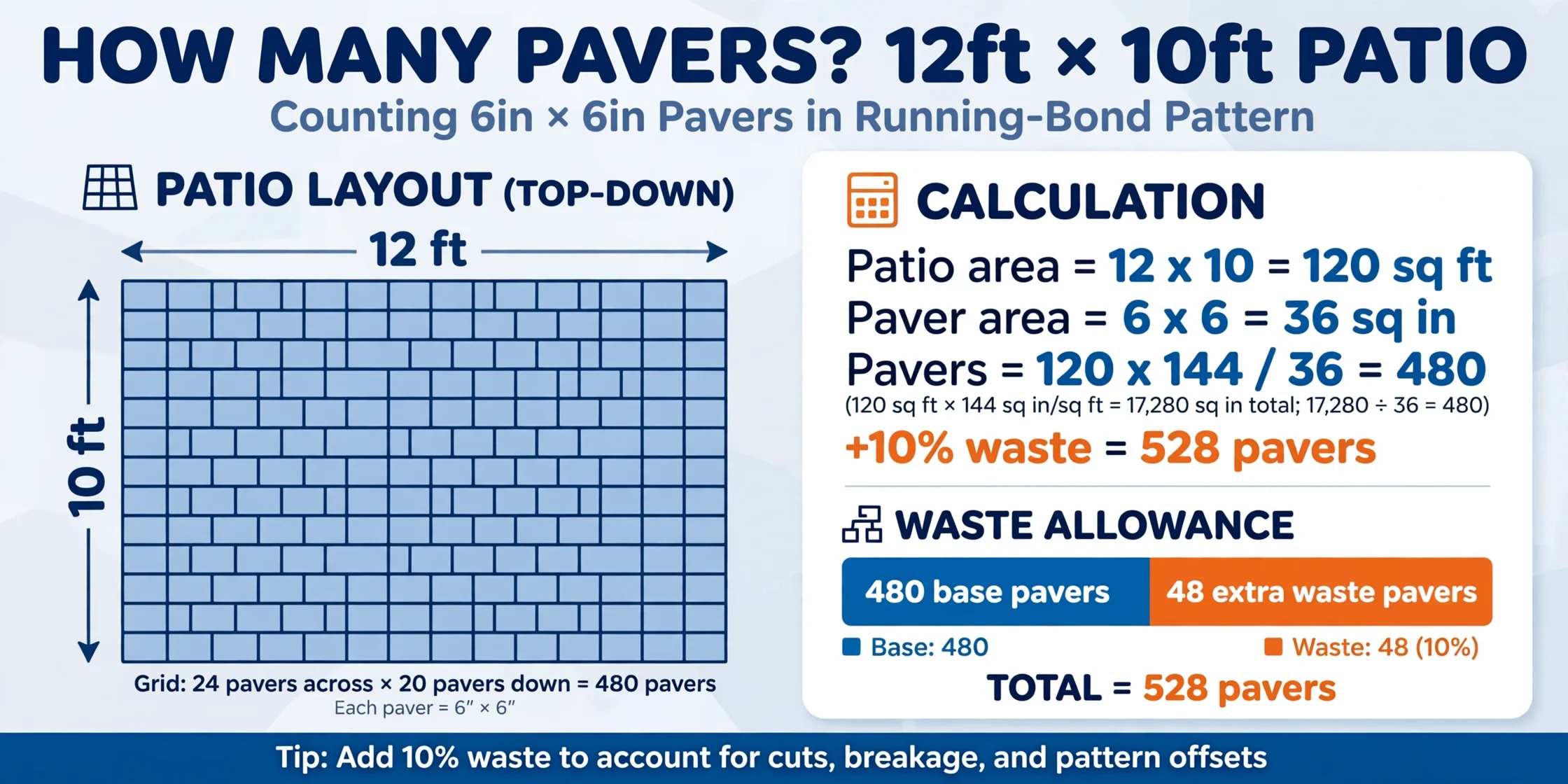
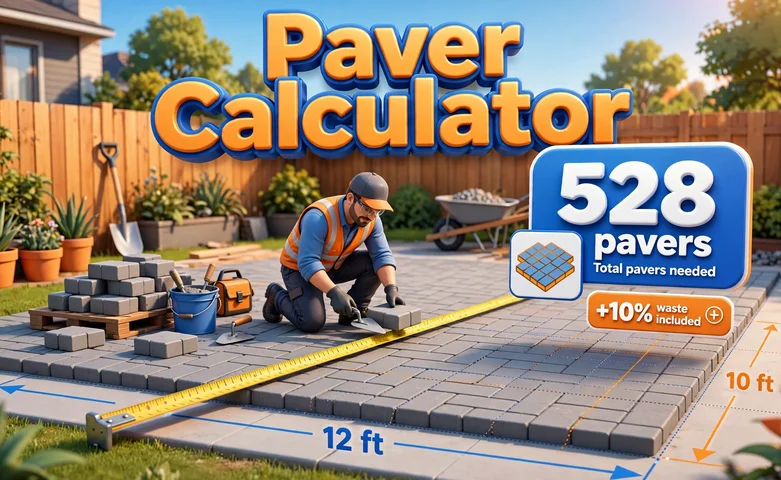
You are laying a 12 ft × 10 ft patio with 6 × 6 inch pavers, a 10% waste allowance, 4 in of base gravel and 1 in of bedding sand.
Area: 12 × 10 = 120 sq ft. Paver area: 6 × 6 = 36 sq in. Pavers: 120 × 144 ÷ 36 = 480, plus 10% waste = 528 pavers to order. Bedding sand: 120 × (1 ÷ 12) ÷ 27 ≈ 0.37 cu yd. Base gravel: 120 × (4 ÷ 12) ÷ 27 ≈ 1.48 cu yd.
How to use the paver calculator
Measure the project first — a tape measure and a helper beat guessing every time.
Step by step
- Enter the project length and width in feet. For L-shaped areas, split the shape into rectangles and run the calculator for each.
- Enter the paver length and width in inches. Use the actual product dimensions from the spec sheet, not the nominal name.
- Set the waste allowance. 10% is standard for simple rectangles; raise it for patterns and curves.
- Enter base and sand depths. 4 in of gravel base and 1 in of bedding sand suit most patios and walkways.
- Press Calculate. Take the paver count, gravel and sand totals to the supplier — and order from a single dye lot.
Common paver sizes and patterns
The paver you choose sets the count per square foot — smaller pavers mean more pieces, more cuts and more laying time:
| Paver size | Area (sq in) | Pavers per sq ft | Common use |
|---|---|---|---|
| 4 × 8 in | 32 | 4.5 | Brick-style patios, driveways |
| 6 × 6 in | 36 | 4.0 | Classic square patios |
| 6 × 9 in | 54 | 2.7 | Patios, pool surrounds |
| 12 × 12 in | 144 | 1.0 | Large modern patios |
| 16 × 16 in | 256 | 0.6 | Stepping stones, large format |
| 24 × 24 in | 576 | 0.3 | Contemporary large format |
Per-square-foot figures use the exact paver area; a typical 1/8–1/4 in joint gap lowers the count slightly, and the waste allowance absorbs the difference. Large-format pavers lay faster but show lippage on uneven bases — small pavers forgive more.
Base gravel and bedding sand: what goes under the pavers
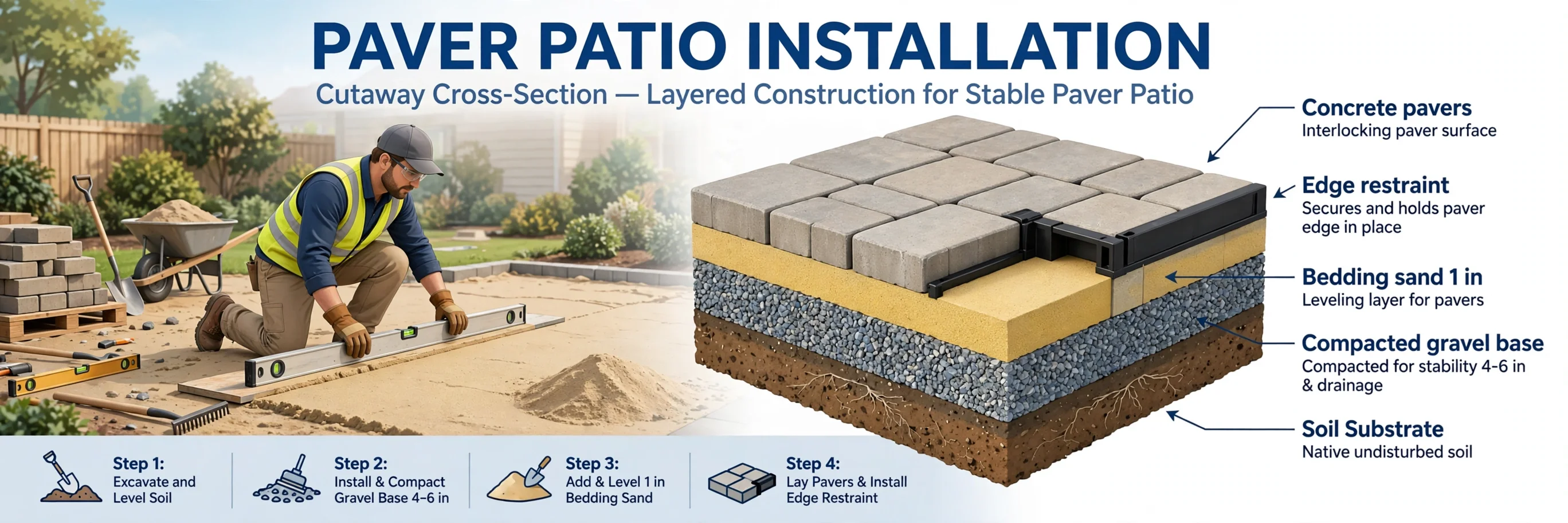
Pavers are only as good as what sits under them. The standard residential build-up, bottom to top:
| Layer | Typical depth | Purpose |
|---|---|---|
| Compacted soil (subgrade) | — | Firm, level foundation |
| Compacted gravel base | 4–6 in | Load spreading and drainage (6–8+ in for driveways) |
| Bedding sand | 1 in | Screeded level; do not compact before laying pavers |
| Pavers | — | Laid to pattern with narrow joints |
| Jointing sand + edge restraint | — | Locks the field in place |
Compact the gravel in lifts and screed the sand to a uniform 1 in — low spots telegraph straight through to the paver surface. If your project includes a poured concrete edge or footings rather than a paver base, a concrete calculator estimates that mix separately.
Patterns, cuts and the waste allowance
The laying pattern decides how much cutting you will do — and cutting is what the waste allowance is for:
- Running bond / stack bond: 10% waste covers a simple rectangle with straight edges.
- Herringbone: allow 10–15% — every edge course needs angled cuts.
- Curves and circles: allow 15% — offcuts from curved cuts are rarely reusable.
- Edge restraint is non-negotiable: without it, the outer pavers creep outward and the field loosens within a season.
Buy 5–10 extra pavers beyond the calculated waste and keep them — dye lots vary, and a matching batch is hard to find a year later. For indoor floors laid the same way, a tile calculator counts tiles and boxes with its own waste logic.
For installation best practices from the industry body, see the Concrete Masonry & Hardscapes Association homeowner resources.
Frequently asked questions
How many pavers do I need for a 12x10 ft patio?
120 sq ft of patio. With 6x6 in pavers (36 sq in each): 120 × 144 ÷ 36 = 480 pavers, plus a 10% waste allowance = 528 pavers to order.
What waste percentage should I add for pavers?
10% is the standard allowance for a simple rectangle in running bond. Raise it to 10–15% for herringbone patterns, curves, or areas with many edges to cut around.
How thick should the gravel base be under pavers?
4–6 in of compacted gravel for patios and walkways; 6–8+ in for driveways. Compact in lifts and follow local specs for soil, drainage and freeze-thaw conditions.
How much sand goes under pavers?
A 1 in layer of bedding sand, screeded level and not compacted before the pavers go down. Volume in cubic yards = area (sq ft) × (sand depth ÷ 12) ÷ 27.
Should I include the joint gap in the paver size?
For a quick estimate you can skip it: a typical 1/8–1/4 in joint slightly reduces the pavers per square foot, and the waste allowance absorbs the difference. For tight ordering, use (paver + joint) as the pitch in each direction.
How many pavers come on a pallet?
It varies by paver size and manufacturer — check the supplier's product spec for coverage per pallet (often 100+ sq ft for standard pavers). Divide your total by the pallet coverage and round up to whole pallets.
Can I lay pavers directly on soil?
Not recommended — pavers laid on bare soil shift, settle unevenly and grow weeds through the joints. The minimum durable build is a compacted gravel base plus bedding sand with an edge restraint.
How do I estimate pavers for an L-shaped patio?
Split the shape into rectangles, run the calculator for each rectangle, and add the totals. For curved areas, measure the bounding rectangle and keep the higher 10–15% waste allowance.
Related calculators
Concrete Calculator
Estimate concrete volume in cubic yards and count 80, 60 and 40 lb bags.
Use calculator
Tile Calculator
Figure tiles and boxes needed for any floor with your waste allowance.
Use calculator
Deck Calculator
Deck boards, joists, screws and linear feet from deck dimensions.
Use calculator