Driveway Calculator

Work out how much material your driveway needs before you order. Enter the length, width and depth, pick concrete, asphalt, gravel or pavers, and this driveway calculator gives you the area, the volume in cubic yards and the amount to order with a waste allowance.

The length of the driveway from the street to the garage.

A single car driveway is about 10 to 12 ft wide, a two car driveway about 20 to 24 ft.

The thickness of the material. 4 in suits cars, 5 to 6 in suits heavier vehicles.

Pick the surface you are building. The amount is shown in cubic yards, tons or pavers.

Extra material for spillage, uneven ground and cutting. 10% is typical.

Formula: volume in cubic feet = length in ft x width in ft x (depth in inches / 12). Cubic yards = cubic feet / 27, because one cubic yard is 27 cubic feet. Order volume = cubic yards x (1 + waste %). Concrete orders round up to the nearest half cubic yard, asphalt and gravel convert at 2.0 and 1.4 tons per cubic yard and round up to the nearest half ton, and pavers need 4.5 per square foot for 4 by 8 in pavers.

How to Use the Driveway Calculator

Measure the driveway, pick the material, and the calculator works out the order. It shows the area, the net volume, the volume with waste, and the amount to order rounded up so you do not run short.

  1. Enter the length and width of the driveway in feet.
  2. Enter the depth in inches. 4 in suits cars, 5 to 6 in suits heavier vehicles.
  3. Pick the material, concrete, asphalt, gravel or pavers.
  4. Set the waste allowance. 10% is typical, and 5% suits a flat, even site.
  5. Press Calculate, or press Enter. The amount to order appears first and large, with the area and the volume below.
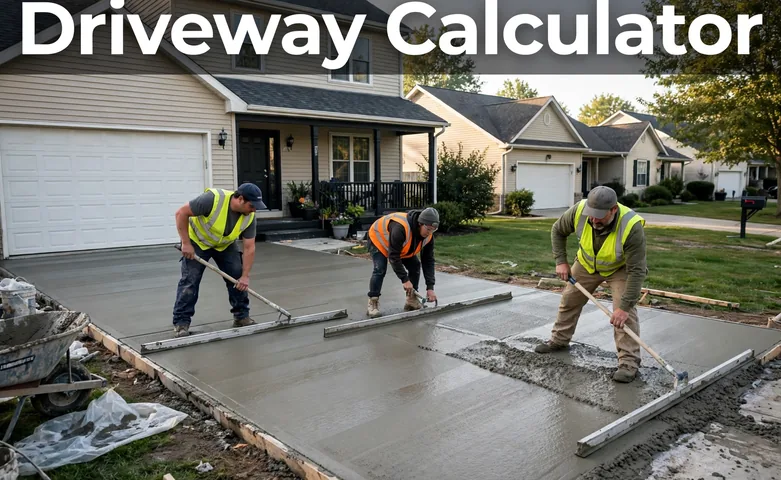
A photo of workers smoothing freshly poured concrete on a driveway in front of a suburban house
A 20 by 12 ft driveway at 4 in deep needs 3.5 cubic yards of concrete to order.

The Driveway Formula

The driveway formula is volume = length x width x depth, with the depth turned from inches into feet first. A 20 by 12 ft driveway at 4 in deep is 20 x 12 x (4 / 12) = 80 cubic feet. Divide by 27, because one cubic yard is 27 cubic feet, and the net volume is 80 / 27 = 2.96 cubic yards.

Then add the waste allowance. At 10%, the order volume is 2.96 x 1.10 = 3.26 cubic yards, and ready mix orders round up to the nearest half yard, so you order 3.5 cubic yards. Asphalt converts at 2.0 tons per cubic yard and gravel at 1.4 tons per cubic yard, each rounded up to the nearest half ton. Pavers skip the volume and count from the area at 4.5 pavers per square foot. Our concrete calculator prices slabs and footings the same way, and our asphalt calculator works out tons for any asphalt area.

Worked Example: 20 by 12 ft Concrete Driveway

A two car driveway is 20 ft long and 12 ft wide, 4 in deep, in concrete, with a 10% waste allowance. Here is exactly what the calculator does.

  1. Area: 20 x 12 = 240 sq ft.
  2. Volume: 240 x 4 / 12 = 80 cubic feet.
  3. Cubic yards: 80 / 27 = 2.96 cu yd.
  4. Waste: 2.96 x 1.10 = 3.26 cu yd to cover.
  5. Order: 3.26 rounded up to the nearest half yard = 3.5 cu yd.
  6. Bags: 88 cubic feet / 0.6 per 80 lb bag = 147 bags, if you mix by hand instead.

As a second check, a 20 by 10 ft single car driveway in asphalt at 3 in deep is 200 sq ft, 50 cubic feet, 1.85 cu yd, 2.04 cu yd with waste, and 4.5 tons to order. The same steps work for any size, so try your own numbers in the tool above.

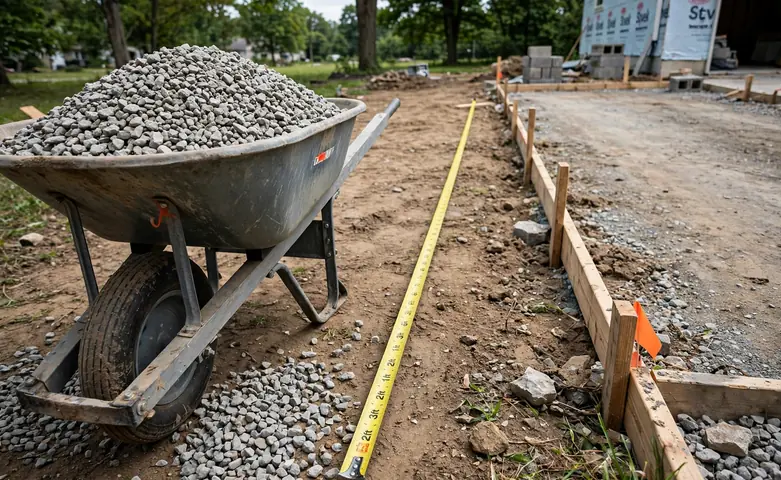
A photo of a wheelbarrow full of gravel beside a driveway under construction with a measuring tape
240 sq ft at 4 in deep is 80 cubic feet, or 2.96 cubic yards before waste.

Concrete, Asphalt, Gravel or Pavers

Concrete is the most common driveway surface. It lasts 25 to 30 years, needs a 4 in slab for cars and 5 to 6 in for heavier vehicles, and costs about $130 to $180 per cubic yard for ready mix, before labor. A 24 by 24 ft driveway at 4 in needs 7.11 cu yd before waste, or 7.82 cu yd with a 10% allowance.

Asphalt costs less up front and goes down fast, but it needs sealing every few years and softens in heat. It runs about 2.0 tons per cubic yard. Gravel is the cheapest to lay and the easiest to repair, but it needs topping up and it migrates, so it suits rural drives and light use. It runs about 1.4 tons per cubic yard.

Pavers cost the most and last the longest, and a single damaged paver can be lifted and replaced without redoing the drive. At 4 by 8 in, they need 4.5 pavers per square foot, so a 10 by 10 ft area needs 495 pavers with a 10% allowance. The depth you enter sets the gravel base under them.

How Much Waste to Allow

Always order more than the net volume. The ground is never perfectly flat, forms flex, spillage happens, and a short load mid pour means a cold joint, a weak seam where the new concrete meets concrete that already started to set. That is why the default waste allowance is 10%.

Use 5% only on a flat, well formed site with an even subgrade you have already checked. Use 10% for most driveways, and 15% for an uneven site, a curved edge, or a first time pour. Ready mix plants also set a minimum load, commonly 2 to 4 cubic yards, and charge a short load fee below it, so a very small driveway can cost more per yard than a big one.

For pavers the waste covers cutting at the edges and a few broken pieces. For gravel it covers compaction, because the base settles under the first rains and the first cars. Measure the site twice, and order the rounded up figure the calculator gives you.

Common Mistakes to Avoid

The most common mistake is forgetting the depth conversion. Depth in inches must be divided by 12 before it multiplies the area. A 4 in slab is 0.333 ft, not 4 ft, and skipping that step gives a volume twelve times too big.

A second mistake is ordering the net volume with no waste. The pour always needs a little more than the math says, and running short mid pour costs far more than the extra half yard would have. Order the rounded up figure, and keep the waste allowance at 10% unless the site is truly flat.

A third mistake is pouring too thin for the traffic. A 4 in slab suits cars, but a driveway that carries a heavy truck, a boat or a camper needs 5 to 6 in, and a weak subgrade needs a thicker gravel base under it. Check the base, compact it, and confirm the thickness with your supplier before the truck arrives.

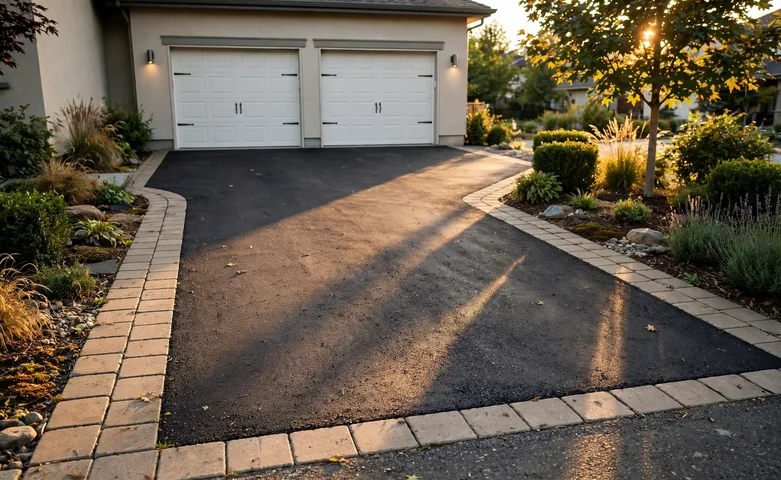
A photo of a finished asphalt driveway with neat paver edging leading to a garage in late afternoon sun
Order the rounded up figure with a 10 percent waste allowance so the pour never runs short.

Frequently asked questions

How many cubic yards of concrete do I need for a driveway?

Multiply length by width by depth in feet, then divide by 27. A 20 by 12 ft driveway at 4 in deep is 2.96 cubic yards, and you should order 3.5 cubic yards with a 10% waste allowance.

How thick should a concrete driveway be?

4 in suits cars and light vehicles. Use 5 to 6 in for heavy trucks, boats or campers, and put a compacted gravel base under the slab on weak soil.

How much does concrete cost per cubic yard?

Ready mix runs about $130 to $180 per cubic yard delivered in most US markets, before pump hire and short load fees. Bagged concrete costs more per yard, about $270 to $400 once you count the 45 bags of 80 lb mix per yard.

How many pavers do I need per square foot?

Standard 4 by 8 in pavers need 4.5 pavers per square foot. A 100 sq ft area needs 450 pavers before waste, or 495 with a 10% allowance.

How much waste should I allow for a driveway?

Allow 10% for most driveways. Use 5% only on a flat, even site, and 15% on an uneven site or a first time pour. Running short mid pour is far more costly than the extra material.

How many bags of concrete make a cubic yard?

About 45 bags of 80 lb premixed concrete make one cubic yard, because each bag yields about 0.6 cubic feet. A 3.5 cubic yard order equals about 147 bags, which is why ready mix wins on any driveway sized job.

This is an estimate for planning. Actual material amounts and prices vary by supplier and site conditions, so confirm quantities with your supplier before you order.

Start Calculating Now!

Discover the power of smart tools at KitQuarter.

Explore All Tools