Gravel Calculator: Volume, Tons and Pounds to Order
Gravel is sold by the ton or the cubic yard, but projects are measured in feet and inches. This free gravel calculator bridges the gap: enter your area and depth, and it returns the volume in cubic feet and cubic yards plus the tons and pounds to order, with a waste allowance built in.
Formulas verified against standard construction references. Calculator logic tested with verified worked examples. Last reviewed: October 2026. Our methodology
How the gravel math works
A gravel estimate is a volume calculation followed by a weight conversion. Suppliers sell by the ton or the cubic yard, so the calculator first figures the space your project fills, then converts it into the units you order.
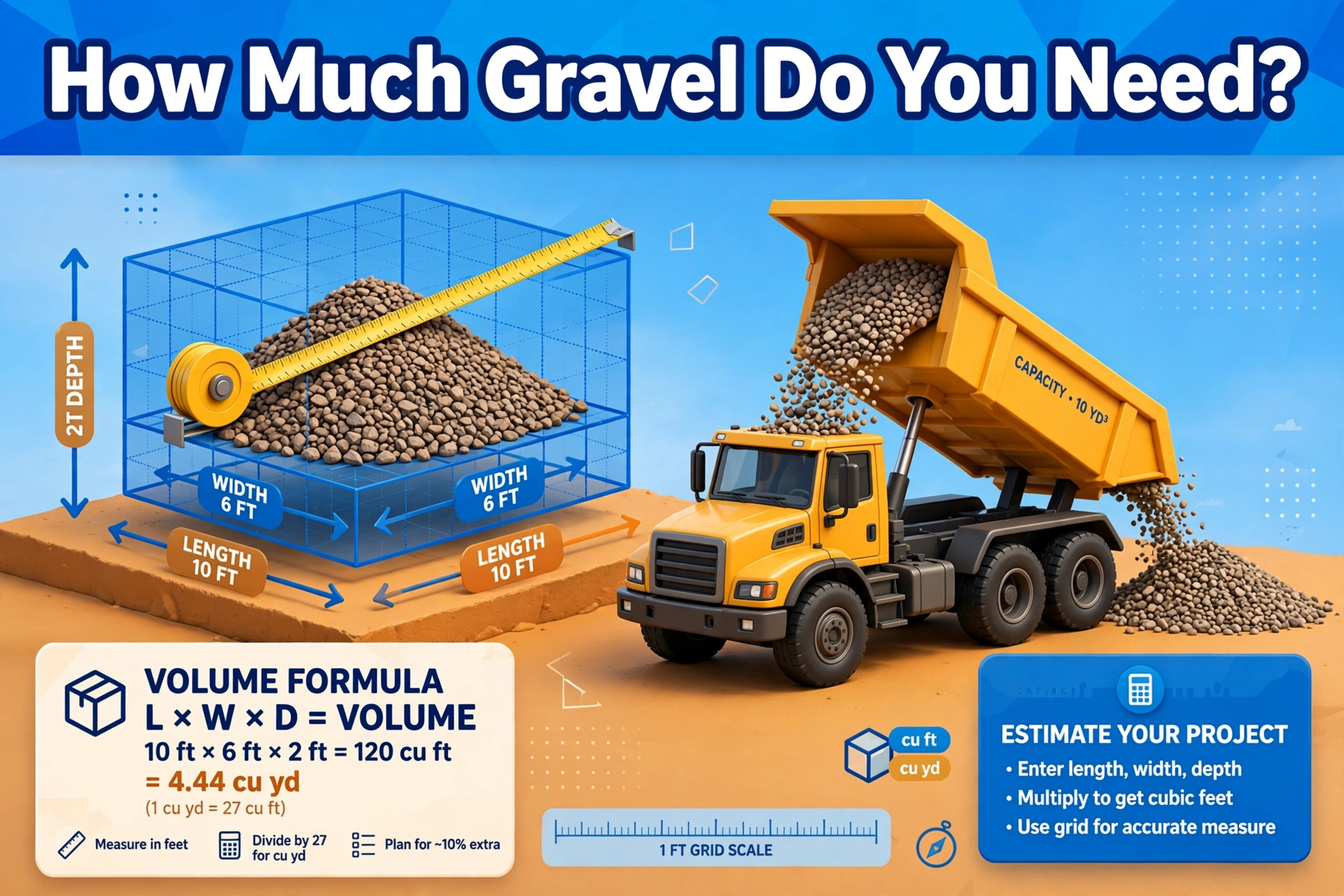
- Cubic feet: length (ft) × width (ft) × (depth (in) ÷ 12). Dividing inches by 12 keeps every measurement in feet.
- Cubic yards: cubic feet ÷ 27, since one cubic yard is 3 × 3 × 3 = 27 cubic feet.
- With waste: cubic yards × (1 + waste % ÷ 100). The 10% default covers compaction, spillage, and an uneven subgrade.
- Tons to order: cubic yards with waste × 1.4. Typical crushed gravel weighs about 1.4 tons (2,800 lb) per cubic yard, the figure most suppliers quote.
- Pounds: tons × 2,000.
Sources: density estimates reflect commonly published values for crushed stone/gravel aggregate (~1.4 tons per cubic yard); see published gravel density references.
Worked example
Take a 10 ft × 10 ft patio with 4 inches of gravel and a 10% waste allowance:
- Convert the depth: 4 in ÷ 12 = 0.333 ft
- Volume: 10 × 10 × 0.333 = 33.33 cubic feet
- Cubic yards: 33.33 ÷ 27 = 1.234 cubic yards
- With 10% waste: 1.234 × 1.10 = 1.358 cubic yards
- Tons: 1.358 × 1.4 = 1.9 tons
- Pounds: 1.9 × 2,000 = 3,800 lb
So for a 10×10 area at 4 inches deep, order about 1.9 tons (3,800 lb) of gravel — roughly two tons for a single delivery.
How to use the gravel calculator
Four numbers are all the calculator needs. Measure carefully — the result is only as good as the measurements behind it.
Step by step
- Enter the length of the area in feet, measuring the longest side.
- Enter the width in feet. For irregular areas, split the space into rectangles and run the calculator once per section, then add the results.
- Enter the depth in inches — the thickness of the finished gravel layer you want.
- Set the waste allowance. The default is 10%, which is the standard for most projects. Use 15% on sloped or uneven ground.
- Press Calculate to get cubic feet, cubic yards, tons to order, and pounds.
What you get
- Volume in cubic feet — the raw space the gravel fills
- Volume in cubic yards — the unit many bulk suppliers quote
- Volume with waste — the number to actually base your order on
- Tons to order — the figure to give your supplier
- Pounds — useful for bag-count math at the hardware store
The formulas
- Cubic feet = length (ft) × width (ft) × (depth (in) ÷ 12)
- Cubic yards = cubic feet ÷ 27
- With waste = cubic yards × (1 + waste % ÷ 100)
- Tons = cubic yards with waste × 1.4
- Pounds = tons × 2,000
How deep should the gravel be?
Depth is the input people get wrong most often, and it matters more than any other measurement: doubling the depth doubles the order. A thin decorative layer and a load-bearing driveway base are entirely different projects.
Recommended depths by project
| Project | Recommended depth |
|---|---|
| Garden bed or decorative topping | 2 in |
| Walkway or garden path | 2–3 in |
| Patio base | 3–4 in |
| Driveway (passenger cars) | 4–6 in |
| Heavy vehicles or soft soil | 6–8 in |
| Drainage trench or French drain | 6–12 in |
For driveways, the total usually comes in layers: 4 inches of compacted base stone topped with 2–3 inches of surface gravel. If your project mixes layers, run the calculator once per layer and add the results.
One warning: gravel compacts. A freshly spread 4-inch layer can settle to about 3.5 inches after rain and traffic. The default 10% waste allowance covers normal compaction; on soft or sloped ground, raise it to 15%.
If your project uses a poured slab instead of loose stone — a concrete pad or footing — depth works the same way but the material math differs. Our concrete calculator estimates volume and bag counts for poured concrete the same way this page handles gravel.
From cubic yards to tons: the weight conversion
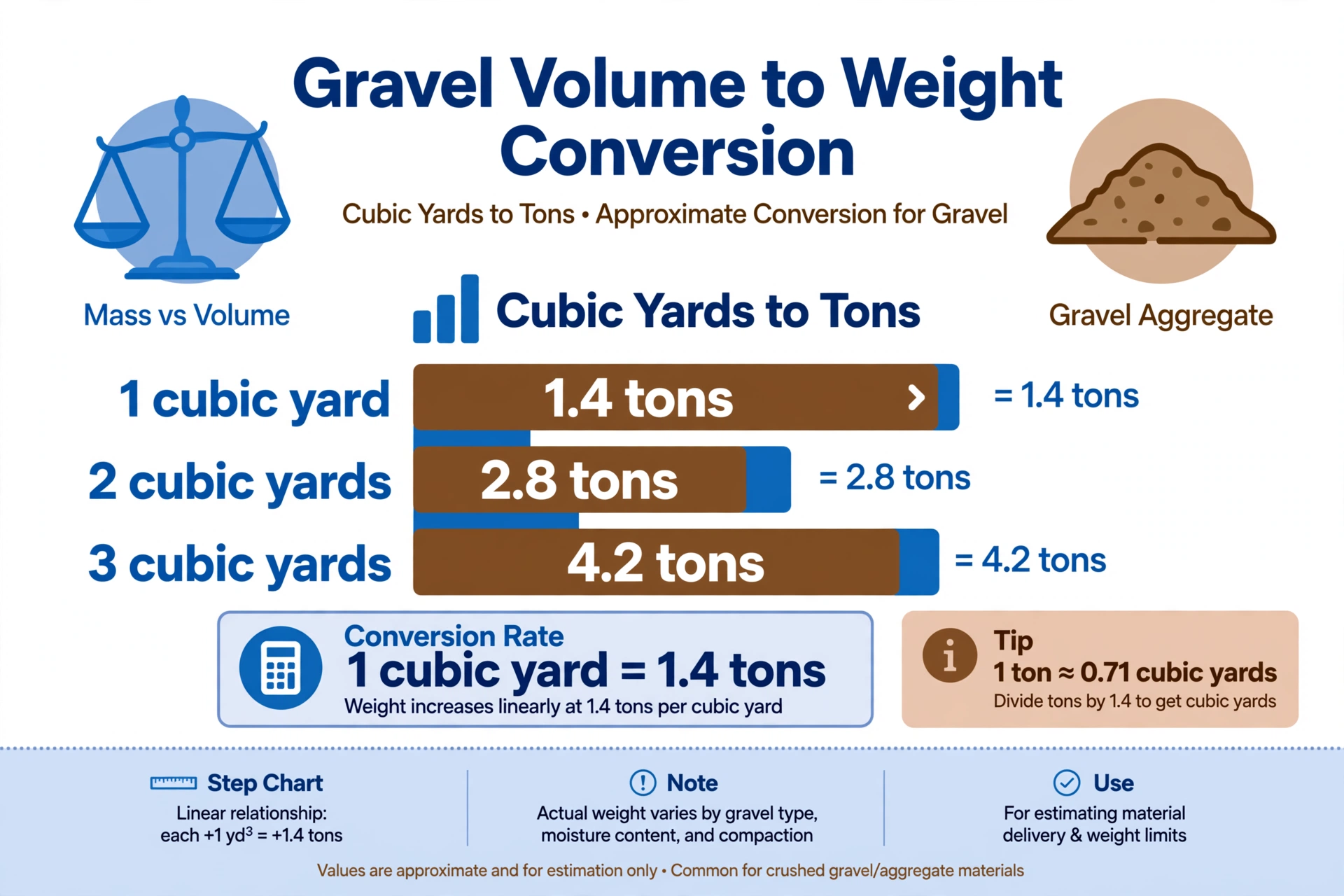
Suppliers price and deliver gravel by weight, so the last step converts your volume into tons. Typical crushed stone weighs about 1.4 tons — roughly 2,800 lb — per cubic yard. Pea gravel runs a little lighter and crusher run a little heavier, but 1.4 is the rule of thumb most yards quote, and it matches published aggregate density tables.
The relationship is linear: twice the cubic yards means twice the tons. You can sanity-check any result with this quick reference for a 4-inch depth, with 10% waste already included:
Driveway quick reference (4 in depth, 10% waste included)
| Area | Cubic yards (before waste) | Tons to order |
|---|---|---|
| 10 × 10 ft | 1.23 | 1.9 |
| 12 × 20 ft | 2.96 | 4.6 |
| 20 × 30 ft | 7.41 | 11.4 |
| 20 × 50 ft | 12.35 | 19.0 |
Reverse the conversion when a supplier quotes a price per ton but you think in volume: divide tons by 1.4 to get cubic yards. And if you need the answer in kilograms or metric tonnes for a metric-quoting supplier, our weight converter handles the unit switch in one step.
Because density varies with stone type and moisture, treat the tonnage as an estimate and confirm the exact figure with your supplier before a large order. You can cross-check the volume and weight steps against Calculator.net's gravel calculator, which uses the same area-times-depth math.
Frequently asked questions
How much gravel do I need for a 10x10 area?
At 4 inches deep, a 10 ft × 10 ft area needs 33.33 cubic feet, or 1.23 cubic yards. With a 10% waste allowance, order about 1.9 tons (3,800 lb) of gravel. Use the calculator above with your own depth for an exact figure.
How many tons are in a cubic yard of gravel?
About 1.4 tons. Typical crushed stone weighs roughly 2,800 pounds per cubic yard, which is the figure most suppliers quote. Pea gravel is a little lighter at around 1.2 to 1.3 tons per cubic yard, and crusher run is a little heavier at about 1.5 tons.
How deep should gravel be for a driveway?
Most passenger-car driveways use 4 to 6 inches of compacted base gravel, often built in layers: about 4 inches of base stone topped with 2 to 3 inches of surface gravel. Heavy vehicles or soft soil call for 6 to 8 inches total.
Why add a waste factor to a gravel order?
Gravel compacts after spreading, some spills during handling, and subgrades are rarely perfectly level. A 10% waste allowance covers all three for a typical project. Raise it to 15% on sloped or uneven ground so you do not run short and pay for a second delivery.
How do I convert cubic feet to cubic yards?
Divide by 27. One cubic yard is a cube 3 feet on each side, so it holds 3 × 3 × 3 = 27 cubic feet. For example, 33.33 cubic feet divided by 27 is 1.23 cubic yards.
Should I buy gravel by the ton or by the cubic yard?
Most suppliers price and deliver by weight, so the tons figure is the one to quote when you order. Some bulk yards sell by the cubic yard instead. The calculator above gives you both, so you are covered either way.
How many cubic yards fit in a dump truck?
A typical tandem dump truck carries about 10 cubic yards of gravel, which is roughly 14 tons. Smaller single-axle trucks carry 5 to 8 cubic yards. If your estimate is well under one truckload, ask your supplier about minimum delivery charges.