Asphalt Calculator: Volume in Cubic Yards and Tons
Enter the length, width and depth of your asphalt area to get cubic feet, cubic yards and tons — plus tons for common depths.
Formulas verified against standard references. Calculator logic tested with verified worked examples. Last reviewed: October 2026. Our methodology
How asphalt estimation works
Asphalt is sold by the ton, but most projects are measured in feet and inches. This calculator bridges the two: enter the length and width of the area and the depth of the asphalt layer, and it converts that volume into cubic feet, cubic yards and tons.
The weight calculation uses a density assumption of 145 pounds per cubic foot. That is a standard planning figure for compacted hot-mix asphalt; the actual density of a delivered mix can vary slightly, so treat the tonnage as an estimate and confirm the final order with your supplier.
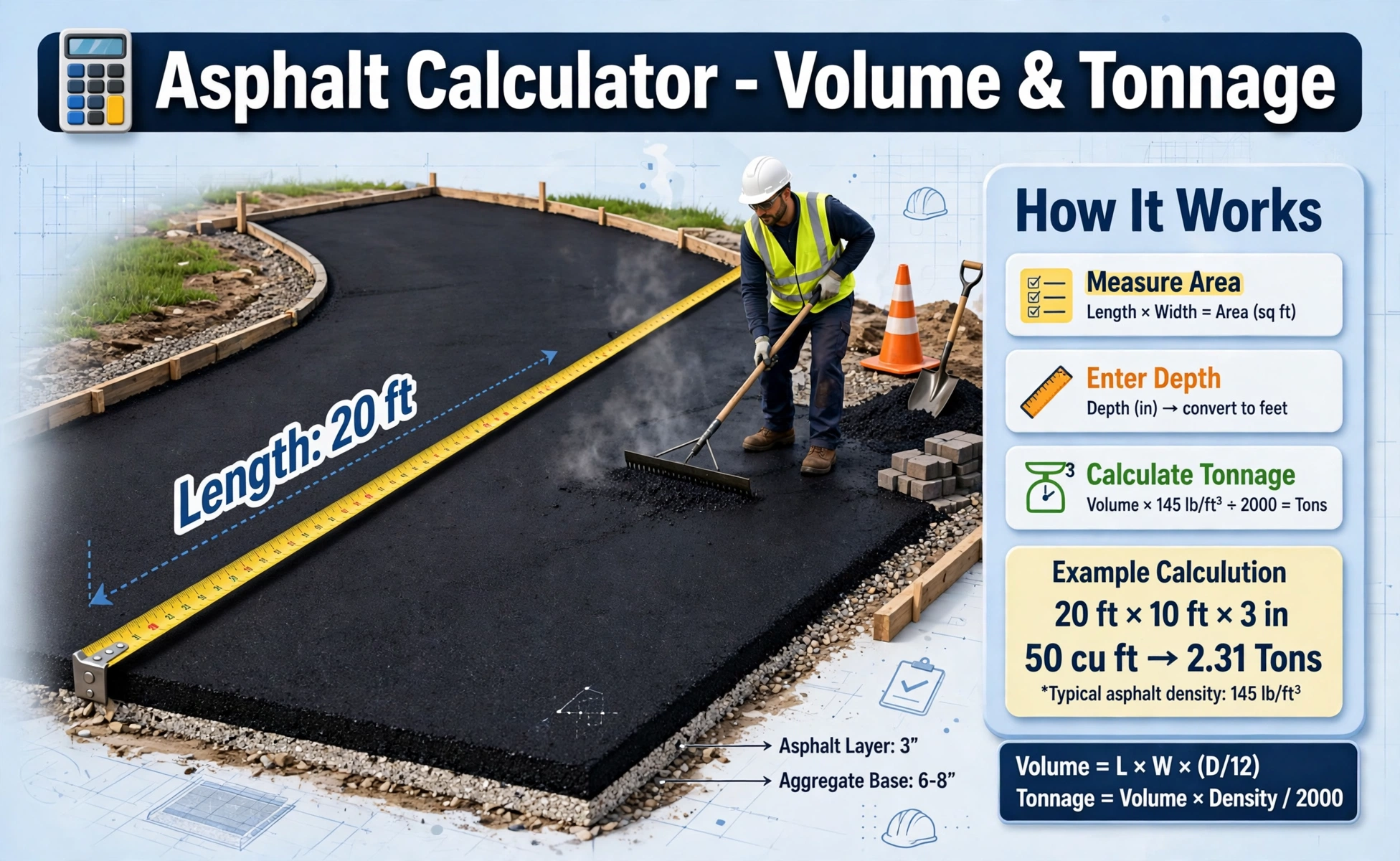
The asphalt formula
Depth is entered in inches, so it is first converted to feet by dividing by 12. The three steps are:
Volume (cubic feet) = length (ft) x width (ft) x (depth (in) / 12)
Volume (cubic yards) = cubic feet / 27
Weight (tons) = cubic feet x 145 lb per cubic foot / 2000
One cubic yard equals 27 cubic feet, and one ton equals 2000 pounds — those two conversions are all that stand between a measured area and an order quantity.
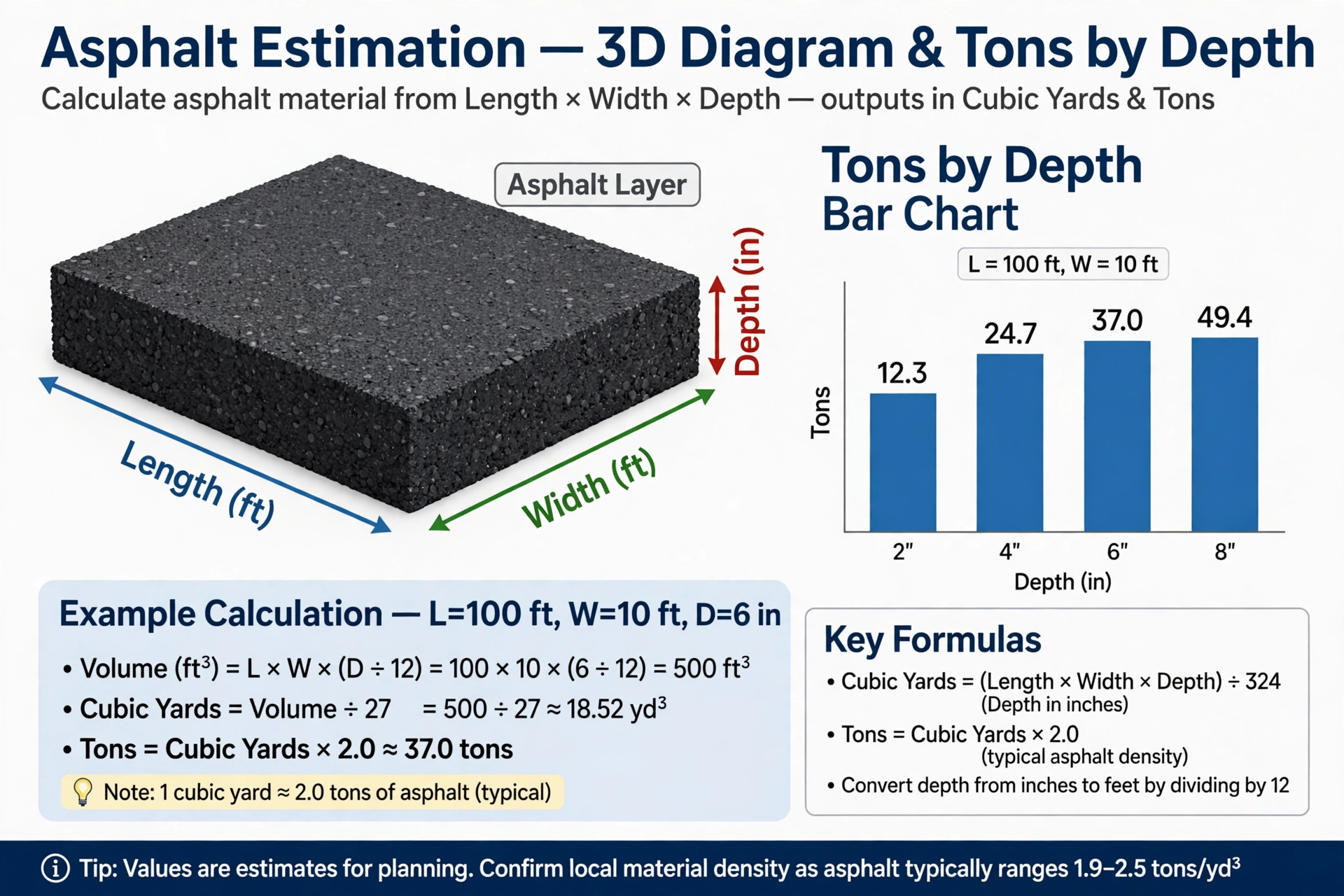
Worked example: 20 ft x 10 ft driveway at 3 inches
A driveway 20 feet long and 10 feet wide, paved 3 inches deep:
- Depth in feet: 3 / 12 = 0.25 ft
- Cubic feet: 20 x 10 x 0.25 = 50.00 cu ft
- Cubic yards: 50.00 / 27 = 1.85 cu yd
- Tons: 50.00 x 145 / 2000 = 3.63 tons
So the job needs about 1.85 cubic yards, or about 3.63 tons, of asphalt before any allowance for waste or compaction.
| Quantity | Calculation | Result |
|---|---|---|
| Volume | 20 x 10 x (3 / 12) | 50.00 cu ft |
| Cubic yards | 50.00 / 27 | 1.85 cu yd |
| Weight | 50.00 x 145 / 2000 | 3.63 tons |
Tons by depth for a 20 ft x 10 ft area
Depth changes the order more than most people expect: doubling the depth doubles the tonnage. The table below holds the area fixed at 20 ft x 10 ft (200 square feet) and varies only the depth, using the same 145 lb per cubic foot density.
Use the same idea for any area: the calculator above recomputes this table for your own length and width when you submit the form.
| Depth (in) | Cubic feet | Cubic yards | Tons |
|---|---|---|---|
| 2 | 33.33 | 1.23 | 2.42 |
| 3 | 50.00 | 1.85 | 3.63 |
| 4 | 66.67 | 2.47 | 4.83 |
| 5 | 83.33 | 3.09 | 6.04 |
| 6 | 100.00 | 3.70 | 7.25 |
Ordering tips and related materials
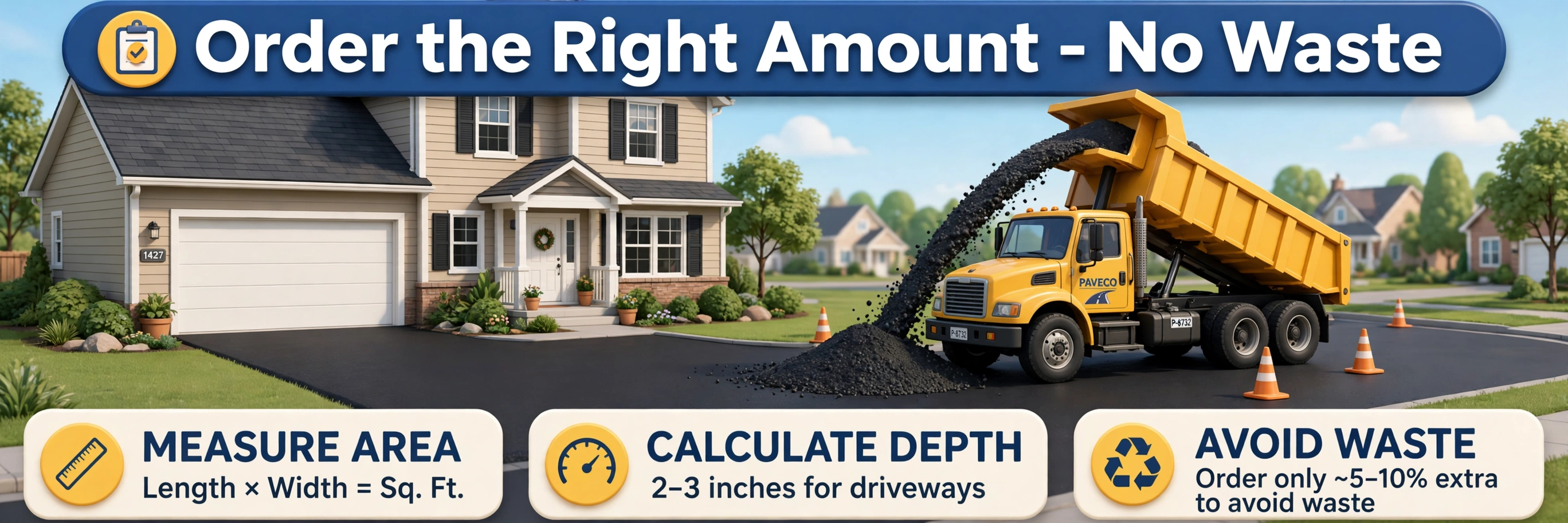
Measure the area in a few places and use the largest length and width — an area that is wider at one end than the other will need more material than the smallest measurement suggests. Irregular shapes should be split into rectangles and estimated one piece at a time.
For the base layer underneath the asphalt, a concrete calculator can help when part of the project uses a concrete pad or footing instead of asphalt.
For loose-surface areas such as paths and borders around the paved section, a gravel calculator estimates the stone by the same volume method, with a different density.
Finally, allow a small margin over the calculated tonnage for uneven ground and trimming at the edges, and confirm the density and minimum order with your supplier before booking delivery.
| Conversion | Value |
|---|---|
| 1 cubic yard | 27 cubic feet |
| 1 ton | 2000 pounds |
| Density used here | 145 lb per cubic foot |
| 1 inch of depth | 1/12 foot |
Frequently asked questions
How do I calculate asphalt tonnage?
Multiply length by width by depth in feet to get cubic feet, then multiply by 145 pounds per cubic foot and divide by 2000 to get tons.
How many tons of asphalt do I need for a 20 ft x 10 ft driveway at 3 inches?
50.00 cubic feet, which is 1.85 cubic yards or 3.63 tons, using a density of 145 pounds per cubic foot.
How many cubic yards are in a ton of asphalt?
At 145 pounds per cubic foot, one ton is about 13.79 cubic feet, or about 0.51 cubic yards. The exact figure depends on the mix density.
Why is depth entered in inches?
Asphalt layers are usually specified in inches (for example, 3 inches for a driveway), while length and width are measured in feet. The calculator divides inches by 12 to convert depth to feet.
Should I add extra for waste?
Yes, a small margin is sensible for uneven ground, edge trimming and compaction. Confirm the margin and the mix density with your supplier before ordering.
Does the calculator account for compaction?
No. It calculates the compacted volume implied by your finished depth. If you are ordering loose material, ask your supplier what compaction factor applies to their mix.
What if my area is not a rectangle?
Split it into rectangles, estimate each one separately, and add the results together.
Related calculators
Concrete Calculator
Estimate concrete volume in cubic yards for slabs, footings and driveways.
Use calculatorGravel Calculator
Estimate gravel volume and weight for driveways, paths and landscaping.
Use calculatorPaver Calculator
Estimate how many pavers you need for a patio, walkway or driveway.
Use calculator