Small Bakery Ingredient Cost Calculator

Work out what the ingredients in one batch of baked goods cost. Enter the pack price, pack size and amount used for each ingredient, plus the number of items you can sell, and the calculator shows the ingredient cost per item, the batch total and the food cost percent.

Ingredient 1

Ingredient 2

Ingredient 3

Ingredient 4

Ingredient 5

The number of items you can actually sell. If two muffins break, divide by 10, not 12.

Boxes, bags and labels for the whole batch. Enter 0 to leave packaging out.

What you sell one item for. Enter 0 to skip the food cost and profit check.

Formula: cost of one ingredient = pack price / pack size x amount used. Total ingredient cost = the sum of all ingredient costs. Total batch cost = total ingredient cost + packaging cost per batch. Cost per item = total batch cost / sellable yield.

How to Use the Small Bakery Ingredient Cost Calculator

Price a batch of baked goods from your own receipts. For each ingredient, enter what the pack cost, how much was in the pack, and how much the recipe uses. The calculator works out what each ingredient costs in the batch, adds them up, and divides by the number of items you can actually sell.

  1. For each of the five ingredient rows, enter the name, the pack price, the pack size, and the amount used. Leave a row blank if your recipe has fewer than five ingredients.
  2. Enter the sellable yield, which is the number of items you can actually sell, not the number you hoped to bake.
  3. Enter the packaging cost per batch, such as boxes, bags and labels.
  4. Enter the selling price per item if you want the food cost percent and profit per item, or leave it at 0 to skip that check. Press Calculate or press Enter. The ingredient cost per item appears first and large, with the batch total and food cost below.
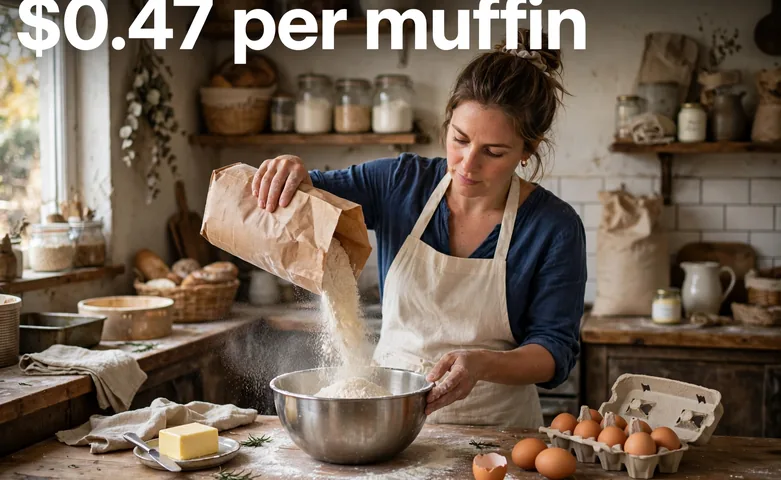
A photo of a baker pouring flour from a paper bag into a metal mixing bowl on a wooden counter in a small home bakery
A batch of 12 muffins costs $0.47 per muffin in ingredients and packaging.

The Bakery Ingredient Cost Formula

Every ingredient is priced the same way. Divide the pack price by the pack size to get the cost of one unit, then multiply by the amount the recipe uses. A $9.00 bag with 5,000 g of flour costs $0.0018 per gram, so 300 g in the recipe costs $0.54. Counted ingredients work the same way. A $3.60 dozen of eggs costs $0.30 each, so 4 eggs cost $1.20.

Cost of one ingredient = pack price / pack size x amount used. Total ingredient cost = the sum of all ingredient costs. Total batch cost = total ingredient cost + packaging cost per batch. Cost per item = total batch cost / sellable yield. Food cost % = cost per item / selling price per item x 100, and profit per item = selling price - cost per item. Our AI recipe cost calculator prices a home-baked recipe the same way with packaging, labor and overhead, and our unit price calculator compares two pack sizes before you buy.
Worked Example: 12 Muffins

A small bakery makes 12 muffins. The batch uses 300 g flour from a $9.00 bag of 5,000 g, 200 g butter from an $8.00 pack of 1,000 g, 200 g sugar from a $2.00 pack of 1,000 g, 4 eggs from a $3.60 dozen, and 150 g milk from a $4.40 pack of 1,000 g. Packaging costs $1.20 a batch, and each muffin sells for $1.50.

  1. Flour: $9.00 / 5,000 g x 300 g = $0.54.
  2. Butter: $8.00 / 1,000 g x 200 g = $1.60.
  3. Sugar: $2.00 / 1,000 g x 200 g = $0.40.
  4. Eggs: $3.60 / 12 x 4 = $1.20.
  5. Milk: $4.40 / 1,000 g x 150 g = $0.66.
  6. Total ingredient cost: $0.54 + $1.60 + $0.40 + $1.20 + $0.66 = $4.40.
  7. Total batch cost: $4.40 + $1.20 packaging = $5.60.
  8. Cost per muffin: $5.60 / 12 = $0.47. Ingredients only are $0.37 each.
  9. Food cost: $0.47 / $1.50 x 100 = 31.33%. Profit per muffin: $1.50 - $0.47 = $1.03.

As a second check, take a batch of 24 cookies with $5.78 of ingredients, $2.00 packaging and a $2.00 selling price. The batch costs $7.78, the cost per cookie is $0.32, the food cost is 16.00%, and the profit per cookie is $1.68. The same steps work for any recipe, so try your own numbers in the tool above.

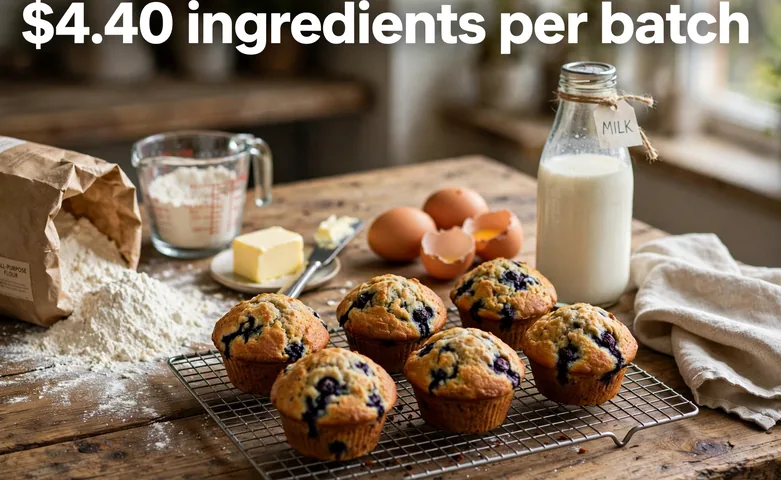
A photo of freshly baked muffins cooling on a wire rack with flour, butter, eggs and milk arranged on a wooden counter
The worked example batch uses $4.40 of ingredients for 12 muffins.

Sellable Yield, Not Hoped-For Yield

The most common mistake in recipe costing is dividing by the number the recipe promises instead of the number you can sell. If you bake 12 muffins but two are too small or damaged, divide by 10, not 12. At $5.60 a batch, 12 sellable muffins cost $0.47 each, but 10 sellable muffins cost $0.56 each, and the food cost at a $1.50 selling price rises from 31.33% to 37.33%. Two broken muffins are worth 9 cents each on every muffin you sell.

Weigh your ingredients instead of scooping them, because a cup of flour can vary by 20% or more. Small errors add up across a batch, and they hide in the ingredients you forget, such as cinnamon, vanilla, oil, filling and toppings. List every ingredient, even the ones that cost a few cents, because a batch with 14 ingredients is impossible to price in your head. Use your own receipts for pack prices, not prices from a website, because your supplier and your pack size decide the real cost.

The 25 to 35% Food Cost Rule

Most food businesses target a food cost between 25% and 35% of the selling price. The worked example sits at 31.33%, which is inside that range. If your food cost is above 35%, your price is too low for your ingredient costs, or your yield is too low, or one ingredient is eating the margin. Butter is often the culprit in baking, because it is the dearest ingredient by weight in most recipes.

If your food cost is below 25%, you may be underpricing your work rather than overcharging for ingredients. The food cost percent only counts ingredients and packaging. It does not pay for your time, your rent, your oven, or your selling fees. A muffin that costs $0.47 in ingredients still needs labor and overhead on top. Our profit margin calculator shows what is left after all costs, our markup calculator sets a selling price from cost and markup, and our break-even calculator shows how many items you must sell to cover your fixed costs.

What the Ingredient Cost Leaves Out

The ingredient cost is not the selling price. The $0.47 muffin figure pays for ingredients and packaging only. It has not paid for your time, your rent, your electricity and gas, your market stall fee, or the platform fee on an online sale. Home bakers often charge $15 to $30 an hour for their labor, and packaging, electricity and gas typically add $1 to $5 per batch or 10% to 15% of the ingredient cost.

To set a price, add labor and overhead to the ingredient cost, then check the food cost percent and the profit per item. If the numbers do not work, change the recipe, buy a bigger pack, raise the price, or accept a smaller margin on a product that brings customers in for something else. Re-cost a recipe whenever a supplier price changes, because a 50 cent rise in butter changes every batch you bake.

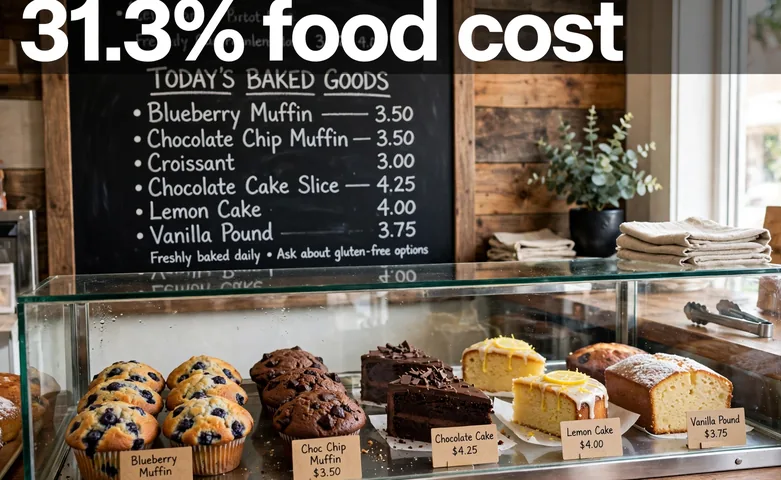
A photo of a small bakery counter display with muffins and cakes in a glass case and small price tags, a chalkboard menu behind
The worked example food cost is 31.33% at a $1.50 selling price, inside the 25 to 35% target range.

Frequently asked questions

How do I calculate the ingredient cost for a bakery recipe?

Use the formula cost of one ingredient = pack price / pack size x amount used, add up all the ingredients, add packaging, then divide by the number of items you can sell. In the worked example, 12 muffins use $4.40 of ingredients and $1.20 of packaging, so the batch costs $5.60 and each muffin costs $0.47.

How many items should I divide the batch cost by?

Divide by the number you can actually sell, not the number the recipe promises. If you bake 12 muffins but two are damaged, divide by 10. At $5.60 a batch, 12 sellable muffins cost $0.47 each, but 10 sellable muffins cost $0.56 each.

What is food cost percentage and what should it be?

Food cost percent is the cost per item divided by the selling price, times 100. In the worked example the cost per muffin is $0.47 and the selling price is $1.50, so the food cost is 31.33%. Most food businesses target 25% to 35%.

Is the ingredient cost the same as my selling price?

No. The ingredient cost covers ingredients and packaging only. It does not pay for your time, rent, electricity, market fees or selling fees. Add labor and overhead to the ingredient cost before you set a price, and check the profit per item the calculator shows.

What mistakes do bakers make when costing a recipe?

List every ingredient, even the ones that cost a few cents, such as cinnamon, vanilla, oil, filling and toppings. Weigh your ingredients instead of scooping them, because a cup of flour can vary by 20% or more. Use your own receipts for pack prices, because your supplier and pack size decide the real cost.

Can I cost a recipe with several ingredients at once?

Yes. Enter each ingredient with its own pack price, pack size and amount used, up to five ingredients. The calculator prices each line separately and adds them up. For a recipe with more than five ingredients, combine the smallest ones into one row, such as spices, or run the biggest five first and add the rest by hand.

This is an estimate for planning. Actual ingredient costs vary by supplier, pack size and season, so use your own receipts for the prices you pay.

Start Calculating Now!

Discover the power of smart tools at KitQuarter.

Explore All Tools