AI Recipe Cost Calculator for Home Bakers
Find what a recipe really costs to bake at home. Enter the ingredient cost for the batch, the packaging, your time and your overhead to get the cost per item and a selling price that covers them all. Free, no sign-up, everything runs in your browser.
Formula: labor cost = minutes / 60 x hourly rate. Total batch cost = ingredients + packaging + labor, plus overhead. Cost per item = total batch cost / items. Selling price = cost per item / (1 - margin).

Formulas verified against standard references. Calculator logic tested with verified worked examples. Published: November 10, 2026 | Last updated: November 10, 2026. Fact-checked: November 10, 2026. Our methodology
How to Use the AI Recipe Cost Calculator for Home Bakers
Getting a recipe cost takes seven quick entries. The tool adds up the batch cost first, then divides it by the items and prices it at your margin.
- Enter the total ingredient cost for one batch, added up from your receipts. If you know each ingredient separately, add the lines together first.
- Enter how many items the batch makes, and the packaging cost for one item, such as a bag or a box.
- Enter the minutes of hands-on time the batch takes and the hourly rate you pay yourself.
- Enter your overhead as a percent, for the oven, power and card fees, and your profit margin as a percent. Press Calculate, or press Enter. The cost per item appears first and large, with the batch total, the selling price and the price per dozen below. Press Reset to clear the form and start over.
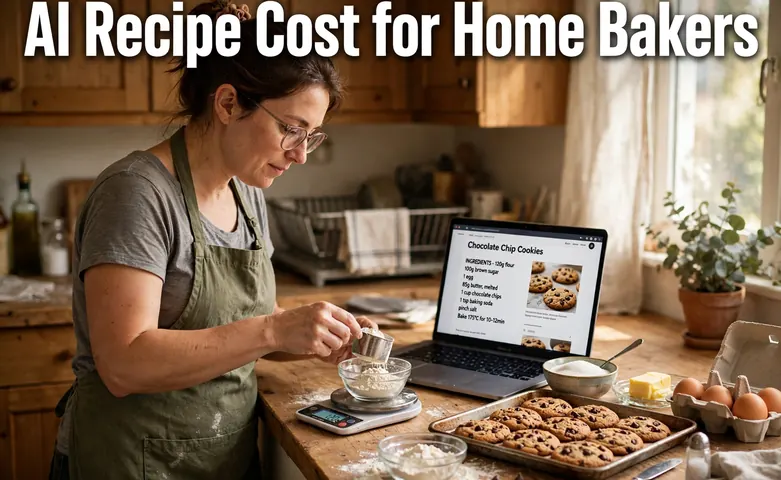
The AI Recipe Cost Formula
The formula has four short steps. First, work out your labor cost. Labor cost = minutes / 60 x hourly rate. 45 minutes at $15 an hour is 0.75 x $15 = $11.25. Second, add up the batch. Subtotal = ingredient cost + packaging per item x items + labor cost. Third, add overhead. Total batch cost = subtotal x (1 + overhead / 100). Fourth, divide and price. Cost per item = total batch cost / items. Selling price = cost per item / (1 - margin / 100). A 40 percent margin means you keep 40 cents of every dollar of price, so the price is the cost divided by 0.60.
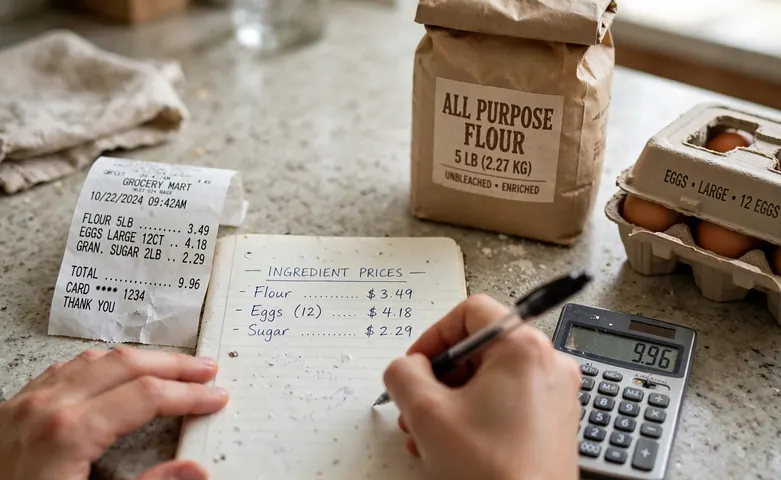
To work out the ingredient cost itself, divide each package price by the package size to get the cost per unit, multiply by the amount the recipe uses, and add up every ingredient. Our unit price calculator does that division for you when you buy in bulk.
Worked Example: A Batch of 36 Chocolate Chip Cookies
A batch of 36 chocolate chip cookies uses $7.12 of ingredients. Packaging costs $0.15 per cookie, the batch takes 45 minutes of hands-on time at $15 an hour, overhead is 10 percent and the profit margin is 40 percent. Here is exactly what the calculator does.
- Labor cost: 45 / 60 x $15 = $11.25.
- Packaging: $0.15 x 36 = $5.40. Subtotal: $7.12 + $5.40 + $11.25 = $23.77.
- Overhead: $23.77 x 10% = $2.38. Total batch cost: $23.77 + $2.38 = $26.15.
- Cost per item: $26.15 / 36 = $0.73. Selling price: $0.73 / (1 - 0.40) = $1.21 per cookie, or $14.53 per dozen.
As a second check, a 9 inch pie for 8 servings with $10 of ingredients, $0.35 of packaging per serving, 2 hours of labor at $22 an hour and 10 percent overhead costs $62.48 a batch, or $7.81 per serving, and sells for $13.02 at a 40 percent margin.
Labor Is Usually the Biggest Cost
New bakers look at the ingredients and miss the labor, but the labor is often the biggest line in the batch. In the worked example, labor is $11.25 while the ingredients are only $7.12. A decorated cake is more extreme still, because the decorating hours can cost more than every ingredient combined.
Count only hands-on time. Mixing, loading and unloading the oven, decorating, packing and washing up all count. The hour the cake sits in the oven on its own does not. Most home bakers charge $15 to $30 an hour for that time, and the right rate is the one you would pay someone else to do the same work. If you value your time at $0, the price looks low, but you are paying yourself nothing for the work.
When you sell at a market or to a cafe, the same math applies at a bigger scale. Our food truck menu pricing calculator prices menu items from the same cost parts when the batches get larger.
Margin, Markup and the Price That Pays You
Margin and markup sound alike but they are not the same, and mixing them up is the fastest way to underprice. Margin is a share of the selling price. Markup is a share of the cost. A 40 percent margin on a $0.73 cookie gives a price of $1.21, because $0.73 divided by 0.60 is $1.21. A 40 percent markup on the same cookie gives only $1.02, because $0.73 times 1.40 is $1.02.
| Profit margin | Selling price | You keep per cookie |
|---|---|---|
| 20% | $0.91 | $0.18 |
| 30% | $1.04 | $0.31 |
| 40% | $1.21 | $0.48 |
| 50% | $1.45 | $0.73 |
Many home bakers start at a 30 to 40 percent margin and adjust for the work involved. A plain loaf can sit at the low end, while a decorated cake earns the high end.
Common Pricing Mistakes
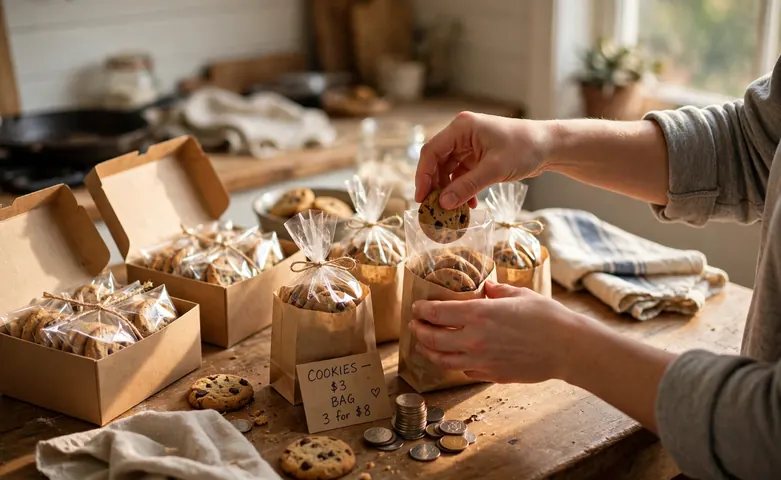
Forgetting labor is the first mistake, and forgetting packaging is the second. Boxes, bags, liners and labels are real costs, and at $0.15 a cookie they add $5.40 to a batch of 36. Pricing from sale prices is the third mistake, because the next batch costs the regular price. Price from what the ingredients usually cost, not from one good week.
Pricing by what friends charge is the fourth mistake. Their ingredient prices, their time and their overhead are not yours, so their price tells you nothing about your cost. Work out your own cost per item first, then check the market. When ingredient prices rise, run the calculator again with the new numbers, so the price moves before the margin disappears. For a big one-off order, our wedding cake cost calculator applies the same steps to a cake that serves a crowd.
Frequently asked questions
How do I calculate the cost of a recipe?
Add the ingredient cost, the packaging and your labor, then add overhead as a percent and divide by the number of items. A batch of 36 cookies at $26.15 costs $0.73 per cookie.
What should I charge per hour for my baking time?
Most home bakers charge $15 to $30 an hour for hands-on time. Count only the time you are actively working, not the time the cake sits in the oven.
What is a good profit margin for home baking?
Many home bakers use a 30 to 40 percent margin on the selling price. At 40 percent, a cookie that costs $0.73 sells for $1.21.
Should packaging count in the recipe cost?
Yes. Boxes, bags, liners and labels are real costs. At $0.15 a cookie, packaging adds $5.40 to a batch of 36.
How do I work out the ingredient cost for a batch?
Divide each package price by the package size to get the cost per unit, multiply by the amount the recipe uses, and add up every ingredient.
Do I need a license to sell home baked goods?
Rules depend on your state and county, so check your local cottage food rules before you sell. This calculator covers cost math only.
This is an estimate for planning. Actual ingredient and packaging prices come from your supplier. See our disclaimer.
Related calculators
Wedding Cake Cost Calculator
Price a wedding cake from ingredients and labor.
Use calculatorFood Truck Menu Pricing Calculator
Price food truck menu items from real costs.
Use calculatorCoffee Shop Menu Pricing Calculator
Price coffee shop menu items from real costs.
Use calculatorUnit Price Calculator
Compare unit prices to find the better buy.
Use calculatorMarkup Calculator
Work out markup and margin on any product.
Use calculatorBudget Calculator
Build a monthly budget and see where money goes.
Use calculator