Food Truck Menu Pricing Calculator
Price one food truck menu item so it covers its cost and leaves a profit. Enter what one serving costs you, add the overhead for that serving, pick the food cost percentage you want to hit, and the calculator shows the menu price, the profit on each item and the monthly profit. Free, no sign-up, everything runs in your browser.
Formula: Menu price = (Food cost per serving + Overhead per serving) / Target food cost percentage as a decimal. Profit per item = Menu price - Food cost - Overhead. Monthly profit = Profit per item x Items sold per month.

Formulas verified against standard references. Calculator logic tested with verified worked examples. Published: November 7, 2026 | Last updated: November 7, 2026. Fact-checked: November 7, 2026. Our methodology
How to Use the Food Truck Menu Pricing Calculator
Getting a price takes four quick steps. Enter the cost of one serving, pick the food cost percentage you want to hit, add the overhead for that serving, and tell the calculator how many you expect to sell in a month.
- Type the food cost per serving. This is the ingredients and packaging for one item, before overhead.
- Type the overhead per serving. This is the share of fuel, commissary rent, event fees and other running costs that one serving must carry. Enter 0 if you already include it in the food cost.
- Type your target food cost percentage. The calculator starts at 30%, which is the usual target for a food truck main dish.
- Type how many of this item you expect to sell each month. This number is used only for the monthly profit.
- Press Calculate, or press Enter. The menu price appears first and large, with the total cost per serving, the profit per item, the monthly profit and the step-by-step math below. Press Reset to clear the form and start over.
The Food Truck Menu Pricing Formula
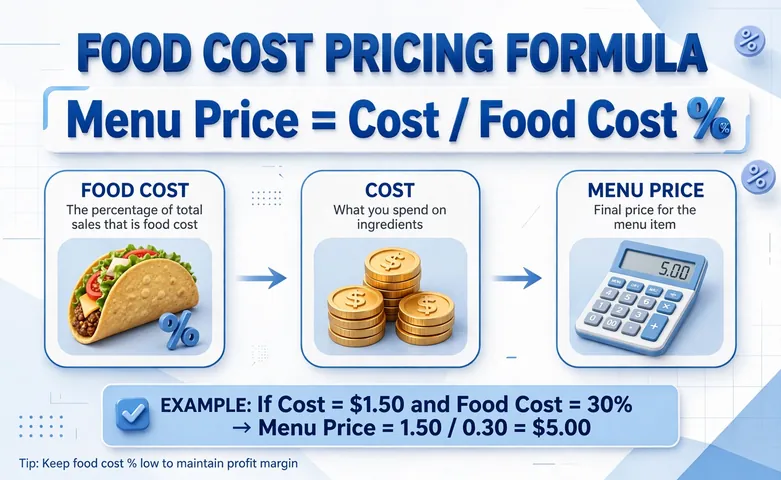
One formula sets the price. It starts with the full cost of a serving and divides it by the target food cost percentage, so the price leaves room for everything else the truck must pay for.
Menu price = (Food cost per serving + Overhead per serving) / Target food cost percentage as a decimal. Food cost per serving is what the ingredients and packaging for one item cost you. Overhead per serving is the share of fuel, commissary rent, fees and other running costs that one item must carry. The target food cost percentage is the share of the menu price you want food and overhead to take, written as a decimal, so 30% becomes 0.30.
Profit per item is the menu price minus the food cost and the overhead. Monthly profit is the profit per item times the number of items you expect to sell. The formula comes from the food cost percentage method used across the restaurant trade, where food cost percentage equals cost divided by menu price times 100.
Worked Example: A Taco Priced at 30% Food Cost
You sell a taco. The ingredients and packaging cost $3.50 per taco and the overhead is $1.50 per taco. You want a 30% food cost percentage and you expect to sell 1,000 tacos in a month. Here is exactly what the calculator does.
- Total cost per serving = $3.50 + $1.50 = $5.00.
- Turn 30% into a decimal: 30 / 100 = 0.30.
- Menu price = $5.00 / 0.30 = $16.67.
- Profit per item = $16.67 - $5.00 = $11.67.
- Monthly profit = $11.67 x 1,000 = $11,670.00.
As a check, the same method prices the chicken taco in the Mobile Food Math guide. Its total cost is $5.18 per serving, so at 30% the price is $5.18 / 0.30 = $17.27, which matches the guide exactly.
What Food Cost Percentage Should You Target
There is no single right percentage. Drinks and desserts run low, mains run in the middle, and meat-heavy dishes run high. The table below shows the usual targets from the Mobile Food Math guide, so you can see where your item lands.
| Item type | Target food cost | Gross profit margin |
|---|---|---|
| Coffee and beverages | 15% to 20% | 80% to 85% |
| Tacos and Mexican | 25% to 30% | 70% to 75% |
| General food truck | 28% to 33% | 67% to 72% |
| BBQ and meat heavy | 35% to 40% | 60% to 65% |
Aim for a blended 28% to 33% across the whole menu, not the same number on every item. Drinks and sides at 15% to 22% are your high-margin items, while a protein-heavy main at 32% to 38% can still be right if it brings customers in. If you force every item to exactly 30%, your signature dish ends up overpriced and your drinks end up underpriced. Before you lock a target, check it against your costs with our break-even calculator so the price covers your fixed costs too.
How the Target Changes the Price and the Profit
A lower target means a higher price, because you divide by a smaller number. The table below uses the worked example cost of $5.00 per serving, so you can see how much each target moves the price and the profit.
| Target food cost | Menu price | Profit per item |
|---|---|---|
| 25% | $20.00 | $15.00 |
| 30% | $16.67 | $11.67 |
| 35% | $14.29 | $9.29 |
| 40% | $12.50 | $7.50 |
Moving from 30% to 25% adds $3.33 to the price and $3.33 to the profit on every item, but only if customers still buy at $20.00. If you prefer to think in markup instead of food cost percentage, use our markup calculator to see the same price from the other side.
Common Food Truck Pricing Mistakes
Leaving out packaging is the most common mistake. Every sale leaves in a container, and clamshells, cups, napkins and bags typically run $0.30 to $0.80 per order. At 50 orders a day that is $15 to $50 a day, so always include packaging in the food cost per serving.
Portion drift is next. If staff overfill a plate by 10%, the food cost rises by about 10% and the price you set no longer hits your target. Standardize portions with scoops and pre-portioned proteins, and weigh a few plates during service to check.
Finally, set the price once and never review it is a slow way to lose money. Ingredient costs move constantly, so recompute the formula whenever a key ingredient moves by more than 10%, and review prices at least every quarter. Small regular rises of $0.50 or $1.00 are easier for customers to accept than one large jump, and keeping the price inside your wider plan helps too, so check the monthly profit with our budget calculator before you print a new menu.
Disclaimer
This calculator gives an estimate for planning and is for informational purposes only, not financial advice. Actual food truck prices depend on your supplier costs, your overhead, your location and what customers in your area will pay. See our disclaimer.

Sources
- Mobile Food Math: Food Truck Menu Pricing. Menu price equals total cost per serving divided by target food cost percentage, with a $5.18 taco priced at $17.27 at 30% and target ranges by item type.
- Retail Toolkit: Recipe and Product Cost Calculator. Selling price equals cost per portion divided by target food cost percentage, with a $2.50 cost priced at $8.33 at 30%.
- Restaurant Margin: Food Cost Formula for Restaurants. Menu price equals ingredient cost divided by target food cost percentage, with a $7.20 dish priced at $25.71 at 28%.
Frequently asked questions
What is a good food cost percentage for a food truck?
Most food trucks aim for a blended 28% to 33% across the whole menu. Coffee and drinks can run 15% to 20%, while BBQ and meat-heavy dishes run 35% to 40%.
How do you calculate a menu price from food cost?
Divide the total cost per serving by your target food cost percentage as a decimal. With a $5.00 total cost and a 30% target, the price is $5.00 divided by 0.30, which is $16.67.
What counts as food cost per serving?
Everything in one serving, which is the ingredients, the packaging and any condiments or garnish. Packaging alone typically runs $0.30 to $0.80 per order, so leaving it out understates the real cost.
Why do you divide by the target percentage instead of adding a markup?
Dividing grosses the cost up so that food and overhead take exactly the target share of the price. If you want food to be 30% of the menu price, the other 70% has to cover labor, overhead, fuel, fees and profit.
How many items do I need to sell to make a profit?
It depends on the profit per item. At $11.67 of profit per taco, selling 1,000 tacos in a month gives $11,670.00 of monthly profit before fixed costs. Enter your own expected sales to see your number.
How often should I reprice my menu?
Review prices at least every quarter, and recompute the formula whenever a key ingredient moves by more than 10%. Prefer small rises of $0.50 or $1.00 over one large jump.
Related calculators

Markup Calculator
Work out a selling price from cost and markup instead of food cost percentage.
Use calculatorUnit Price Calculator
Work out the cost of one portion before you price it.
Use calculatorBreak-Even Calculator
Check how many items you must sell to cover your fixed costs.
Use calculatorBudget Calculator
Fit the monthly profit from your menu into your wider budget.
Use calculator