Coffee Shop Menu Pricing Calculator
Price every drink and dish on your coffee shop menu from its real ingredient cost. Enter what one serving costs you and the food cost percent you want to hit, and the calculator shows the menu price, the profit per item and the gross margin. Free, no sign-up, everything runs in your browser.
Formulas: Menu price = Ingredient cost / Target food cost %. Profit = Menu price - Ingredient cost. Gross margin = Profit / Menu price × 100.

Formulas verified against standard references. Calculator logic tested with verified worked examples. Published: November 8, 2026 | Last updated: November 8, 2026. Fact-checked: November 8, 2026. Our methodology
How to Use the Coffee Shop Menu Pricing Calculator
Pricing one item takes two numbers and about a minute. The tool divides your ingredient cost by your target food cost percent to find the price that hits it.
- Type the ingredient cost for one serving. Include everything that leaves the counter with it, which is coffee, milk, syrup, cup, lid and sleeve.
- Type your target food cost as a percent. Beverages usually target 15 to 25%, and food items usually target 28 to 35%.
- Optional: type your current menu price to see its real food cost percent and compare it with your target.
- Press Calculate, or press Enter. The suggested price appears first and large, with the profit per item, the gross margin and the step-by-step math below. Press Reset to clear the form and start over.
The Menu Pricing Formula
One division sets the price. The food cost percent is the share of the selling price that goes to ingredients, so the price is the cost divided by that share written as a decimal.
Menu price: Menu price = Ingredient cost / Target food cost %. With a $1.43 ingredient cost and a 22% target, the price is $1.43 / 0.22 = $6.50. A lower target gives a higher price, because fewer cents of each dollar may go to ingredients.
Profit per item: Profit = Menu price - Ingredient cost. At $6.50 the profit is $6.50 - $1.43 = $5.07 per drink. That profit still has to cover labor, rent, power and everything else, so it is gross profit, not money in the bank.
Gross margin: Gross margin = Profit / Menu price × 100. At $6.50 the margin is $5.07 / $6.50 × 100 = 78%. Margin and food cost percent always add to 100%, so a 22% food cost means a 78% gross margin.
Worked Example: Pricing a Latte at $6.50
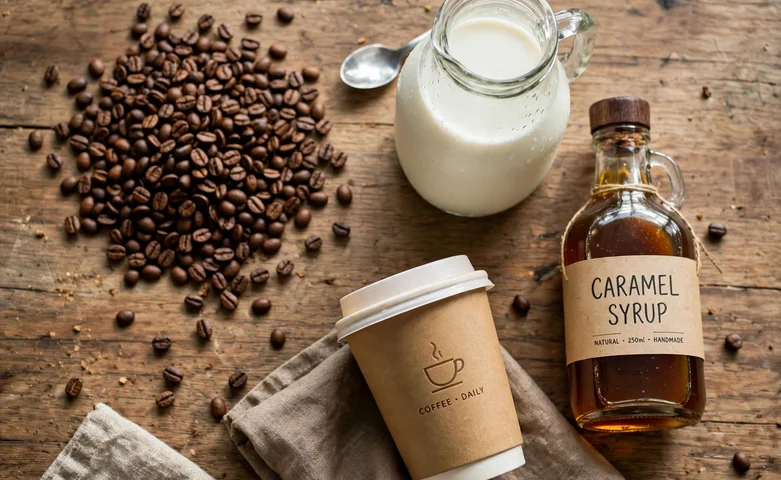
A 12-ounce latte costs $1.43 to make. The beans, milk, syrup, cup, lid and sleeve add up to $1.43, and the shop targets a 22% food cost for drinks. Here is exactly what the calculator does.
- Write the target as a decimal: 22% = 0.22.
- Divide: $1.43 / 0.22 = $6.50.
- Profit per cup = $6.50 - $1.43 = $5.07.
- Gross margin = $5.07 / $6.50 × 100 = 78%.
This matches the MenuPricer example exactly, which prices the same $1.43 drink at $6.50 with a 22% food cost and a 78% gross margin. As a second check, a $1.20 ingredient cost at the same 22% target gives $5.45, which MenuPricer rounds to a $5.50 menu price.
What Food Cost Percent to Aim For
Drinks and food need different targets, because drinks use far fewer ingredients per dollar of price. The table below shows the typical ranges MenuPricer publishes for 2026.
| Item | Ingredient cost | Typical price | Food cost |
|---|---|---|---|
| Espresso | $0.35 to $0.55 | $3.00 to $4.50 | 10 to 15% |
| Latte, 12 oz | $1.20 to $1.60 | $5.00 to $7.00 | 18 to 25% |
| Cold brew, 12 oz | $0.90 to $1.20 | $4.50 to $6.50 | 16 to 22% |
| Pastry or sandwich | $1.50 to $4.00 | $4.00 to $14.00 | 28 to 40% |
Blended food cost across a whole coffee shop usually lands at 25 to 30%. If your drinks sit at 22% but your food sits at 38%, the blended number still works, because drinks carry the margin. Keep the beverage cost under 25% and the overall menu under 32% to stay healthy.
Round Prices and Check the Market
The formula gives a price to the cent, but menus show round prices. Round up, never down, because rounding down raises your food cost percent. A $5.45 result becomes $5.50, and a $6.50 result stays $6.50. MenuPricer and Momoscreen both round up for the same reason.
Then check the rounded price against what customers near you pay. Toast measured a $5.46 average latte in the United States in early 2024, so a $6.50 latte is at the higher end and needs quality or location to justify it. A price the formula loves and customers refuse is not a good price.
Also remember that the formula prices ingredients only. Labor, rent, power, card fees and waste all come out of the 78% margin, and the average cafe keeps only about 5 to 7% as net profit. Use our markup calculator to compare markup and margin on the same item, and our food truck menu pricing calculator if you price a mobile menu too.
Common Menu Pricing Mistakes
The most common mistake is leaving the cup out of the cost. A cup, lid, sleeve and stirrer can add 20 to 30 cents, which is a fifth of a latte ingredient cost. Price the whole serving as the customer receives it, not just the coffee inside it.
The second mistake is copying a competitor price without knowing your own cost. Their beans, milk contract and rent differ from yours, so their price may lose money at your cost. Run your own numbers first, then check the market.
The third mistake is never repricing. Bean prices move every year, and the ICO green coffee indicator averaged 262 US cents a pound in September 2026. Re-cost your top five drinks every quarter and adjust the menu when the ingredient cost moves more than a few cents.
Disclaimer
This calculator gives an estimate for planning and is for informational purposes only, not financial advice. Actual profit depends on your ingredient prices, labor, rent and sales volume. See our disclaimer.
Frequently asked questions
What is a good food cost percentage for a coffee shop?
Coffee drinks usually target 15 to 25%, with espresso at the low end and milk-heavy drinks at the high end. Food items usually target 28 to 35%. Blended food cost across the whole shop usually lands at 25 to 30%.
How do I price a latte?
Add up the ingredient cost for one serving, including the cup and lid, then divide by your target food cost as a decimal. A $1.43 latte at a 22% target costs $1.43 / 0.22 = $6.50. Round the result up to a clean menu price.
What is the difference between food cost and gross margin?
Food cost is the ingredient cost as a share of the price, and gross margin is the profit as a share of the price. They always add to 100%. A 22% food cost means a 78% gross margin on the same drink.
Should I include the cup and lid in the ingredient cost?
Yes. The cup, lid, sleeve, stirrer and napkin are part of what the customer takes away, and they can add 20 to 30 cents per drink. Leaving them out makes the price too low and the real food cost percent higher than you think.
How often should I reprice my coffee shop menu?
Re-cost your top five drinks every quarter, and reprice when an ingredient moves more than a few cents. Bean prices change through the year, so a menu priced once and left alone slowly loses margin.
Related calculators
Food Truck Menu Pricing Calculator
Price a mobile menu from ingredient cost the same way.
Use calculatorMarkup Calculator
Compare markup on cost with margin on price.
Use calculatorUnit Price Calculator
Compare ingredient prices per unit before you buy.
Use calculatorSales Tax Calculator
Work out the tax on a menu total.
Use calculatorDiscount Calculator
Price a happy-hour or loyalty discount without losing margin.
Use calculatorBreak Even Calculator
Find how many cups a day cover your fixed costs.
Use calculator