Salary to Hourly Calculator
Convert your annual salary into an equivalent hourly wage. Enter your salary, your hours per week and the weeks you work each year, and get your hourly rate plus daily, weekly and monthly pay, with every step of the math shown. For the reverse trip, the hourly to salary calculator turns an hourly wage back into a yearly figure.

Formulas verified against standard references. Calculator logic tested with verified worked examples. Published: November 3, 2026 | Last updated: November 3, 2026. Fact-checked: November 3, 2026. Our methodology
What the Salary to Hourly Calculator Shows
A salary on an offer letter is hard to judge on its own. This salary to hourly calculator turns it into the number you can compare with everything else: your hourly wage. Type your annual salary, the hours you work each week and the weeks you work each year, and it returns your hourly rate with daily, weekly and monthly pay beside it.
The math divides your salary by the hours you actually work in a year, so part-time and overtime schedules give honest answers too. All figures are gross pay before tax. The hourly to salary calculator runs the same conversion in the opposite direction when you start from an hourly wage.

The Salary to Hourly Formula
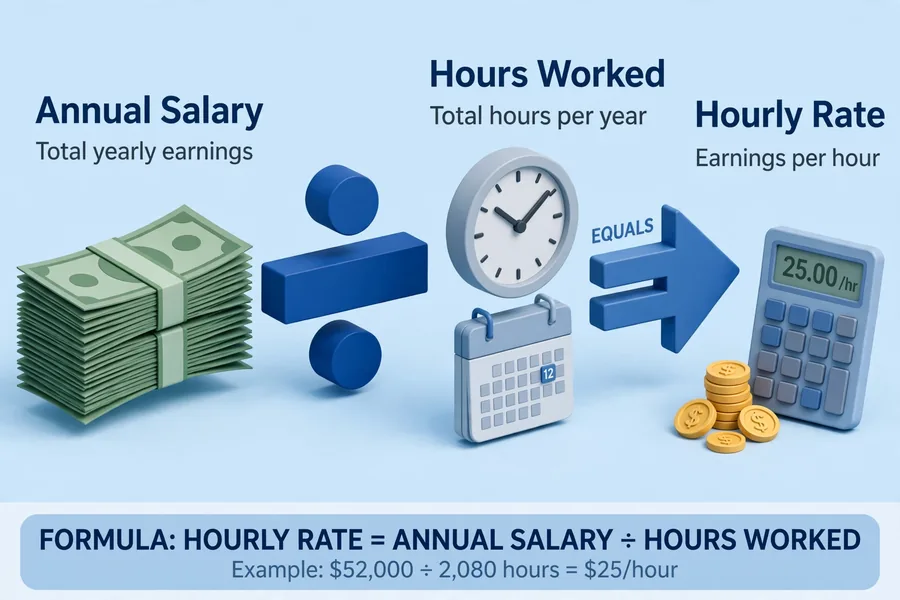
Hourly rate = Annual salary ÷ (Hours worked per week × Weeks worked per year). Annual salary is your gross yearly pay before tax. Hours worked per week is your actual weekly schedule, not the company standard. Weeks worked per year is the number of paid weeks, so enter a smaller number if you take unpaid leave.
The weekly, monthly and daily figures follow from the same three inputs. Weekly pay = Annual salary ÷ Weeks worked per year. Monthly pay = Annual salary ÷ 12. Daily pay = Weekly pay ÷ 5. For the standard full-time year of 40 hours times 52 weeks, the total is 2,080 hours, which is the shortcut most employers and recruiters use.
Worked Example: $60,000 at 40 Hours a Week
Take an annual salary of $60,000 with a 40-hour week and 52 working weeks.
First, hours worked per year: 40 × 52 = 2,080. Then the hourly rate: $60,000 ÷ 2,080 = $28.85 an hour. The supporting figures are weekly pay of $60,000 ÷ 52 = $1,153.85, monthly pay of $60,000 ÷ 12 = $5,000.00 and daily pay of $1,153.85 ÷ 5 = $230.77.
Try it above with salary 60000, hours 40 and weeks 52, and you will see the same four numbers with every step shown.
How to Use the Calculator
- Type your annual salary in dollars, for example 60000.
- Check the hours worked per week. It starts at 40, so change it to your real schedule, for example 37.5 or 50.
- Check the weeks worked per year. It starts at 52, so lower it if you take unpaid time off.
- Press Calculate. The hourly rate appears first and large, then your daily, weekly and monthly pay, followed by the step-by-step math.
Why Weeks Per Year Changes Your Rate
The weeks field sets how many weeks the salary is spread across. Take a $78,000 salary at 40 hours a week. Spread over the full 52 weeks the hourly rate is $78,000 ÷ 2,080 = $37.50. But if you actually work 50 weeks, enter 50 instead. The same salary then works out to $78,000 ÷ 2,000 = $39.00 an hour.
The difference is real. Each hour you actually work earns $1.50 more in the 50-week case, because your salary covers fewer hours. This is why the weeks field matters most for teachers, seasonal workers and anyone with unpaid leave, and why a freelancer matching a salary needs the effective rate, not the 2,080 shortcut.
Compare a Salary Offer With an Hourly Offer
Comparing a salary to an hourly wage is where this calculator earns its keep. A $65,000 salary at 40 hours a week is $31.25 an hour. That looks better than a $30-an-hour offer until you adjust for reality. Many salaried roles quietly expect 45 hours a week. At 45 hours the same $65,000 salary pays $65,000 ÷ 2,340 = $27.78 an hour.
Now run the hourly offer the other way. $30 an hour times 2,080 hours is $62,400 a year, which beats the overworked salary's effective $27.78 rate. Type the offered salary with the hours you will really work, and the honest comparison appears. An overtime pay calculator prices extra hours when a role pays for them separately.
Common Mistakes When Converting Salary to Hourly
The biggest mistake is using the 2,080 shortcut for every schedule. It is only right for 40 hours and 52 weeks. A $50,000 salary at 25 hours a week is $50,000 ÷ 1,300 = $38.46 an hour, not $24.04. Always type your own hours.
The second mistake is fixing the daily rate at 8 hours. Some calculators multiply the hourly rate by 8 no matter the schedule, which misleads part-time workers. This calculator divides your weekly pay by 5 instead, so the daily figure follows your real hours.
The third mistake is treating the result as take-home pay. Every figure here is gross, before income tax, Social Security, Medicare and benefits deductions. Your paycheck will be lower. A paycheck calculator estimates what actually lands in your account after those deductions.

Disclaimer
This calculator gives an estimate for planning. Your actual take-home pay depends on taxes, benefits and deductions from your employer.
Frequently asked questions
How do I convert my salary to an hourly rate?
Divide your annual salary by the total hours you work in a year, which is hours per week times weeks per year. For a standard 40-hour week that is salary divided by 2,080. A $60,000 salary works out to $28.85 an hour.
Is the hourly rate before or after tax?
Before tax. Every figure is gross pay, and your take-home pay will be lower after income tax, Social Security, Medicare and benefits deductions. Use a paycheck calculator to estimate what actually lands in your account.
What is my hourly rate if I work 37.5 hours a week?
Divide your salary by 1,950 hours (37.5 times 52). A $45,000 salary at 37.5 hours a week is $23.08 an hour. Enter your exact schedule above for the precise figure.
Does the salary to hourly calculator include overtime?
No. It converts regular scheduled hours only, and salaried roles often do not earn overtime for extra hours. If your role pays for hours beyond the regular week, price them separately with an overtime pay calculator.
How do I compare a salary offer with an hourly offer?
Convert the salary with the hours you will really work, not just 40. A $65,000 salary at 45 hours a week is $27.78 an hour, which is less than a $30-an-hour offer worth $62,400 a year. The effective hourly rate gives the honest comparison.
How is the daily pay calculated?
Daily pay is your weekly pay divided by 5, so it matches any weekly schedule. A fixed 8-hour day would mislead part-time workers, which is why this calculator uses the weekly figure instead.
Related calculators

Hourly to Salary Calculator
Convert an hourly wage to yearly pay.
Use calculatorPaycheck Calculator
Estimate your take-home pay after tax.
Use calculatorOvertime Pay Calculator
Pay for hours beyond the regular week.
Use calculatorPay Raise Calculator
See what a raise is worth per hour.
Use calculatorIncome Tax Calculator
Estimate federal and state income tax.
Use calculatorBudget Calculator
Plan monthly spending around your pay.
Use calculator401k Calculator
Project retirement savings growth.
Use calculatorBill Splitter
Split shared bills fairly.
Use calculatorEmergency Fund Calculator
How much savings to keep handy.
Use calculatorDebt-to-Income Ratio Calculator
Check how lenders size you up.
Use calculator